When life gets messy, don’t blame the monsters. You built the nest, they just moved in. Clean it up—because nobody’s coming to save you.
Let’s Not Sugarcoat It: You’ve Got Rats
Rats. Literal ones, sure. But also the rats in your life: bad habits, toxic people, that one drawer you keep stuffing bills and ignoring. And here’s the plot twist – where there are rats, there will be snakes.
That’s right. You’re not just avoiding problems. You’re inviting danger in for dinner.
Snakes Don’t Knock – They Slither In
Think of snakes as the crap storms you never see coming:
• Your toxic boss flipping out.
• A surprise bill that kills your bank account.
• Your back going out from years of “I’ll stretch tomorrow.”
Snakes love silence. They move in the shadows. They show up when you pretend nothing’s wrong.
The Rats? Oh, You Fed Them
Rats don’t just show up either. You invited them.
• Didn’t pay that bill? Rat.
• Still ghosting that awkward convo? Rat.
• Left your yard looking like a jungle? Rat buffet.
And guess what follows rats? Snakes. Because one thing leads to another. Always has. Always will.
Your Life Is Not a National Geographic Episode
But if it was, here’s how the narration would go:
“Here we see a human, blissfully ignoring every red flag in their surroundings. The rats run free. The snakes circle. And the human, oblivious, wonders why everything’s on fire.”
Seriously though – this isn’t a zoo. This is your life. You don’t need a documentary. You need a broom and a wake-up call.
The Signs You’re In Deep (aka Rat City, Snake Central)
Step 1: Stop Feeding the Rats
Look, if you keep tossing cheese on the floor, don’t be shocked when rodents show up.
Here’s what to do:
• Toss the junk. The physical and emotional kind.
• Fix what’s broken. You know exactly what that is.
• Quit ignoring the mess. It’s not going away on its own.
Step 2: Lock Out the Damn Snakes
Once the rats are gone, make your life snake-proof.
Tips for that? Oh, I’ve got some:
• Seal your doors (literally and metaphorically).
• Trim the emotional weeds.
• Put up boundaries so snakes have nowhere to hide.
Still inviting trouble? Then congratulations, you’re building a zoo.
Saw a Snake Eating a Rat? You’re Too Late
If you’re watching that drama unfold live in your living room, guess what? You’ve ignored the rats for way too long.
Don’t do this:
• Scream and chase it with a broom.
Do this:
• Back the hell up.
• Call someone who knows what they’re doing.
• Swear to never let it get this bad again.
“Only You Can Safe Yourself” – And That’s Not a Joke
Waiting for someone else to fix your crap? Cute.
Here’s the truth:
• Nobody’s coming.
• No magic snake whisperer is solving your issues.
• You’re the hero, the villain, and the janitor in this story.
So stop hoping. Start sweeping.
Some Brutally Honest FAQs
What’s this “snakes eats rats” nonsense really about?
It’s about your problems and how ignoring them makes everything worse. Rats are the issues. Snakes are the consequences. And no, it’s not a fable. It’s real life.
2. Do snakes actually sneak into homes?
Yup. Especially if you’ve rolled out the red carpet with rat poop and leftover pizza. Clean up.
3. Can I kill a snake if I see one?
In some places, that’s illegal. Plus, why would you? It’s not the snake’s fault you left the door open.
4. What do I do if one bites me?
Call 911. Then sit down and reflect on all the dumb decisions that led to this moment.
5. Is this just a metaphor or are you seriously talking about animals?
Both. Your life is a zoo and I’m here to help you shut it down.
6. How do I avoid all this?
Wake up. Clean up. And grow up.
Need Actual Help? Fine. Here.
If this sass isn’t enough and you want some real-world resources, check these out:
Final Thought: Handle Your Rats Before Life Hands You a Snake
This isn’t about wildlife documentaries. It’s not even about animals. It’s about you being the reason your life is a mess – and you being the only one who can unf*ck it.
Snakes eat rats. Clean up your rats. Stop blaming the snakes.
Your True Direction is dedicated to empowering individuals navigating life’s transitions. Through inspiring stories and actionable strategies, we aim to help you reclaim ambition, overcome challenges, and thrive in every stage of your journey.
Connect with Us
Follow us on Medium @YourTrueDirection
Your journey is yours to shape – take the next step in Your True Direction.
I’m not here to play nice, I’m here to make change. I work with veterans, teens, career shifters, and anyone who’s ever been told they’re too late, too broken, or too much. I help people rewrite their story when the world hands them a script they never asked for.
I don’t save people. I remind them how to save themselves.
That’s my legacy, and I’m just getting started.
Follow along as I speak truth, challenge systems, and help folks build a life that actually fits.
Connect with Us
Follow us on Medium @YourTrueDirection.
Your journey is yours to shape, take the next step in Your True Direction.
I’m not here to play nice, I’m here to make change. I work with veterans, teens, career shifters, and anyone who’s ever been told they’re too late, too broken, or too much. I help people rewrite their story when the world hands them a script they never asked for.
I don’t save people. I remind them how to save themselves.
That’s my legacy, and I’m just getting started.
Follow along as I speak truth, challenge systems, and help folks build a life that actually fits.
Connect with Us
Follow us on Medium @YourTrueDirection.
Your journey is yours to shape, take the next step in Your True Direction.
I’m not here to play nice, I’m here to make change. I work with veterans, teens, career shifters, and anyone who’s ever been told they’re too late, too broken, or too much. I help people rewrite their story when the world hands them a script they never asked for.
I don’t save people. I remind them how to save themselves.
That’s my legacy, and I’m just getting started.
Follow along as I speak truth, challenge systems, and help folks build a life that actually fits.
Connect with Us
Follow us on Medium @YourTrueDirection.
Your journey is yours to shape, take the next step in Your True Direction.
Someone asked me recently, “What legacy do you want to leave behind?”
Not what job I want. Not what title I’m gunning for.
But legacy – the real kind. The kind that echoes. The kind that leaves a mark.
That question didn’t feel polite. It felt like a punch to the chest. Because let’s be honest – most people are too busy surviving to even think about legacy. But I’ve been through enough, seen enough, fought enough, to know that the real work isn’t in the day-to-day grind. It’s in the lives you change while you’re grinding.
So here it is. Raw and real.
I’m not here to leave behind perfect spreadsheets or polished LinkedIn posts. I’m here to leave behind a trail of people who remember what it felt like to finally be seen. Really seen. Especially the ones who had been counted out.
I want my legacy to be the ones who stood up straighter after talking to me.
The ones who walked into that job interview after years of rejection – and nailed it.
The ones who were told they weren’t enough, weren’t experienced enough, weren’t “corporate” enough – and found out that was a damn lie.
I want to be remembered as the one who called out bullshit policies, stood firm in rooms where people whispered, and used every ounce of experience I had – military, career development, leadership, trauma – to light the way forward. Not just for me. But for everyone around me.
I want my legacy to be about impact. Not impressions.
Because I’ve walked through doors no one wanted to open for me.
I’ve been overqualified and underestimated in the same breath.
I’ve watched less-experienced people get promoted while I held the line and kept everything running.
And still, I didn’t shrink.
Because I wasn’t here to play politics.
I was here to serve. To advocate. To build something better.
Let me be clear: I didn’t build my legacy in perfect conditions. I built it while navigating burnout, chronic stress, leadership that didn’t lead, and systems that tried to silence me. I built it while dealing with trauma and training a service dog who saved my life in ways I can’t fully explain.
I built it while helping others find jobs when I was struggling to find my own sense of purpose. I coached people through their breakdowns while still managing mine in silence. I mentored with a cracked heart and a full schedule – because I knew someone else’s survival might start with my willingness to show up, just one more time.
That’s what legacy looks like.
Not glamour. Not followers. Consistency.
Showing up. Even when you’re tired. Even when no one’s clapping. Even when they’re whispering behind closed doors.
I don’t want to be remembered for being liked.
I want to be remembered for being real – for speaking up when it wasn’t convenient, for calling out injustice even when it cost me something, for pushing others to rise even when I was still crawling.
If someone says my name years from now and follows it with:
“Ryan didn’t just help me get a job. He helped me remember who the hell I was.”
Then I did what I came here to do.
That’s the legacy I’m leaving.
It’s made of grit, grace, fire, and purpose.
It’s covered in dog hair, sweat, sacrifice, and second chances.
And no matter what room I walk into – whether I’m welcomed or not – I’ll keep showing up like I belong. Because I do. And so do you.
I’m not here to play nice – I’m here to make change. I work with veterans, teens, career shifters, and anyone who’s ever been told they’re too late, too broken, or too much. I help people rewrite their story when the world hands them a script they never asked for.
I don’t save people. I remind them how to save themselves.
That’s my legacy – and I’m just getting started.
Follow along as I speak truth, challenge systems, and help folks build a life that actually fits.
Connect with Us
Follow us on Medium @YourTrueDirection.
Your journey is yours to shape – take the next step in Your True Direction.
I’m not here to play nice, I’m here to make change. I work with veterans, teens, career shifters, and anyone who’s ever been told they’re too late, too broken, or too much. I help people rewrite their story when the world hands them a script they never asked for.
I don’t save people. I remind them how to save themselves.
That’s my legacy, and I’m just getting started.
Follow along as I speak truth, challenge systems, and help folks build a life that actually fits.
Connect with Us
Follow us on Medium @YourTrueDirection.
Your journey is yours to shape, take the next step in Your True Direction.
I’m not here to play nice, I’m here to make change. I work with veterans, teens, career shifters, and anyone who’s ever been told they’re too late, too broken, or too much. I help people rewrite their story when the world hands them a script they never asked for.
I don’t save people. I remind them how to save themselves.
That’s my legacy, and I’m just getting started.
Follow along as I speak truth, challenge systems, and help folks build a life that actually fits.
Connect with Us
Follow us on Medium @YourTrueDirection.
Your journey is yours to shape, take the next step in Your True Direction.
“The boy I buried didn’t die – he waited. Behind every crack, every scar, every silence I called strength. He’s not haunting me. He’s reminding me who the hell I was before the world got loud.”
The boy I once was?
Oh, he was a goddamn legend.
He believed cereal could fix anything,
that Band-Aids healed betrayal,
and that adults actually knew what they were doing.
(Adorable, right?)
He thought love meant forever.
Thought saying sorry meant something.
Thought being “good” earned you safety.
Spoiler:
It didn’t.
It doesn’t.
He used to stare out windows and dream in color.
Now I scroll through screens and call that vision.
He built forts to keep the world out.
Now I build walls and call it “boundaries.”
He cried when people yelled.
Now I flinch when someone cares.
And somewhere between “be yourself” and “grow up,”
he got stuffed into a box labeled “too much.”
Too loud. Too sensitive. Too emotional. Too intense.
So I dulled him down into a version of myself
that fit other people’s expectations.
Congrats, world.
You win.
He’s quieter now.
Until 2AM – when he rips through my chest
asking why I let him disappear.
And I don’t have an answer.
Just more silence.
But hey –
at least I’m employed, right?
At least I pay my taxes, don’t cry in public,
and answer “I’m good” like it’s a sacred chant.
The boy I once was would call bullshit on all of it.
He’d stand on the table and yell,
“This is the life you chose?”
And I’d look him in the eye
and whisper –
No.
But it’s the life I settled for.
Not anymore.
He’s back.
With messy hair, scraped knees, and a thousand unspoken questions.
I’m not here to play nice, I’m here to make change. I work with veterans, teens, career shifters, and anyone who’s ever been told they’re too late, too broken, or too much. I help people rewrite their story when the world hands them a script they never asked for.
I don’t save people. I remind them how to save themselves.
That’s my legacy, and I’m just getting started.
Follow along as I speak truth, challenge systems, and help folks build a life that actually fits.
Connect with Us
Follow us on Medium @YourTrueDirection.
Your journey is yours to shape, take the next step in Your True Direction.
“The boy I buried didn’t die – he waited. Behind every crack, every scar, every silence I called strength. He’s not haunting me. He’s reminding me who the hell I was before the world got loud.”
The boy I once was?
Oh, he was a goddamn legend.
He believed cereal could fix anything,
that Band-Aids healed betrayal,
and that adults actually knew what they were doing.
(Adorable, right?)
He thought love meant forever.
Thought saying sorry meant something.
Thought being “good” earned you safety.
Spoiler:
It didn’t.
It doesn’t.
He used to stare out windows and dream in color.
Now I scroll through screens and call that vision.
He built forts to keep the world out.
Now I build walls and call it “boundaries.”
He cried when people yelled.
Now I flinch when someone cares.
And somewhere between “be yourself” and “grow up,”
he got stuffed into a box labeled “too much.”
Too loud. Too sensitive. Too emotional. Too intense.
So I dulled him down into a version of myself
that fit other people’s expectations.
Congrats, world.
You win.
He’s quieter now.
Until 2AM – when he rips through my chest
asking why I let him disappear.
And I don’t have an answer.
Just more silence.
But hey –
at least I’m employed, right?
At least I pay my taxes, don’t cry in public,
and answer “I’m good” like it’s a sacred chant.
The boy I once was would call bullshit on all of it.
He’d stand on the table and yell,
“This is the life you chose?”
And I’d look him in the eye
and whisper –
No.
But it’s the life I settled for.
Not anymore.
He’s back.
With messy hair, scraped knees, and a thousand unspoken questions.
I’m not here to play nice, I’m here to make change. I work with veterans, teens, career shifters, and anyone who’s ever been told they’re too late, too broken, or too much. I help people rewrite their story when the world hands them a script they never asked for.
I don’t save people. I remind them how to save themselves.
That’s my legacy, and I’m just getting started.
Follow along as I speak truth, challenge systems, and help folks build a life that actually fits.
Connect with Us
Follow us on Medium @YourTrueDirection.
Your journey is yours to shape, take the next step in Your True Direction.
Alone, but never lonely — because belief begins when the world is silent.
“It doesn’t matter if everyone believes in you, you have to believe in yourself to succeed.”
Read that again. Let it land.
Here’s the truth: regardless of how loud the applause is or how many people support you, if you don’t support yourself, you won’t make any progress.
You can be surrounded by believers. But if you don’t believe in you? You’re stuck. Spinning. Stalling. Second-guessing.
This isn’t a warm hug. It’s a cold splash of reality.
Because borrowed confidence will only take you so far.
You’ve Been Sold a Lie
You’ve been told that enough cheerleaders can cancel out your self-doubt. That if your circle is strong enough, you don’t need to be.
That’s a myth.
Because when life punches you in the throat, and it will, the crowd quiets. The cheerleaders go home. And you’re left gasping for belief you never built.
Borrowed Confidence Is a Sugar High
It gives you a boost. Maybe even a spotlight. But it’s temporary.
You know the moment: You’re about to leap, apply, speak, and commit. And someone says, “You’ve got this!” And for a second, you believe them.
Then that old voice creeps in: Do I really?
Confidence that depends on someone else’s words isn’t real. It’s rented armor, polished, but never yours. Not molded by your battles. Not forged in your fire.
And when sh*t hits the fan? That confidence bails.
Self-Belief Is the Only Armor That Sticks
What Real Confidence Feels Like
(Hint: It’s not loud.)
It’s not screaming affirmations. It’s not hashtags and high-fives. It’s not declaring “I’m enough” while secretly drowning.
Real confidence is quiet. It’s built in the shadows. In moments no one sees. In the whisper: I’ve got this, even when your hands are shaking.
Confidence isn’t thinking you’ll never fall. It’s knowing that when you do, you’ll rise.
So How Do You Build Real Confidence?
You don’t download it. You don’t buy it. You build it. One gritty, honest day at a time.
1. Keep Small Promises to Yourself
Said you’d get up early? Get up. Promised you’d apply to one job a day? Do it. Your mind watches everything. Follow through, and it starts to believe: We are who we say we are.
2. Stack the Evidence
Track your wins. Big or small. Didn’t flinch in that meeting? Write it down. Stood your ground? Hell yes. That’s data. That’s proof.
3. Do Hard Things on Purpose
Pick fear. Face it. Mess it up. Start before you’re ready. Confidence is born in resilience, not perfection.
4. Talk to Yourself Like You’re Worth Betting On
If your inner voice were a coach, would you trust them?
No?
Then change the damn script.
Let’s Get Real: No One’s Coming to Save You
There will be days when no one claps. No one cheers. Not your friends. Not your boss. Maybe not even your family.
And on those days?
Not a podcast. Not a quote. Only one thing will carry you,
Your belief in your own damn self.
Final Word: Stop Borrowing. Start Becoming.
Believing in yourself isn’t hype. It’s not fluff. It’s survival.
It’s what keeps you steady when the world shakes. It’s the only thing no one can take from you.
So stop outsourcing your worth. Stop waiting for permission.
Build it. Back it. Become it.
Because when you believe in yourself, really believe, You’re not just confident. You’re dangerous.
And the world better watch out.
Call to Action
If this hit where it needed to, don’t keep it to yourself.
Please share it. Tag someone who is still waiting for permission. Then take that first terrifying step,
Because your belief is the only one that really matters.
I’m not here to play nice, I’m here to make change. I work with veterans, teens, career shifters, and anyone who’s ever been told they’re too late, too broken, or too much. I help people rewrite their story when the world hands them a script they never asked for.
I don’t save people. I remind them how to save themselves.
That’s my legacy, and I’m just getting started.
Follow along as I speak truth, challenge systems, and help folks build a life that actually fits.
Connect with Us
Follow us on Medium @YourTrueDirection.
Your journey is yours to shape, take the next step in Your True Direction.
Your True Direction is dedicated to empowering individuals navigating life’s transitions. Through inspiring stories and actionable strategies, we aim to help you reclaim ambition, overcome challenges, and thrive in every stage of your journey.
Connect with Us
Follow us on Medium @YourTrueDirection
Your journey is yours to shape — take the next step in Your True Direction.
Day 1 of a 7-part series exploring the emotional cost of conditional love, family estrangement, and the quiet strength it takes to heal when those meant to love you choose silence instead.
Sometimes, the loudest absences are the ones that never needed words. This empty chair holds the weight of what was missing.
The Day Love Was Conditional
On what should’ve been one of the happiest days of my life, my wedding, I was met not with celebration, but silence. Not because I didn’t invite my father, but because he chose not to come. He couldn’t support me marrying the man I love. That silence has lasted for 3,116 days.
And it still echoes.
What Is Parental Rejection and Why It Hurts So Deeply
Parental rejection is the denial of emotional, physical, or moral support from a parent to a child. It cuts especially deep when rooted in identity, whether it’s about sexuality, gender, religion, or personal choices. For LGBTQ+ individuals, this kind of rejection can be life-altering.
When a parent turns their back not on your actions, but your essence, it sends one clear message: You are not enough.
The Hidden Weight of Conditional Love
Love that comes with strings attached is not love; it’s control in disguise. It’s the unspoken rule that says, “Be who we want you to be, or else.”
When my father said, “I love you, but…,” I learned that love had conditions. That I had to earn my worth. That my joy came second to his discomfort.
“I Love You, But…” — The Words That Haunt
Those five words are silent daggers. They divide families. They teach shame. They echo for years.
For LGBTQ+ individuals, these statements validate a lie we’ve heard too often: You are not worthy of love unless you conform.
This leads to internal conflict, wanting to be accepted, while also needing to be authentic.
The Long-Term Effects of Being Rejected by a Parent
Here’s what many don’t realize: this pain doesn’t fade. It morphs into:
Anxiety and self-doubt
Fear of abandonment in adult relationships
Difficulty trusting others
Depression and complex trauma
Perfectionism or people-pleasing
Estrangement from family
Loss of cultural or religious identity
We carry it silently until we don’t anymore.
Rewriting the Narrative: Healing Through Self-Acceptance
Healing begins when you stop seeking approval from those who can’t give it, when you stop blaming yourself. When you realize you are worthy of love, just as you are.
I stopped chasing their acceptance and began creating my own definition of family. I chose to love myself the way they couldn’t.
And it changed everything.
7 Ways Parental Rejection Damages LGBTQ+ Children
Shame-Based Identity — Children internalize guilt over something they cannot change.
Mental Health Struggles — Higher rates of depression, self-harm, and suicide.
Loss of Safety Net — Lack of emotional or financial support during critical years.
Estrangement Trauma — Fear of being “cut off” for who they are.
Delayed Self-Acceptance — Many suppress their identity far into adulthood.
Attachment Wounds — Struggles with romantic and platonic relationships.
Life-Limiting Beliefs — “I’m not enough,” “I’m unlovable,” “I’ll be alone forever.”
Resources: Support Systems for Healing and Growth
If you or someone you love has experienced parental rejection, you’re not alone. Here are some powerful resources:
PFLAG — The nation’s largest organization for LGBTQ+ people, their parents, and families.
The Trevor Project — Crisis intervention and suicide prevention for LGBTQ+ youth.
GLAAD — Media advocacy and resources to support LGBTQ+ representation and support.
FAQs About Parental Rejection and LGBTQ+ Identity
Q1: Is it common for LGBTQ+ people to be rejected by their parents? Yes, unfortunately. Studies show nearly 40% of LGBTQ+ youth report parental rejection at some point in their lives.
Q2: How can I begin to heal after being rejected by a parent? Start by affirming your own identity, seeking LGBTQ+ communities, and working with a trauma-informed therapist.
Q3: Should I try to reconcile with my parents? Only if it supports your healing. Reconciliation should never come at the cost of your mental health or authenticity.
Q4: What if my parents say they love me but still don’t support my relationship? That’s conditional love. You deserve to be supported fully, without exceptions.
Q5: Is it okay to set boundaries or go no contact with parents? Yes. Boundaries are essential for healing and safety — especially in toxic dynamics.
Q6: How do I find chosen family or supportive communities? Start with LGBTQ+ support groups, online forums, or local centers. Community is healing.
The Light Beyond the Silence
If your story mirrors mine, know this: You are not broken. You are not unworthy. And the absence of someone at your wedding — or in your life — does not define your value.
The day love became conditional was painful, yes. But it also became the day I chose myself.
Your True Direction is dedicated to empowering individuals navigating life’s transitions. Through inspiring stories and actionable strategies, we aim to help you reclaim ambition, overcome challenges, and thrive in every stage of your journey.
Connect with Us
Follow us on Medium @YourTrueDirection
Your journey is yours to shape — take the next step in Your True Direction.
The Power, Pain, and Politics of Queer Expression in a Spectacle-Obsessed Society
Your True Direction
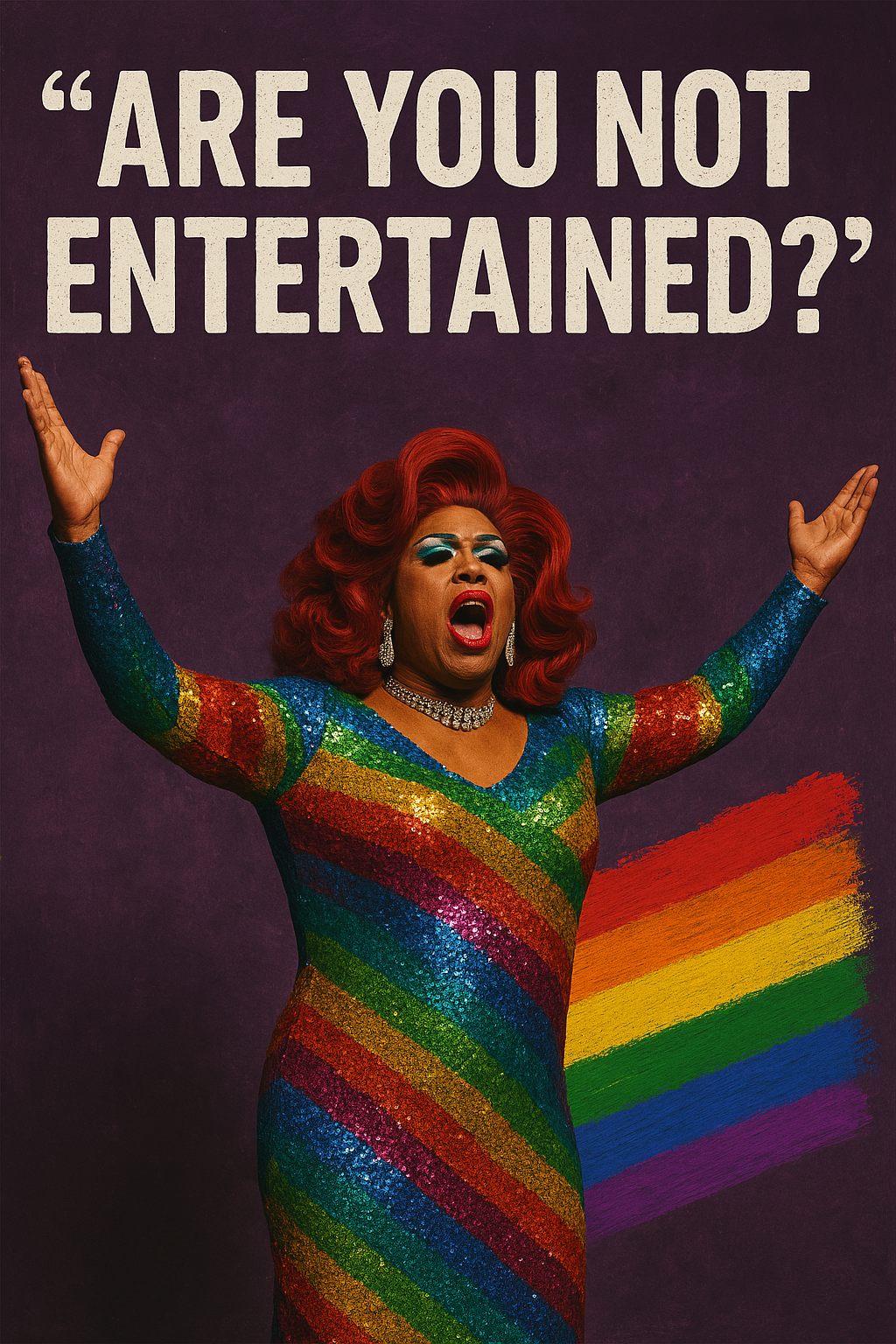
“Are you not entertained?”
This iconic line, shouted by a bloodied Maximus in Gladiator, wasn’t a celebration of victory — it was a challenge. A callout. A haunting indictment of a society addicted to violence, numbed by spectacle, and detached from the humanity of those forced to perform. He wasn’t seeking applause. He was holding up a mirror.
More than two decades later, that same mirror reflects something eerily similar in the experience of queer people today — especially those whose identities are flamboyant, loud, expressive, and unapologetically visible.
The Spectacle of Queer Visibility
From Pride parades to drag performances, queer expression is often seen — and dismissed — as mere show. Colorful. Chaotic. Entertaining. Aesthetic. It’s packaged and consumed like a streaming show, a TikTok trend, a night out on the town. But beneath the glitter lies a deeper truth: visibility for queer people isn’t a costume — it’s courage.
Society too often views expressive queerness — especially drag, gender nonconformity, or flamboyant behavior — as performance. But these aren’t acts for applause. They’re acts of defiance in a world that polices difference. Every strut, every sequin, every “yes queen!” is stitched together by centuries of resistance, pain, and the radical right to exist.
So when society asks, “Why are they doing all this? Why do they need attention?”
The answer, echoing from Maximus, is simple: Are you not entertained?
The Double Bind of Visibility
Queer people walk a tightrope of contradiction. Be visible enough to advocate for rights, but not so visible that it makes others uncomfortable. Be proud, but not too proud. Be out, but not too loud.
This paradox plays out every day:
• A trans woman is called brave on a magazine cover, then harassed on the street.
• A drag performer wins an Emmy, then is banned from reading to children.
• A gay teen posts a dance video, then is doxxed and bullied offline.
Visibility becomes both lifeline and lightning rod. And the irony? The same society that celebrates queer culture in curated doses often vilifies it when it challenges their comfort.
Drag Is Not a Distraction — It’s a Declaration
Drag, in particular, sits at the center of this cultural conflict. Once underground, now mainstream (thanks in part to RuPaul’s Drag Race), it has been simultaneously commodified and condemned.
Drag is dismissed by critics as obscene, as grooming, as “just for fun.” But that framing erases its political roots. Drag was — and still is — a rebellion. A theatrical protest against gender norms, patriarchy, and erasure. It says: We’re here. We’re fierce. We won’t shrink to fit your expectations.
When a drag queen steps onto a stage or reads a book to children, that is not a performance for approval. It’s a statement of presence in a world that would rather they disappear.
Flamboyance Is Survival, Not Showboating
The flamboyant gay man. The femme nonbinary teen. The trans woman with bright eyeshadow and higher heels. These expressions aren’t for applause — they’re armor.
In a culture where queerness has historically been criminalized, pathologized, and punished, to exist out loud is an act of survival. These individuals aren’t performing for your amusement. They’re breathing in their full truth — something so many are denied.
And when people react with discomfort or accusation — “They’re just doing it for attention” — it reveals more about the observer than the observed.
When the World Demands Conformity, Expression Is Resistance
Every culture has norms. But when those norms are rigid, any deviation becomes disruption. Queer visibility disrupts the narrative of binary gender, heteronormative romance, and quiet assimilation. That disruption often triggers backlash.
But conformity is not peace — it’s compliance. And for queer people, especially those from marginalized intersections (Black, brown, disabled, poor), compliance has never guaranteed safety.
So instead, many choose to live vividly. Loudly. Colorfully. Not to entertain, but to exist on their own terms.
Society’s Uneasy Addiction to Queer Culture
Here lies the ultimate irony: society can’t stop watching queer people. From voguing in pop videos to queer slang in advertising, from Pride floats to rainbow capitalism, the world profits from queer aesthetics while rejecting queer lives.
It’s like watching Maximus fight — cheering the bloodshed but ignoring the cost.
So again we ask:
Are you not entertained?
Because if visibility rattles you, maybe it’s not the expression that’s the problem — it’s your expectations.
FAQs
1. Why is drag considered political?
Drag challenges gender norms and stereotypes. It has historically been a form of protest, particularly during events like the Stonewall Riots. Today, it still represents resistance, especially in the face of anti-LGBTQ+ legislation and cultural backlash.
2. Isn’t queer expression just for attention?
No. Queer expression is often a survival mechanism and a form of self-affirmation. It challenges conformity and gives voice to identities that have been historically erased or marginalized.
3. Why do some people feel uncomfortable with queer visibility?
Discomfort often stems from internalized biases or rigid expectations about gender and identity. Queer visibility challenges these norms, which can feel threatening to some.
4. How can allies support expressive queer culture?
By listening, learning, advocating, and showing up. Support local queer artists, attend drag shows, push back against harmful narratives, and vote for inclusive policies.
5. Isn’t visibility enough for LGBTQ+ rights?
Visibility is important but not sufficient. Legal protections, healthcare access, education, and cultural acceptance are all critical. Visibility without safety can still be dangerous.
6. What’s wrong with enjoying queer culture for entertainment?
Appreciating queer culture is fine, but problems arise when it’s consumed without respect for the people behind it. Enjoying the art while ignoring or undermining the artist’s humanity is exploitative.
The Cost of the Curtain Call
Queer people don’t exist to perform. And yet, every day, they are forced to audition for acceptance — in families, schools, jobs, and public life. The performance is relentless, and the stakes are life and death.
So when the world gawks at drag queens, critiques gay men for being “too much,” or questions why a trans person is “so visible,” remember this:
They’re not asking for your entertainment. They’re demanding your recognition.
Your True Direction is dedicated to empowering individuals navigating life’s transitions. Through inspiring stories and actionable strategies, we aim to help you reclaim ambition, overcome challenges, and thrive in every stage of your journey.
Connect with Us
Follow us on Medium @YourTrueDirection
Your journey is yours to shape — take the next step in Your True Direction.
Day 1 of a 7-part series exploring the emotional cost of conditional love, family estrangement, and the quiet strength it takes to heal when those meant to love you choose silence instead.
Sometimes, the loudest absences are the ones that never needed words. This empty chair holds the weight of what was missing.
The Day Love Was Conditional
On what should’ve been one of the happiest days of my life, my wedding, I was met not with celebration, but silence. Not because I didn’t invite my father, but because he chose not to come. He couldn’t support me marrying the man I love. That silence has lasted for 3,116 days.
And it still echoes.
What Is Parental Rejection and Why It Hurts So Deeply
Parental rejection is the denial of emotional, physical, or moral support from a parent to a child. It cuts especially deep when rooted in identity, whether it’s about sexuality, gender, religion, or personal choices. For LGBTQ+ individuals, this kind of rejection can be life-altering.
When a parent turns their back not on your actions, but your essence, it sends one clear message: You are not enough.
The Hidden Weight of Conditional Love
Love that comes with strings attached is not love; it’s control in disguise. It’s the unspoken rule that says, “Be who we want you to be, or else.”
When my father said, “I love you, but…,” I learned that love had conditions. That I had to earn my worth. That my joy came second to his discomfort.
“I Love You, But…” — The Words That Haunt
Those five words are silent daggers. They divide families. They teach shame. They echo for years.
For LGBTQ+ individuals, these statements validate a lie we’ve heard too often: You are not worthy of love unless you conform.
This leads to internal conflict, wanting to be accepted, while also needing to be authentic.
The Long-Term Effects of Being Rejected by a Parent
Here’s what many don’t realize: this pain doesn’t fade. It morphs into:
Anxiety and self-doubt
Fear of abandonment in adult relationships
Difficulty trusting others
Depression and complex trauma
Perfectionism or people-pleasing
Estrangement from family
Loss of cultural or religious identity
We carry it silently until we don’t anymore.
Rewriting the Narrative: Healing Through Self-Acceptance
Healing begins when you stop seeking approval from those who can’t give it, when you stop blaming yourself. When you realize you are worthy of love, just as you are.
I stopped chasing their acceptance and began creating my own definition of family. I chose to love myself the way they couldn’t.
And it changed everything.
7 Ways Parental Rejection Damages LGBTQ+ Children
Shame-Based Identity — Children internalize guilt over something they cannot change.
Mental Health Struggles — Higher rates of depression, self-harm, and suicide.
Loss of Safety Net — Lack of emotional or financial support during critical years.
Estrangement Trauma — Fear of being “cut off” for who they are.
Delayed Self-Acceptance — Many suppress their identity far into adulthood.
Attachment Wounds — Struggles with romantic and platonic relationships.
Life-Limiting Beliefs — “I’m not enough,” “I’m unlovable,” “I’ll be alone forever.”
Resources: Support Systems for Healing and Growth
If you or someone you love has experienced parental rejection, you’re not alone. Here are some powerful resources:
PFLAG — The nation’s largest organization for LGBTQ+ people, their parents, and families.
The Trevor Project — Crisis intervention and suicide prevention for LGBTQ+ youth.
GLAAD — Media advocacy and resources to support LGBTQ+ representation and support.
FAQs About Parental Rejection and LGBTQ+ Identity
Q1: Is it common for LGBTQ+ people to be rejected by their parents? Yes, unfortunately. Studies show nearly 40% of LGBTQ+ youth report parental rejection at some point in their lives.
Q2: How can I begin to heal after being rejected by a parent? Start by affirming your own identity, seeking LGBTQ+ communities, and working with a trauma-informed therapist.
Q3: Should I try to reconcile with my parents? Only if it supports your healing. Reconciliation should never come at the cost of your mental health or authenticity.
Q4: What if my parents say they love me but still don’t support my relationship? That’s conditional love. You deserve to be supported fully, without exceptions.
Q5: Is it okay to set boundaries or go no contact with parents? Yes. Boundaries are essential for healing and safety — especially in toxic dynamics.
Q6: How do I find chosen family or supportive communities? Start with LGBTQ+ support groups, online forums, or local centers. Community is healing.
The Light Beyond the Silence
If your story mirrors mine, know this: You are not broken. You are not unworthy. And the absence of someone at your wedding — or in your life — does not define your value.
The day love became conditional was painful, yes. But it also became the day I chose myself.
Your True Direction is dedicated to empowering individuals navigating life’s transitions. Through inspiring stories and actionable strategies, we aim to help you reclaim ambition, overcome challenges, and thrive in every stage of your journey.
Connect with Us
Follow us on Medium @YourTrueDirection
Your journey is yours to shape — take the next step in Your True Direction.
Alone at the edge, where silence meets the sky, the first step of a thousand begins with stillness.
A Poem Created from Silence, Rejection, and the Battle to Heal. A very personal letter — one written in the wake of quiet endured, love rejected, and the agonizing cost of staying true to oneself in the face of rejection from family, inspired this poem, “3,116 Days.” There is more to this story than just one missed wedding day. There are years of mental damage, quiet fights, and the heartbreaking realization that not all love is unconditional.
The poem will be the essence of a weeklong study of issues many LGBTQ+ people and adult children of toxic homes can relate to as we travel into this road together. Every stanza opens one of the seven wounds; each wound will be dissected further via daily releases throughout the next week.
Designed to provide understanding, support, and healing for everyone who has ever felt invisible by people who should have loved them most, the poem in full is below, together with links to each related topic.
🔗 Explore the Journey (Each Will Be Hyperlinked Below As They Publish)
Below is the poem that inspired this entire series — a journey through grief, resilience, and self-liberation. Each verse is a mirror of emotional truths that too many carry in silence.
“3,116 Days”
All of us walk a winding road, Seeking love, our hearts exposed. But even love, when left unmet, Can carve deep wounds we can’t forget.
Three thousand one hundred sixteen nights, Since joy was stolen from my sights. A wedding day, meant full of grace, But marked by absence — your empty place.
Dad, you chose silence over me, Not even fifteen minutes free. Because of who I dared to love, You turned away, no push, no shove.
And Mom, you stood there, still and cold, Not brave enough, not strong, not bold. You asked me not to dance that night, To dim my truth, to dim my light.
You feared what others thought or said, While my soul bled in silent dread. No empathy, no “why” or “how,” Just shame and silence, then and now.
You say you love, but with a “but” — A little word that wounds and cuts. It takes that love and twists it sharp, Till all that’s left is a broken heart.
You held traditions in your hands, While stepping on where true love stands. And now, I speak, no longer mute, From pain that once, I dared dispute.
Gaslight, guilt, the subtle jabs, The echo of emotional grabs. The child you knew is grown and free, And no, you won’t manipulate me.
You gave to others what you denied, To me, your son, you pushed aside. You drove for weddings, gave your cheer, But couldn’t come when I stood near.
I see it now, I see it plain, The roots of all this hurt and strain. For years I tried, for years I gave, But now I rise, my soul to save.
No longer held in tangled chains, Of fear, and guilt, and silent pain. You taught me love — how it can break, But also how new love can wake.
I found it in a man so kind, In chosen family, redefined. And though your absence scars my core, It taught me I deserve much more.
So this is not an “I’m sorry” song, It’s truth I’ve held inside too long. It’s courage born of quiet tears, And standing strong through all these years.
You may not see, or understand, But still I walk, still I withstand. I do not hate, I do not curse, But I will no longer make it worse.
For healing asks we let things go, And plant new seeds, and let love grow. And though I’ve cried, and still may cry, This is not a goodbye; this is my why.
So if you love me, love me whole, Without conditions, without control. Until that day, I’ll find my way, And let the past no longer stay.
💔 From Verse to Reality: Why We Begin With Parental Rejection
The poem above captures the heartbreak of being unseen and unloved by those who were supposed to love unconditionally. And it all began with a single, defining moment — the day love was no longer freely given.
In Day 1 of this series, we take a closer look at what it means to experience parental rejection, especially for LGBTQ+ individuals, and how it affects the heart, the mind, and the path to healing.
Your True Direction is dedicated to empowering individuals navigating life’s transitions. Through inspiring stories and actionable strategies, we aim to help you reclaim ambition, overcome challenges, and thrive in every stage of your journey.
Connect with Us
Follow us on Medium @YourTrueDirection
Your journey is yours to shape — take the next step in Your True Direction.
You never gave up. Not on me, not on anyone. When the silence got too loud, when the weight of it all became unbearable, you were there. No questions, no judgment – just there. In the darkest moments, when I felt like I was slipping away, your words pulled me back.
Some heroes wear uniforms. Others just show up when it matters most.
Every step tells a story. Every scar holds a memory. Music heals what words cannot.
The Battle That Never Ends
PTSD is a battlefield all its own. It doesn’t come with armor, rules of engagement, or an exit strategy. It doesn’t wave a white flag when the war is over because, for many veterans, the war never truly ends. It follows them home, creeping into their minds, hijacking their emotions, and turning everyday life into a warzone.
Some wounds bleed. Some leave scars. And some, like PTSD, stay hidden – festering in the silence, breaking a person from the inside out.
For veterans, PTSD is not just about remembering the past; it’s about reliving it. The mind becomes a battlefield, where memories become landmines, exploding without warning. A simple sound, a sudden movement, a smell – any of these can send them spiraling back into the warzone they never wanted to return to.
And the worst part? They fight this battle alone.
Jelly Roll’s song Save Me isn’t just music – it’s an anthem of pain, a raw confession of struggle, a cry for help that so many veterans relate to. Because while the world moves on, they remain stuck in a war they never truly left.
Jelly Roll’s voice spilled from the truck speakers as Jake sat on the bridge, gripping the steering wheel so hard his fingers ached.
”Somebody save me…
”Me from myself…”
He exhaled sharply.
The world outside his windshield looked normal. People walking, talking, laughing. How could they not see?
How could those in his life not see the war still raging inside him?
Lost in the night, weighed down by the struggle – holding on feels impossible, but hope is never out of reach.
Drowning in Demons
The whiskey bottle clinked against the guardrail as Jake sat on the edge of the bridge, the cold steel biting into his skin. The city lights below were a blur, cars moving like ants on a highway he no longer felt connected to. The wind whipped against his face, numbing everything except the pain in his chest.
The war had ended, but it never really left him.
His hands shook as he wiped his face. He wasn’t even sure if the moisture on his skin was sweat, tears, or the mist from the river below. Maybe all three.
For years, he had fought to keep himself together. Fought the nightmares. Fought the memories. Fought the guilt. But tonight, he was tired. Tonight, the weight was too much.
“Maybe they were right,” he thought. “Maybe I should’ve died over there with them.”
He pulled his jacket tighter, the wind slamming into his back, urging him forward. One step. One second.
”I’m lost and I’m found, but I’m lonely at the same time…”
God, that line.
It ripped through him like shrapnel. Because that was it, wasn’t it?
Alive, but not living.
Surviving, but lost.
Screaming, but silent.
He squeezed his eyes shut. But when he did, the faces were there. Their faces.
Matthews. Torres. Bishop.
He closed his eyes, and suddenly, he was back in the desert. The heat scorching his skin, the sandstorm whipping around him. The radio crackling with desperate voices.
“We’re taking fire! We need air support – NOW!”
Jake could still hear the panic, the urgency. He remembered gripping his rifle so tightly that his fingers ached. He remembered the deafening blast that sent him flying backward.
And then he remembered looking over and seeing them – his brothers, his family – lying still.
Gone.
He should have saved them.
The bridge creaked slightly as he shifted his weight forward.
“One step,” he told himself. “One step, and it all stops.”
No more nightmares.
No more waking up in a sweat, screaming at ghosts.
No more hearing their voices in his head, begging him to do something – anything – to change what happened.
Jake exhaled, long and slow.
Then his phone buzzed.
He almost ignored it. But something made him glance down.
Davis: “Hey man, I know you’re struggling. Just let me know you’re okay.”
Jake’s breath caught in his throat.
Davis.
The only one who still checked in. The only one who seemed to notice that Jake was slipping away.
His fingers trembled as he typed. He wasn’t even sure why he responded, but he did.
Jake: “Not really, man.”
Within seconds, his phone rang.
He didn’t want to answer. He wanted silence. He wanted the pain to stop.
But somehow, he pressed the button.
“Jake.”
Davis’s voice was steady. No panic, no pity. Just there.
“I know where you are,” Davis said. “I’m coming.”
Jake let out a shaky breath.
“You don’t have to.”
“Yeah, I do,” Davis said. “Just hold on, brother.”
The wind still howled. The river still raged below. But for the first time in a long time, Jake felt something other than pain.
He felt seen.
And for tonight, that was enough.
Climbing Out of the Darkness
Healing wasn’t fast, and it sure as hell wasn’t easy.
Jake started showing up – at therapy, at veteran support meetings, even just for a walk around the block. Each step was a battle, but he kept fighting.
One day, he played Save Me in his truck again. But this time, it didn’t feel like a cry for help.
It felt like a reminder.
”I ain’t no savior, no angel, no saint…”
No, he wasn’t.
But maybe he didn’t need to be. Maybe he just needed to keep going.
Resources for Veterans Struggling with PTSD
If you or someone you know is struggling, you are not alone. Here are some resources that can help:
PTSD affects about 11–20% of veterans who served in combat zones, but many cases go unreported.
2. Can PTSD be cured?
There is no “cure,” but PTSD can be managed with therapy, medication, and peer support.
3. What are the signs that a veteran might be struggling?
Withdrawal, irritability, difficulty sleeping, substance abuse, and signs of self-harm are all warning signs.
4. How can I help a veteran with PTSD?
Be there. Listen without judgment. Encourage them to seek help, but don’t push. A simple check-in can save a life.
5. Does music like Jelly Roll’s Save Me really help?
For many, music provides a way to feel understood. Songs like Save Me give voice to struggles that are hard to put into words.
Call To Action
Jake’s story is real. Maybe his name is different. Maybe his struggle looks a little different.
But the pain? The fight? That’s something too many veterans know all too well.
If you or someone you know is struggling, reach out. A text, a call, a conversation – it could be the lifeline that saves a life.
Because in the end, the words of Jelly Roll’s song ring true:
Somebody save me…
And sometimes, all it takes is one person willing to answer that call.
This is for Chris. This is for every Davis. And this is for every Jake who still needs saving.
About Your True Direction
Your True Direction is dedicated to empowering individuals navigating life’s transitions. Through inspiring stories and actionable strategies, we aim to help you reclaim ambition, overcome challenges, and thrive in every stage of your journey.
Mental health awareness is at an all-time high, but many people still struggle with how to support loved ones facing challenges. Listening seems simple, yet truly hearing and understanding someone battling depression, anxiety, or other mental health conditions is an art — one that requires patience, empathy, and self-awareness.
When someone opens up about their mental health struggles, our instinct is often to reassure them, to fix the problem, or to make them feel better. But what if that’s not what they need? What if the best support we can offer is not advice, but deep, genuine listening?
Join Your True Direction as we dive into what it truly means to listen, the common mistakes people make, and how to become a better ally for those struggling with mental health.
A Story of Feeling Unheard
“I told them I was struggling. They told me to ‘stay positive.’ I said I felt like I was drowning. They said ‘everyone feels like that sometimes.’ That’s when I realized — they weren’t really listening.”
For those battling depression, anxiety, or trauma, opening up about their struggles can be incredibly difficult. When they finally do, the way people respond can either help them feel validated and supported or make them retreat further into isolation.
Many well-meaning people unintentionally minimize, dismiss, or invalidate the feelings of someone in pain. Recognizing these patterns is the first step toward becoming a better listener and supporter.
The Difference Between Hearing and Listening
Hearing is passive — you register the words being spoken. Listening, however, is active — it requires full engagement, comprehension, and empathy.
True listening is not just about processing words but also about understanding emotions, recognizing unspoken pain, and responding in a way that makes the other person feel seen and heard.
Why People Struggle to Truly Listen
Even with the best intentions, many people find it difficult to truly listen because:
• They feel uncomfortable with emotions — They try to “fix” the problem instead of sitting with the discomfort.
• They want to be helpful but don’t know how — They believe advice is the best way to offer support.
• They unintentionally make it about themselves — Instead of listening, they start sharing their own experiences.
Overcoming these tendencies is key to becoming a more compassionate supporter.
What NOT to Say to Someone Battling Mental Health Issues
Even if said with good intentions, certain phrases can be incredibly harmful:
• “Just be positive.” → Invalidates real pain.
• “It could be worse.” → Minimizes their struggle.
• “You should try exercising/eating better/etc.” → Sounds like blame rather than support.
• “Everyone feels like this sometimes.” → Dismisses their unique experience.
Instead, use phrases that validate:
✔ “That sounds really tough, I’m here for you.”
✔ “I don’t have all the answers, but I want to support you.”
How to Truly Support Someone Without Making It About You
1. Avoid comparing struggles. Saying “I’ve been through worse” is not helpful.
2. Resist the urge to fix. Sometimes, just listening is enough.
3. Follow their lead. If they want to talk, listen. If they need space, respect it.
Supporting Someone Without Burning Yourself Out
Caring for someone with mental health struggles can be emotionally exhausting. To help sustainably:
• Set boundaries on your availability.
• Prioritize your own mental health.
• Seek support from a therapist or trusted friend if needed.
When to Encourage Professional Help
Sometimes, professional intervention is necessary. If someone:
• Talks about self-harm or suicidal thoughts
• Is unable to function in daily life
• Shows extreme mood swings or withdrawal
It may be time to gently encourage seeking help. Offer to help them find a therapist or call a support hotline together.
True listening is a skill that requires practice, self-awareness, and patience. By learning to listen without judgment, validate without dismissing, and support without overwhelming ourselves, we can make a real difference in the lives of those struggling with mental health.
Being there for someone isn’t about having the right words — it’s about being present, understanding, and truly hearing them.
Frequently Asked Questions (FAQs)
What is the best way to respond to someone struggling with depression?
Acknowledge their pain, listen without judgment, and offer support without pushing solutions.
2. How can I avoid saying the wrong thing?
Stick to validating statements like, “That sounds hard, I’m here for you,” instead of offering advice or minimizing their feelings.
3. What if I don’t know what to say?
That’s okay. Simply saying, “I don’t know what to say, but I care about you,” can be powerful.
4. How do I encourage someone to seek therapy?
Gently express concern, provide resources, and offer to support them in finding help.
5. Can listening really make a difference?
Yes. Feeling heard and validated can reduce feelings of isolation and hopelessness.
About Your True Direction
Your True Direction is dedicated to empowering individuals navigating life’s transitions. Through inspiring stories and actionable strategies, we aim to help you reclaim ambition, overcome challenges, and thrive in every stage of your journey.
Join Your True Dirction and learn how to foster mutual respect between parents and adult children with actionable tips to improve communication, honor boundaries, and build trust.
Building stronger connections through respect, communication, and shared moments.
Relationships between parents and adult children can be some of the most fulfilling yet complex connections we navigate in life. However, mutual respect is often at the heart of building and maintaining these relationships. Whether it’s respecting boundaries, honoring differences, or learning to communicate better, the key is to build a foundation of trust and understanding.
In this article, we’ll explore why mutual respect matters, common mistakes that lead to conflict, and actionable tips to strengthen your relationship with your adult child.
Why Mutual Respect Matters in Parent-Adult Child Relationships
Mutual respect is essential for fostering trust, understanding, and a lasting bond between parents and their adult children. Without it, misunderstandings can lead to resentment, distance, and long-term conflict.
How Disrespect Damages Family Connections
When parents unintentionally dismiss their adult child’s feelings, undermine their decisions, or cross established boundaries, it can damage the family dynamic. Adult children may feel invalidated, leading to emotional distance or strained communication.
For example, a parent might disregard their adult child’s request for privacy, thinking it’s a trivial matter. Over time, these small actions erode trust and create a pattern of disconnect. Research from Psychology Today highlights that validating emotions and respecting autonomy are key to maintaining healthy family relationships.
The Role of Mutual Respect in Building Trust
Mutual respect is a two-way street. When parents respect their adult children’s independence, those children are more likely to reciprocate with gratitude and respect. A study from BetterHelp emphasizes that mutual trust develops when both parties feel heard and valued.
Rebuilding trust and strengthening bonds through open dialogue and understanding.
Signs of Disrespect in Parent-Adult Child Relationships
It’s not always easy to identify disrespect in parent-adult-child relationships. Here are some common signs to look out for:
Ignoring boundaries (e.g., entering their home uninvited or criticizing life choices).
Dismissing their emotions (e.g., saying, “You’re overreacting” or “You’ll understand when you’re older”).
Undermining their decisions or expertise (e.g., “I know better because I’ve lived longer”).
How Parents Unintentionally Disrespect Their Adult Children
Parents may unintentionally disrespect their adult children by clinging to old dynamics, where they see their child as dependent or needing guidance. This can include offering unsolicited advice or refusing to acknowledge their child’s autonomy. Learn more about these behaviors in Harvard Business Review’s guide to managing relationships.
Why Adult Children May Feel Invalidated or Undermined
Adult children often feel disrespected when their parents downplay their experiences or question their decisions. Statements like, “You’re too young to understand” or “That’s not how things are done” can make them feel undervalued despite their education, achievements, or personal growth. For tips on how to navigate invalidation, check out VerywellMind’s article on emotional validation.
How Parents Can Respect Adult Children’s Boundaries
Respecting boundaries is one of the most critical aspects of a healthy relationship between parents and adult children. Boundaries help define personal space, emotional limits, and autonomy, ensuring both parties feel respected and valued.
Steps to Honor Emotional and Physical Boundaries
Ask for Permission: Before visiting their home or offering advice, ask if it’s a good time or if they’re open to your suggestions.
Listen Actively: Show genuine interest in their thoughts and opinions without immediately judging or offering solutions.
Respect Their Decisions: Even if you disagree, avoid criticizing their choices. Support their independence. Learn more about setting boundaries in MindTools’ boundary guide.
How to Stop Undermining Your Child’s Decisions
Instead of saying, “You should’ve done it my way,” try saying, “I trust that you’re doing what’s best for you.” Acknowledging their autonomy will make them feel respected and valued. Read about healthy family dynamics at National Alliance on Mental Illness (NAMI).
Actionable Tips to Improve Communication Between Parents and Adult Children
Good communication is the backbone of any healthy relationship. By improving how you talk and listen to each other, you can reduce misunderstandings and strengthen your bond.
Practice Active Listening for Better Understanding
Active listening involves fully focusing on what your adult child is saying without interrupting or jumping to conclusions. Try rephrasing their statements to show you understand: “So what I’m hearing is that you feel… Is that right?” Learn more about active listening techniques at SkillsYouNeed.
Avoiding Common Communication Pitfalls
Don’t interrupt them when they’re speaking.
Avoid bringing up past mistakes in unrelated discussions.
Don’t assume your way is the only correct way. Check HelpGuide’s communication tips for tips on overcoming common communication issues.
How Small Gestures of Respect Can Strengthen Family Bonds
Sometimes, it’s the little things that matter. A kind word, a thoughtful text, or simply respecting their time can show your adult child that you value and appreciate them. For more ideas, check out Greater Good Science Center.
The Key to Building Mutual Respect in Families
Ultimately, mutual respect is about seeing each other as equals—adults with unique perspectives, experiences, and values. As parents, taking steps to listen, validate, and respect your adult child’s boundaries can transform your relationship. As adult children, recognizing your parents’ efforts and expressing gratitude can create a reciprocal relationship built on trust and love.
Fostering mutual respect will strengthen your bond and create a lasting legacy of love and understanding in your family.
FAQs About Parent-Adult Child Relationships
1. Why do some parents struggle to respect their adult children’s boundaries?
Parents may struggle because they are used to seeing their children as dependents. Transitioning to an adult-adult relationship can be challenging. Setting boundaries early and reinforcing them kindly can help. Read more about healthy boundaries:National Alliance on Mental Illness — Setting Limits.
2. How can parents stop invalidating their adult child’s feelings?
Parents can practice active listening and avoid dismissive language. Repeating what their child says, like, “I hear that you felt hurt by my actions,” helps create understanding. Learn about active listening here:SkillsYouNeed — Active Listening.
3. Is it normal for adult children to set boundaries with their parents?
4. Can family therapy help improve respect in relationships?
Yes. Family therapy provides a neutral space to address issues, improve communication, and rebuild trust. Find family therapists here:Psychology Today — Find a Therapist.
5. How do I know if I’m crossing my adult child’s boundaries?
Pay attention to their verbal and non-verbal cues. If they seem uncomfortable or express that they feel disrespected, take it as an opportunity to step back and reassess. Learn to recognize social cues:Healthline — Social Awareness
The Bottom Line: Respect as the Foundation of Relationships
Respect between parents and adult children isn’t about control or authority; it’s about building trust, understanding, and connection. By acknowledging feelings, respecting boundaries, and fostering open communication, parents and children can strengthen their bonds and create a healthier dynamic.
Your True Direction is dedicated to empowering individuals navigating life’s transitions. Through inspiring stories and actionable strategies, we aim to help you reclaim ambition, overcome challenges, and thrive in every stage of your journey.
Connect with Us
Follow us on Medium: @YourTrueDirection
Have a story to share or want to collaborate? Email Ryan at ryan@yourtruedirection.com.
A reflection on what it feels like to be unheard when you need it most.
Lost in the Rain: A Moment of Reflection
We say “I’m fine” because it’s easier.
Because the truth — the real, raw, bleeding truth — makes people shift in their seats, glance at their phones, and mutter something meaningless like, Stay strong.
But what happens when we stop saying what they want to hear?
What happens when we tell them the truth — and they still look away?
You Were Never Really Listening
I used to say I’m okay
because it was what you wanted to hear.
Because the truth — the real, raw, bleeding truth —
would have made you shift in your seat,
glance at your phone,
mutter something meaningless like, Stay strong,
as if strength alone could hold me together.
I used to lie to protect you.
To keep you from feeling the weight of my reality.
Because every time I tried to let you in,
I watched your face change —
your eyes darting away,
your hands fidgeting,
your mouth forming words that held no meaning.
You’ll be fine. You just need to think positive. It could be worse.
As if I hadn’t already drowned myself in forced gratitude,
as if I hadn’t already begged my own brain
to just stop eating me alive.
But you didn’t see that.
You never did.
You didn’t see the war inside my head,
the battle I fought every second of every day —
not with swords or shields,
but with thoughts that wouldn’t let me breathe,
memories that played on a loop,
a voice that whispered, You don’t belong here.
And some days, I believed it.
Some days, I felt it in my bones,
a weight so heavy I wondered if I would ever stand again.
But I still got up.
I still moved.
I still played my part in the world you live in,
the world where pain is something to be hidden,
where suffering is only acknowledged
when it’s quiet enough to ignore.
I still laughed in the right places.
I still said, I’m just tired when exhaustion wasn’t the word —
when what I really meant was, I don’t want to do this anymore.
I still carried the weight alone,
because every time I tried to set it down,
you looked the other way.
And when I finally stopped lying,
when I finally let the truth slip through my shaking lips —
No, I’m not okay.
No, I don’t know how much longer I can do this.
No, I don’t want to wake up tomorrow.
You cleared your throat.
You glanced at the time.
You patted my shoulder and said, Don’t be so negative.
As if a brighter outlook could erase the years of darkness.
As if forcing a smile could make the pain disappear.
As if I hadn’t already tried that,
every day,
for as long as I can remember.
And that’s when I knew —
you never really wanted the truth.
You never wanted to see the fight it took
just to sit across from you and pretend to be whole.
You never wanted to hear the weight in my voice,
because if you did,
then you might have to carry a piece of it too.
And that’s when I realized —
you were never really listening at all.
If this resonates with you, you’re not alone.
Mental health struggles are real, and you deserve support. If you or someone you know is struggling, here are resources that can help:
• Crisis Text Line— Text HOME to 741741 to connect with a crisis counselor.
Have you ever felt unheard when you needed someone the most? Let’s talk about it in the comments. And if this piece resonated with you, consider clapping, sharing, or following for more.
About Your True Direction
Your True Direction is dedicated to empowering individuals navigating life’s transitions. Through inspiring stories and actionable strategies, we aim to help you reclaim ambition, overcome challenges, and thrive in every stage of your journey.
Join Your True Direction as we learn how veterans can overcome workplace misconceptions, navigate cultural gaps, and thrive in civilian roles, while employers leverage their unique skills for success.
Navigating New Terrain: Veterans face the challenges of transitioning from military service to the civilian workforce, seeking belonging in an unfamiliar office environment.
“Adaptability is about the powerful difference between adapting to cope and adapting to win.”
– Max McKeown
Let’s get one thing straight: veterans, especially former officers, are not out to steal your job or overthrow your company hierarchy. Believe me, we’ve had enough stress, responsibility, and high-stakes decision-making to last a lifetime. What we really want is to be part of the team, contribute, and put our skills to good use. That’s it.
But here’s the problem. The same traits that helped us thrive in the military—taking initiative, owning responsibility, and leading when necessary—can sometimes rub people the wrong way in civilian workplaces. And trust me, the last thing we want is to intimidate anyone or come across as some overzealous leader-in-waiting.
The truth is, you don’t have to be a manager to lead. You don’t need a title to take responsibility. These are values we live by, and they’re not about stealing anyone’s thunder — they’re about getting the job done. So why do these misunderstandings happen? Let’s break it down.
Why Do Civilian Workplaces Misinterpret Veterans?
Misaligned Leadership Styles
In the military, taking initiative isn’t a suggestion, it’s a requirement. If something needs doing, you step up. No waiting around for an official memo or someone to tell you it’s your “lane.” But in the civilian world, this can be misread as trying to outshine your boss or micromanage your peers. Spoiler alert: we’re not. We’re just wired to act when we see a problem.
What’s the alternative? Sit back and wait for someone to ask us to contribute. That’s not how we operate. But hey, we get it; sometimes we need to dial it back, and we’re working on that.
2. Cultural Gaps
The workplace culture in the military is vastly different from civilian environments. Military culture prioritizes teamwork, clear hierarchies, and mission-driven objectives. Civilian workplaces, however, often emphasize individualism, less rigid structures, and a slower pace of decision-making.
Many veterans face cultural misunderstandings in civilian workplaces. According to Pew Research, 67% report feeling misunderstood by their peers. This disconnect can lead to frustration for veterans and confusion for their colleagues.
Bridging this gap requires veterans to observe workplace norms and adapt to new dynamics. Employers, on the other hand, can foster inclusivity by offering training programs and creating environments that encourage open dialogue.
Learn more about military-to-civilian transition strategies at Military.com.
3. Perception of Competence
Let’s not sugarcoat it: veterans bring a lot to the table. Leadership, strategy, and decision-making under pressure—it’s part of the gig. Unfortunately, this can make some people feel insecure, especially if they’re still figuring out their own roles.
We’re not here to show anyone up or make anyone feel bad about their experience. We just want to contribute and strengthen the team. Trust us, we’ve had our share of accolades—we don’t need more.
How Veterans Can Navigate These Misperceptions
“The art of life lies in a constant readjustment to our surroundings.”
– Kakuzō Okakura
Build Relationships
Building trust is the fastest way to break down barriers. Take the time to connect with your colleagues and managers. When people understand your intentions, they’re less likely to misinterpret your actions.
Adjust Your Communication Style
Yes, military communication is direct. Yes, it gets results. But in the civilian world, it can come across as abrupt or overly assertive. Take a breath, tone it down, and make sure you’re coming across as collaborative rather than commanding.
Share Your Intentions
Sometimes, all it takes is a simple conversation. Make it clear you’re there to support the team, not outshine anyone. Let people know you’re focused on collective success, not personal gain.
How Employers Can Support Veterans
“Leadership is not about being in charge. It is about taking care of those in your charge.”
– Simon Sinek
Educate Teams
Provide training to help employees and managers understand the unique skills and perspectives veterans bring to the workplace. This will foster a more inclusive environment and reduce misunderstandings.
Utilize Available Resources
Employers looking to hire and support veterans can access valuable resources through the U.S. Department of Labor’sVeterans’ Employment and Training Service. This guide offers actionable tips and best practices for integrating veterans into civilian workplaces.
Encourage Mentorship Programs
Establish mentorship opportunities to connect veterans with seasoned professionals who can help them adapt and thrive.
Final Thoughts: Let’s Get Over Ourselves
Here’s the bottom line: veterans aren’t here to disrupt your workplace, undermine your authority, or steal your job. We’ve had enough of that in the military, thanks.
We’re here to be part of the team, contribute where we can, and help everyone succeed. And yes, sometimes our methods might seem a little intense — but trust us, they come from a good place. So, let’s work together, stop misinterpreting each other’s intentions, and make the workplace better for everyone.
Take Action Today
For Veterans: Access tools and mentorship to navigate your transition successfully.
For Employers: Build a veteran-friendly workplace with expert guidance.
U.S. Department of Labor’s Employer Guide
Together, we can bridge the gap and create thriving workplaces for all.
FAQs
What challenges do veterans face in civilian workplaces?
Veterans often face challenges like cultural misunderstandings, misaligned leadership expectations, and communication style differences. Traits like taking initiative or being mission-focused can sometimes be misinterpreted as overstepping or being overly assertive. Additionally, their competence and experience can unintentionally intimidate colleagues or managers.
2. How can employers better support veterans in their organizations?
Employers can support veterans by offering training programs to educate teams on veterans’ unique skills, fostering open communication, and creating mentorship opportunities. Providing transition support, such as peer networks or veteran-specific onboarding programs, also helps ease the adjustment to civilian workplace dynamics.
3. Why do veterans often struggle to adapt to civilian roles?
The struggle often comes from differences in workplace culture. Military environments prioritize teamwork, clear hierarchies, and mission-first thinking, while civilian workplaces may emphasize individual achievements, informal hierarchies, or complex processes. Veterans may also find civilian communication styles less direct, which can lead to misunderstandings.
4. How can veterans adjust their leadership style for civilian workplaces?
Veterans can adapt by focusing on relationship-building, softening their communication style, and aligning with the organization’s culture. Seeking feedback, openly sharing their intentions, and finding a mentor within the organization can also bridge the gap and foster better collaboration.
5. What are the benefits of hiring veterans for civilian workplaces?
Veterans bring exceptional leadership, problem-solving, and decision-making skills. They thrive under pressure, have a strong sense of responsibility, and are team-oriented. Their ability to adapt to complex and dynamic situations makes them valuable contributors to any workplace.
Your True Direction is dedicated to empowering individuals navigating life’s transitions. Through inspiring stories and actionable strategies, we aim to help you reclaim ambition, overcome challenges, and thrive in every stage of your journey.
Connect with Us
Follow us on Medium: @YourTrueDirection
Have a story to share or want to collaborate? Email Ryan at ryan@yourtruedirection.com.
Welcome to a journey of self-discovery and empowerment. Sometimes, the bravest choice is to step away from situations that no longer serve your well-being. Whether it’s a toxic relationship, an unfulfilling job, or simply a draining environment, walking away can be the first step toward reclaiming your peace and happiness.
By R. T. Garner
For years, I wrestled with conflicting emotions about my family. While my writings may sometimes seem harsh or tinged with resentment, let me be clear: I love my family deeply. But love alone wasn’t enough to keep me in an environment that slowly eroded my sense of self.
Walking away from toxic family dynamics is never easy, but prioritizing your peace and well-being is a courageous act of self-love.
Growing up, I poured my heart into showing my family who I truly was. I hoped that, with enough effort, they would finally see me, understand me, or even change. But the reality was sobering: people only change when they’re ready, not when you want them to. Accepting this truth was painful, but it also set me free.
Toxicity isn’t always loud or obvious. In many families, including mine, it takes on subtler forms, dismissive attitudes, sharp words, and an unwillingness to listen. My family wasn’t cruel on purpose. They were products of their own pain, repeating patterns they hadn’t yet recognized or healed. These unspoken wounds, passed down over generations, became invisible shackles.
Why Self-Preservation Sometimes Means Walking Away
There came a moment when I realized that love for my family didn’t mean sacrificing my own mental and emotional health. Walking away wasn’t about rejecting them, it was about saving myself. I had to break free from the cycle of toxicity, even if that meant being the first to take the step.
Breaking Generational Cycles: A Path Toward Healing
It’s one thing to talk about family dysfunction; it’s another to confront it. Few people acknowledge how brave it is to walk away from a toxic family environment. It takes courage to break the silence, admit that love isn’t always enough to heal, and recognize that self-preservation can be a profound act of love — for yourself and others.
Choosing Love, Choosing Yourself
Leaving didn’t mean I stopped loving my family. In fact, it allowed me to love them more fully from a distance. Walking away gave me the space to reflect, heal, and rediscover my sense of self. By choosing to love myself, I broke free from patterns that had once held me captive.
Choosing to walk away from toxic family ties is a step toward healing and reclaiming your inner strength.
Final Thoughts
Walking away from family toxicity is never easy. It’s a decision fraught with guilt, fear, and uncertainty. But sometimes, the most loving thing you can do is to create space; for yourself, for healing, and for growth. Choosing yourself isn’t selfish; it’s necessary. And in doing so, you honor not just yourself, but the possibility of a healthier future for everyone involved.
FAQs
1. How do you know when it’s time to walk away from family?
You know it’s time when the relationship consistently harms your mental and emotional well-being, and all attempts at communication or resolution have failed.
2. Is walking away from family selfish?
Walking away isn’t selfish—it’s an act of self-preservation. It allows you to protect your well-being and sometimes even inspires positive change from a distance.
3. What are the subtle signs of family toxicity?
Subtle signs include constant criticism, dismissiveness, emotional manipulation, and a lack of accountability for harmful behavior.
4. Can you heal family relationships after walking away?
Healing is possible, but it requires mutual effort, open communication, and a willingness to address past hurts. Sometimes, space is necessary for growth and understanding.
5. How does walking away help with self-preservation?
Walking away gives you the space to heal, reflect, and rebuild your sense of self without the constant influence of a toxic environment.
Additional Resources
Here are some helpful articles and websites for those navigating family toxicity and self-preservation:
Have you struggled with family dynamics or breaking toxic cycles? Share your thoughts and experiences in the comments. Your journey could help someone else take their first step toward healing.
About Your True Direction
Your True Direction is dedicated to empowering individuals navigating life’s transitions. Through inspiring stories and actionable strategies, we aim to help you reclaim ambition, overcome challenges, and thrive in every stage of your journey.
“Love is not what you say; it’s what you do. True love transcends words and becomes action.” — Unknown
Lost in the Rain: A Mother and Son Struggle to Bridge the Distance
You “Love Me,” you say, but you don’t understand me,
Two words so empty they have no meaning.
You say you love me, but you don’t have empathy,
Blind to my pain, my silent plea.
You claim to love me, but you don’t show it,
A love that is expressed but never committed.
For a mother, your words cut deep,
Promises broken, a wound I keep.
You say you love me, but you hold your mother’s title,
A legacy of judgment, sharp and vital.
You say you love me, but you tell white lies,
Echoes of your toxicity in your eyes.
You wear love like a stolen cloak,
A thin mask and an unspoken joke.
But love is neither control nor quite blame, control,
It’s not wielded as a weapon, not a petty game.
You say you love me, but your hands feel cold,
Tracing scars from stories I’ve already told.
Don’t you see your child left out in the rain,
Searching for warmth but finding only pain?
Break the cycle; don’t just repeat,
Love is not conquest, not deceit.
Hold me with tenderness, and allow the past to go,
Love requires development and the capacity to grow.
You say you love me, but love is shown,
In acts of compassion, seeds you’ve sown.
Allow love to be healing, real, and true,
Without the shadow of suffering I’ve outgrew.
So, if you love me, prove me wrong,
Show me your heart truly belongs.
Because I need love that sustains and finds a place,
Not just words or transient grace.
Recent Articles on Healing Family Relationships
Understanding and Healing Enmeshed Mother-Son Relationships
This article explores the dynamics of enmeshed mother-son relationships and offers therapeutic interventions to help untangle these intricate emotional knots. Symmetry Counseling
Break Free from Toxic Relationships: Steps to Healthier Connections
Discover how to identify and overcome toxic relationship patterns and self-sabotage, paving the way for healthier connections. Our Mental Health
Emotional Enmeshment: Navigating Mother-Son Relationship Boundaries
Learn about the concept of enmeshment in mother-son relationships and strategies to establish healthier boundaries. Neurolaunch
Breaking Free: Escaping Toxic Family Dynamics
Explore the impact of unhealthy family dynamics and steps to break free from toxic cycles for personal development and recovery. Freedom with Therapy
Mother-Son Bond: Shaping Emotional Development and Relationships
Understand how the mother-son bond influences a man’s psychological development and future relationships. Neurolaunch
Breaking Free from Negative Family Cycles: It’s Hard but Doable
Learn about the challenges and strategies involved in breaking harmful family cycles to foster personal growth and healthier relationships. Faith Activist
Healing the Mother-Son Relationship
Practical steps for healing a mother’s strained relationship with her son and building deeper connections. Mental Health Match
Empower Yourself: Strategies for Breaking the Cycle of Toxic Family Relationships
Recognize toxic family dynamics and discover strategies to break free from cycles of dysfunction. The Narcissist Mind
Understanding the Dynamics of Mother-Son Enmeshment
An in-depth look at mother-son enmeshment and its psychological implications. Carla Corelli
Breaking the Cycle: Coping with the Consequences of Toxic Family Relationships
Strategies to cope with and heal from the consequences of growing up in a toxic family environment. Raising Children 101
About Your True Direction
Your True Direction is dedicated to empowering individuals navigating life’s transitions. Through inspiring stories and actionable strategies, we aim to help you reclaim ambition, overcome challenges, and thrive in every stage of your journey.
If you found this meaningful, don’t forget to follow our blog for more heartfelt reflections and inspiring stories. Visit us at Your True Direction.
Thank You for Reading! Your journey is yours to shape — take the next step in Your True Direction. If this article resonated with you, don’t forget to clap, share, and follow us for more inspiring content!
About Your True Direction
Your True Direction is dedicated to empowering individuals navigating life’s transitions. Through inspiring stories and actionable strategies, we aim to help you reclaim ambition, overcome challenges, and thrive in every stage of your journey.
Discover the moving story of a gay soldier’s battle for understanding, his fight against love disguised as control, and the powerful letter that set him free.
By R.T. Garner
“True love is not about holding on — it’s about listening, letting go, and allowing someone to be their truest self.” — Inspired by John’s Story
Image generated by author
The silence between loved ones can wound as deeply as any battle. For John — a 35-year-old Army Officer, seasoned soldier, and a gay man who had lived through years of service in the military; homecoming was not the solace he had imagined. His return was supposed to be about healing, about rediscovering himself after enduring the trauma of war and the emotional toll of a life lived under the shadow of “Don’t Ask, Don’t Tell.”
Instead of finding peace, John finds himself locked in a silent war with his mother, a conflict over control, identity, and love. This war fought without weapons broke him in ways combat never had.
In his final attempt to be heard, John wrote a heartbreaking letter pleading for liberation and understanding.
“I Am Your Mother”: A Mantra of Control
From his earliest memories, John’s mother wielded the phrase “I am your mother” as both a shield and a sword.
As a child, those words were comforting:
“I am your mother; I’ll always protect you.”
“I am your mother; I know what’s best for you.”
However, as John grew older and began to navigate his own identity, the phrase became a leash. It was no longer a promise of love but a declaration of dominance.
When he came out to her at 18, she refused to accept it. “You’re confused,” she said. “You’ll see. I know what’s best for you. I am your mother.”
The military became his escape. At West Point, John found the discipline, structure, and camaraderie he craved. Yet even in the brotherhood of service, he kept a part of himself hidden, fearing rejection. For 15 years, he buried his true self while serving his country with honor.
But when he came home at 35, his mother’s refrain still echoed in his life: “I know what’s best. You’re my son. I’ll always have the final say.”
Love Disguised as Control
His mother had tricked him into returning home, insisting it was out of love. She told him she wanted to “heal” him after his years of military service. She pointed to his PTSD, his weariness, and his guarded demeanor as proof that he needed her care.
Image generated by author
But John soon realized her love came with conditions. She didn’t want to heal him; she wanted to reshape him.
Her attempts to “fix” him ignored the reality of his experiences, both as a soldier and as a gay man. She dismissed the ways war and repression had shaped him, insisting she knew better.
Her words, once a source of comfort, now felt like chains:
“You’ll thank me one day for bringing you home.”
“I’m doing this because I love you.”
“You don’t know what you need — I do.”
What she called love was control. She dismissed his pain, his identity, and his independence as misguided and broken. To her, he was still a boy in need of her guidance, not a man who had fought wars both within himself and on the battlefield.
The Heavy Silence of Home
John tried, night after night, to explain to his mother what he needed. He told her about the weight he carried from years of war. He tried to explain how being forced to hide his identity in the military had left scars more profound than the ones on his body.
“I’m not broken, Mom,” he said. “I just need time. I need space to figure things out on my own.”
But her response was always the same:
“You don’t know what you’re saying, John.”
“I’m your mother — I know what’s best.”
“You’ve never been able to make good decisions for yourself.”
Each dismissal stung like a fresh wound. To her, John was still a child, incapable of knowing what was best for his own life.
Her refusal to acknowledge his identity, to see him as a soldier, a gay man, a person in his own right, was suffocating.
The Final Letter
One night, after another argument where his words were drowned out by hers, John realized he would never reach her. The silence between them would never be broken unless he left.
So, he sat down to write his final letter.
“Dear Mom,” he began. “This will be the last time I try to reach you. I’ve spoken, but my words mean nothing to you. So I’ll write them down, hoping you’ll finally hear me.”
In his letter, John poured out the pain he had carried for years. He spoke of the battles he had fought on foreign soil and in his own heart. He spoke of the shame and silence forced upon him by his mother’s inability to accept him for who he was.
“You’ve always said, ‘I am your mother,’ as if those words give you the right to control my life. But being my mother doesn’t mean you own me. It doesn’t mean you can dismiss my feelings or erase my identity.”
He told her how her love had turned into a cage:
“I know you think you’re helping me, but you’re not. Your version of love doesn’t heal me; it hurts me. You tricked me into coming home, thinking it would fix things. But it hasn’t. This place, your words, your control; it’s breaking me.”
Finally, he wrote the words that had been trapped in his heart for years:
“I love you, Mom, but I can’t stay. You have to let me go. You have to accept that I’m not the boy you raised; I’m the man I’ve become. Goodbye, for now.”
Much like the lyrics of “Listen,” John found himself shouting, unheard:
“I’m done believing you,
You don’t know what I’m feeling.”
John’s story is a powerful reminder that love, when entangled with control, can transform into an emotional prison, stifling growth and individuality.
A Heartbreaking Truth
John’s letter was not just a plea for understanding; it was an act of liberation. For years, he had hidden parts of himself, first in the military and then at home. In leaving, he finally chose to live as his true self.
His mother’s love, though well-meaning, had become suffocating. It left no room for him to grow, to heal, or to be seen for who he indeed was.
The Power of Listening
John’s story mirrors the heart-wrenching themes of Broadway Backwards’ version of “Listen.” The lyrics — rewritten to reflect a gay man’s plea to be seen; capture the depth of John’s journey:
“I’m more than what you made of me.
I followed the voice you gave to me.
But now I’ve got to find my own.”
His journey is a powerful reminder:
To those who feel silenced: Your voice matters. Speak your truth, even if it means leaving behind those who refuse to hear you.
To parents and loved ones: Love is not about control. True love means listening, trusting, and allowing your children to grow into who they are.
John’s story is for anyone who has ever felt unseen, unheard, or misunderstood. It’s a call to action — to listen, to love, and to let go.
If this moves you, share it. Let’s remind the world of the courage it takes to speak and the love it takes to listen truly.
Resources for Healing, Support, and Understanding
If John’s story resonates with you or someone you know, these resources can offer valuable guidance and support:
About Your True Direction
Your True Direction is dedicated to empowering individuals navigating life’s transitions. Through inspiring stories and actionable strategies, we aim to help you reclaim ambition, overcome challenges, and thrive in every stage of your journey.
Connect with Us
Follow us on Medium: @YourTrueDirection
Have a story to share or want to collaborate? Email Ryan at ryan@yourtruedirection.com.
Thank You for Reading! Your journey is yours to shape — take the next step in Your True Direction.
Harness the power of affirmation for success and bold actions to create your best year yet.
By R. T. Garner
“Step boldly into 2025 and take control of your destiny. Discover how aligning your words, thoughts, and actions can turn dreams into reality and create the life you deserve.”
2025 is the perfect year to embrace manifestation techniques and create a life aligned with your intentions. What if you had a magical formula to guide your journey? That’s where Abracadabra comes in; it’s not just a word but a philosophy by which to live. Rooted in the Aramaic meaning “I create as I speak,” this ancient phrase reminds us that we are the architects of our lives.
To help you create your most empowered year yet, here’s a roadmap inspired by the letters of A-B-R-A-C-A-D-A-B-R-A, each representing a principle to guide your transformation.
Your words have power. Start every day with affirmations that declare the reality you want to create. Speak about your goals and dreams as though they’re already happening.
Example: Replace “I hope to succeed” with “I am succeeding and thriving.”
Affirmations align your thoughts and emotions with your vision, making it easier to stay focused and inspired.
B: Believe in Yourself
Everything starts with belief. Trust in your abilities, your resilience, and your potential to achieve greatness. Self-doubt may creep in, but don’t let it overpower the truth: you are capable of extraordinary things.
Practice: Create a “self-belief mantra” to recite when doubt arises, such as “I am capable, resourceful, and unstoppable.”
R: Reflect Daily
Reflection is the key to growth. Dedicate time each day to assess your progress, celebrate wins, and identify areas for improvement. Whether through journaling, meditating, or quiet introspection, reflection keeps you aligned with your goals.
Tip: Use prompts like, “What went well today? What can I improve tomorrow?” to guide your reflections.
A: Act Consistently
Manifestation requires action. Take purposeful steps every day toward your goals, no matter how small. Consistency creates momentum, and momentum leads to results.
Ask Yourself:What’s one action I can take today that brings me closer to my dream? Then do it.
C: Cultivate Gratitude
Gratitude is the secret to abundance. When you focus on what you have, you attract more of what you desire. Gratitude shifts your mindset from scarcity to appreciation, opening doors to new possibilities.
Practice: Write down three things you’re grateful for each night. Over time, you’ll notice how this simple habit transforms your perspective.
A: Adapt and Evolve
Change is inevitable. The key to thriving in 2025 is flexibility. Be open to new ideas, embrace unexpected opportunities, and adjust your plans when needed. Growth comes from adaptability.
Example: Instead of resisting challenges, ask yourself, “What can I learn from this?”
D: Dare to Dream Bigger
Let go of small, safe goals. Challenge yourself to dream boldly and believe in the seemingly impossible. Bold goals ignite passion and creativity, pushing you to explore your full potential.
Exercise: Write down a goal that scares and excites you. Break it into smaller steps, and start taking action today.
A: Align with Your Values
True success is living in harmony with your core values. When your actions reflect your principles, you create a life that feels meaningful and authentic.
Reflection: Ask yourself, “Does this decision align with the person I want to become?” Let your values guide your choices.
B: Build Positive Relationships
Your circle influences your journey. Surround yourself with people who uplift, inspire, and challenge you to grow. Let go of toxic relationships and seek connections that energize and support your vision.
Challenge: Identify one person in your life who motivates you, and reach out to deepen that connection.
R: Reframe Setbacks
Every setback is a setup for a comeback. Shift your perspective to see failures as lessons and stepping stones. Each challenge holds valuable wisdom to help you move forward.
Affirmation: When facing challenges, remind yourself, “This is temporary, and I am learning from it.”
A: Aspire to Inspire
Your growth can spark change in others. Whether through sharing your story, encouraging a friend, or mentoring someone, let your journey inspire those around you. Success is even more fulfilling when it uplifts others.
Action Step: Share a recent win or breakthrough with someone who might benefit from your experience.
The Power of “Abracadabra”
As you navigate 2025, use this Abracadabra framework as your guide. Each letter represents a step toward your best self. Together, they form a blueprint for intentional living, empowering you to:
Speak your reality into existence.
Dream boldly and act with purpose.
Align with your highest values.
Here’s your 2025 Abracadabra Affirmation to repeat daily: “I create as I speak. My words, thoughts, and actions align with the reality I am manifesting. Every day, I step closer to my highest potential and inspire others to do the same.”
This Year, The Magic is You
2025 is your canvas, and you are the artist. Like the ancient meaning of Abracadabra, you hold the power to shape your reality with your words, thoughts, and actions.
Don’t wait for the perfect moment — the moment is now. Speak it. Believe it. Act on it. The magic of 2025 isn’t in wishing; it’s in doing. Let this year be the one where you fully embrace your power and create a life that feels as magical as it is real.
Abracadabra: The magic is you.
Call-to-Action (CTA) Links
Encourage readers to take the next step:
Follow you on Medium:“For more transformative insights, hit the follow button!”
Share the Article on Social Media:“If this inspired you, share it with someone who needs a little magic in their life!”
Here are some Affirmations Websites you might be interested in:
About Your True Direction
Your True Direction is dedicated to empowering individuals navigating life’s transitions. Through inspiring stories and actionable strategies, we aim to help you reclaim ambition, overcome challenges, and thrive in every stage of your journey.
Connect with Us
Follow us on Medium: @YourTrueDirection
Have a story to share or want to collaborate? Email Ryan at ryan@yourtruedirection.com.
Thank You for Reading! Your journey is yours to shape — take the next step in Your True Direction. If this article resonated with you, don’t forget to clap, share, and follow us for more inspiring content!
For veterans, the battle doesn’t always end with service; it continues in the struggle to find purpose, identity, and belonging in civilian life.
By R. T. Garner
Image generated by the author
For 14 years, I’ve been fighting a battle I never expected: the struggle to find my place after leaving the military. I graduated from West Point, served my country, and earned three master’s degrees. On paper, it looks like I should be thriving. Yet here I am, stuck in a cycle of self-doubt, frustration, and a deep sense of failure.
In 2004, I stood among my peers at West Point, filled with pride and a sense of accomplishment. I had earned my place at one of the most rigorous institutions in the world, surrounded by leaders destined for greatness. Like many of my classmates, I envisioned a lifelong career in the Army, rising through the ranks, and eventually transitioning into a civilian leadership role that would capitalize on everything I had learned and accomplished.
But life has a way of veering off course. In 2010, I was medically retired from the Army, years before I had planned to leave. My career, my purpose, and my identity as a leader were suddenly taken away. The structured life I had built, with its clear goals and direction, vanished overnight. What followed was a chaotic and often painful journey of rebuilding, a journey that still feels incomplete.
This year marked my 20-year West Point reunion, a milestone I should have celebrated. Instead, I stayed home. I was too embarrassed to face my classmates, many of whom have gone on to achieve incredible things. They’re now lieutenant colonels, colonels, CEOs, congressmen, etc. And me? I report to a manager who was a private first class when I was leading soldiers.
Once, I confided this to a former classmate who is now a lieutenant colonel. I told him about my current position and my boss’s rank when they left the military. He gave me a smirk and laughed, as if to say, Are you serious? That laugh cut deeper than I expected. It wasn’t just a reaction, it was a mirror reflecting all the doubts and insecurities I’ve carried since leaving the military.
The Burden of Expectations
West Point instills in its graduates a culture of excellence, competition, and relentless discipline. We are trained to lead, to inspire, to rise to any challenge. But what happens when those expectations meet the messy reality of civilian life?
For many veterans, transitioning from the military to civilian careers is a difficult process. For West Point graduates and officers, the challenges are unique. Leadership roles that once defined our identities often don’t translate into civilian contexts. Employers frequently undervalue military experience, and the cultural differences between military and corporate environments create barriers to understanding.
The weight of comparison only magnifies these struggles. Seeing my classmates thrive in high-profile roles while I’ve spent years trying to find my footing has been a constant reminder of my perceived failures. For West Point graduates, the pressure is even greater. We’re seen as the elite — the ones who are supposed to lead by example. When we struggle, it feels like we’ve let everyone down: our families, our peers, and even the institution that shaped us.
A Crisis of Identity and Purpose
The loss of leadership roles and military identity is one of the most profound challenges veterans face during their transition. In the Army, I was responsible for making decisions, leading teams, and carrying the weight of leadership. Those roles gave me a sense of purpose and confidence that I’ve struggled to replicate in civilian life.
Civilian leadership often looks very different from military leadership. Hierarchies are less defined, decision-making processes are slower, and the values driving organizations don’t always align with those we learned in the military. These cultural gaps make it difficult to find roles that feel meaningful, leaving many of us questioning our place and our value.
For me, this struggle has been deeply personal. I work in career development, helping others find jobs and achieve their goals. I guide them through the same transitions I’ve struggled with, and while I’m proud of the work I do, it often feels hollow. How can I help others succeed when I feel like I’ve failed myself? Every success story I help create is a bittersweet reminder of how far I feel from where I want to be.
The Mental Health Toll
These professional struggles are closely tied to mental health challenges. Studies show that the suicide rate among veterans is 1.5 times higher than the general population, and unemployment or underemployment only increases that risk. For officers and academy graduates, the stakes are even higher. The loss of leadership identity, financial strain, and the weight of expectations can create a perfect storm of isolation and despair.
The transition to civilian life can lead to mental health challenges for many veterans, particularly those underemployed. Research shows that underemployed veterans experience significantly higher rates of depression (42%) and suicidal ideation (15%) than their employed counterparts (18% depression, 5% suicidal ideation). (RAND Corporation, 2020).
The stigma surrounding mental health in military culture compounds the problem. We’re trained to be strong, to push through adversity, and to see vulnerability as weakness. Seeking help often feels like admitting defeat, and even when we do, civilian therapists or counselors may not fully understand the nuances of our experiences.
I’ve seen the toll this takes, not just on myself but on friends and classmates who haven’t made it. The grief of losing peers to suicide is compounded by the survivor’s guilt and the unspoken question: Why them and not me?
Financial Strain and Underemployment
The financial challenges of transition add another layer of difficulty. Civilian jobs often pay less than military officer salaries, particularly for leadership roles. Underemployment — working in positions that don’t fully utilize our skills or experience, is a common reality for many veterans.
“The median income for veterans often lags behind the equivalent civilian workforce, particularly for former officers transitioning into leadership roles in the private sector.” (Bureau of Labor Statistics, 2021).
A 2021 RAND study revealed that nearly 50% of veterans feel underemployed, with officers being particularly vulnerable. The cost of transition, from moving families to establishing a civilian lifestyle, combined with the loss of military benefits, creates financial instability that can exacerbate mental health challenges.
For West Point graduates, underemployment isn’t just a financial issue; it’s an emotional one. It’s hard not to tie our worth to our professional titles and achievements, especially when we’ve been trained to lead and excel.
What Needs to Change?
Addressing these challenges requires systemic change and a shift in perspective:
Targeted Transition Programs
Programs tailored to officers and academy graduates, focusing on translating military leadership into civilian careers.
Employer Education
Companies must recognize the value of military leadership and actively recruit veterans for roles that align with their skills and experience.
Mental Health Support
Destigmatizing mental health struggles within the military and alumni networks is crucial. Alumni organizations like West Point’s can play a key role in fostering openness and connection.
Redefining Success
Veterans must learn to see success not as a continuation of rank or status but as finding purpose and fulfillment in new ways.
A Call to Action
This journey is deeply personal, but it’s not unique. Veterans, especially those from leadership backgrounds, face systemic barriers that make transition incredibly challenging. By sharing our stories, we can break the silence around these struggles and advocate for meaningful change.
To my fellow veterans: You’re not alone. The weight of expectations is heavy, but it doesn’t have to define you. Together, we can build a future where veterans are valued not just for their past service but for the incredible potential they bring to civilian life.
Call to Action:
If this resonates with you, share your story or join the conversation. Let’s work together to create a brighter path for veterans navigating life after service.
This link provides access to the full article and its details. Let me know if you’d like additional assistance navigating the content or extracting specific sections!
Citations:
Bureau of Labor Statistics. (2021). Employment Situation of Veterans. Retrieved from https://www.bls.gov.
RAND Corporation. (2020). Understanding Veteran Employment Challenges. Retrieved from https://www.rand.org
About Your True Direction
Your True Direction is dedicated to empowering individuals navigating life’s transitions. Through inspiring stories and actionable strategies, we aim to help you reclaim ambition, overcome challenges, and thrive in every stage of your journey.
Connect with Us
Follow us on Medium: @YourTrueDirection
Have a story to share or want to collaborate? Email Ryan at ryan@yourtruedirection.com.
Thank You for Reading! Your journey is yours to shape — take the next step in Your True Direction. If this article resonated with you, don’t forget to clap, share, and follow us for more inspiring content!
How Elton John’s I’m Still Standing Reflects a Veteran’s Journey
By R. T. Garner
“I’m still standing better than I ever did / Looking like a true survivor, feeling like a little kid.”
For David, a gay veteran just returning home from the front lines, the war was not yet finished. Upon his return home, he battled a different kind — one that tried to his sense of survival, identity, and belonging. As a young child, his father would make nasty comments to him, including, “If you are gay, I will kill you.” Long after he had left his family, long after he had served his nation, long after he had come out to himself, these remarks kept playing back in his head.
Image generated by Author
The road ahead for David was far from easy. But like Elton John’s I’m Still Standing, his story is a testament to the power of resilience, to the unyielding strength that keeps us moving forward when the world seems determined to knock us down.
“I’m still standing after all this time / Picking up the pieces of my life without you on my mind.”
The Battle Before the Battle
Before David even entertained the idea of joining the military, he was having trouble with an argument that was occurring within himself. In light of the fact that his father disapproved of him, it became painfully evident that expressing his true self was not a risk-free alternative. Although the fact that he felt strongly, he denied his feelings, which ended up in an overwhelming feeling of loneliness within him. This immense burden was a reflection of the weight of the struggle that he was carrying. He felt a great sense of betrayal in the air as he tried to deal with the expectations around him. As the weight of his hidden truth settled upon him, bringing him to barely a shadow of himself, the fight for air got harder and harder. His emotional health had suffered dramatically from societal unrelenting rejection, which kept him in a vicious struggle.
This emotional suppression followed him into adulthood. When he joined the military, Don’t Ask, Don’t Tell only reinforced the belief that he was needed to stay hidden. David’s military achievements were impressive, yet each promotion left him feeling empty, a stark contrast to his outward success. He was fighting for a country that wouldn’t accept him for who he was, a dissonance that echoed through his life.
“And if you need to know while I’m still standing, you just fade away.”
David began to internalize the rejection he’d faced, believing the lie that his worth was conditional. But his story didn’t end there.
Image generated by Author
Resilience: The Heartbeat of Survival
Resilience wasn’t just a buzzword for David; it was his lifeline. It carried him through his father’s rejection, the pressure of military life, and the isolation that followed him home. Just like Elton John sings, resilience isn’t about denying the pain — it’s about rising above it.
1. Reclaiming His Identity
David’s first battle after returning home was reclaiming his identity. Years of hiding who he was had taken a toll. He’d spent so long trying to meet others’ expectations that he’d forgotten who he wanted to be.
“Don’t you know I’m still standing better than I ever did?”
Through therapy and self-reflection, David began to piece himself back together. He realized that his identity wasn’t something to be ashamed of — it was a source of strength.
2. Healing From Rejection
The words of his father had haunted David for years, shaping how he viewed himself and his relationships. Even after his father passed, David felt the weight of that rejection. He couldn’t let go of the idea that he had to earn love and respect.
But resilience meant refusing to let that rejection define him. As Elton John’s lyrics echo, “Picking up the pieces of my life without you on my mind,” David learned to leave the pain of his father’s words in the past. He couldn’t change his father’s views, but he could change how much power those views held over him.
3. Embracing Love and Connection
For David, resilience also meant opening himself up to love and connection. His years in the military had taught him to rely only on himself, but this isolation couldn’t last forever.
He found a chosen family in the LGBTQ+ community — people who embraced him fully and saw him as strong, capable, and worthy of love. Romantic relationships were a new challenge, but each step forward was a victory.
“I’m still standing, yeah, yeah, yeah.”
The Unseen Battle: Misconceptions and Isolation
One of David’s biggest struggles after leaving the military wasn’t his own identity — it was how others perceived him. Friends and family assumed he was either too fragile or completely invincible. Both perspectives left him feeling isolated.
Coworkers and acquaintances avoided deeper conversations, either out of discomfort or misplaced fear of offending him.Romantic partners often misunderstood his hesitation to open up, mistaking it for indifference rather than self-preservation.
“Once I never could have hoped to win / You’re starting down the road leaving me again.”
But David’s resilience came through again. He began setting boundaries, clearly communicating his needs, and finding strength in being vulnerable. The more he shared his story, the more he realized that people wanted to understand — they just didn’t know how to start.
The Turning Point: “I’m Still Standing” as a Rallying Cry
One day, while driving alone, David heard I’m Still Standing on the radio. The lyrics struck a chord, echoing his struggles and triumphs. He pulled over, letting the music wash over him.
“I’m still standing better than I ever did / Looking like a true survivor, feeling like a little kid.”
For the first time in years, he saw himself not as a victim of his circumstances but as a survivor. Every hardship he’d faced had shaped him into the resilient man he was. From that moment on, David decided toreclaim his narrative.
Image generated by Author
A New Chapter: Living With Resilience
David’s journey didn’t end with that song, but it marked a turning point. He began to live with purpose, advocating for LGBTQ+ veterans and sharing his story to inspire others.
Resilience, he learned, wasn’t about erasing the past. It was about carrying the lessons of those experiences and using them to build a stronger future.
“I’m still standing after all this time.”
Final Thoughts: The Strength to Stand Tall
David’s story mirrors the journey of countless veterans who face rejection, isolation, and identity struggles. It’s a reminder that resilience isn’t about avoiding hardship — it’s about rising above it.
Elton John’s I’m Still Standing captures this spirit perfectly, celebrating the strength to persevere and the courage to rebuild. For David, the song became more than an anthem — it became a declaration of who he was and who he was becoming.
To anyone who feels like the world is trying to knock them down: You’re stronger than you think. Keep standing tall.
“I’m still standing.”
The River of Resilience: How Elton John’s I’m Still Standing Reflects a Veteran’s Journey
“I’m still standing better than I ever did / Looking like a true survivor, feeling like a little kid.”
For David, a gay veteran just returning home from the front lines, the war was not yet finished. Upon his return home, he battled a different kind — one that tried to his sense of survival, identity, and belonging. As a young child, his father would make nasty comments to him, including, “If you are gay, I will kill you.” Long after he had left his family, long after he had served his nation, long after he had come out to himself, these remarks kept playing back in his head.
The road ahead for David was far from easy. But like Elton John’s I’m Still Standing, his story is a testament to the power of resilience, to the unyielding strength that keeps us moving forward when the world seems determined to knock us down.
“I’m still standing after all this time / Picking up the pieces of my life without you on my mind.”
The Battle Before the Battle
Before David even entertained the idea of joining the military, he was having trouble with an argument that was occurring within himself. In light of the fact that his father disapproved of him, it became painfully evident that expressing his true self was not a risk-free alternative. Although the fact that he felt strongly, he denied his feelings, which ended up in an overwhelming feeling of loneliness within him. This immense burden was a reflection of the weight of the struggle that he was carrying. He felt a great sense of betrayal in the air as he tried to deal with the expectations around him. As the weight of his hidden truth settled upon him, bringing him to barely a shadow of himself, the fight for air got harder and harder. His emotional health had suffered dramatically from societal unrelenting rejection, which kept him in a vicious struggle.
This emotional suppression followed him into adulthood. When he joined the military, Don’t Ask, Don’t Tell only reinforced the belief that he was needed to stay hidden. David’s military achievements were impressive, yet each promotion left him feeling empty, a stark contrast to his outward success. He was fighting for a country that wouldn’t accept him for who he was, a dissonance that echoed through his life.
“And if you need to know while I’m still standing, you just fade away.”
David began to internalize the rejection he’d faced, believing the lie that his worth was conditional. But his story didn’t end there.
Resilience: The Heartbeat of Survival
Resilience wasn’t just a buzzword for David; it was his lifeline. It carried him through his father’s rejection, the pressure of military life, and the isolation that followed him home. Just like Elton John sings, resilience isn’t about denying the pain — it’s about rising above it.
1. Reclaiming His Identity
David’s first battle after returning home was reclaiming his identity. Years of hiding who he was had taken a toll. He’d spent so long trying to meet others’ expectations that he’d forgotten who he wanted to be.
“Don’t you know I’m still standing better than I ever did?”
Through therapy and self-reflection, David began to piece himself back together. He realized that his identity wasn’t something to be ashamed of — it was a source of strength.
2. Healing From Rejection
The words of his father had haunted David for years, shaping how he viewed himself and his relationships. Even after his father passed, David felt the weight of that rejection. He couldn’t let go of the idea that he had to earn love and respect.
But resilience meant refusing to let that rejection define him. As Elton John’s lyrics echo, “Picking up the pieces of my life without you on my mind,” David learned to leave the pain of his father’s words in the past. He couldn’t change his father’s views, but he could change how much power those views held over him.
3. Embracing Love and Connection
For David, resilience also meant opening himself up to love and connection. His years in the military had taught him to rely only on himself, but this isolation couldn’t last forever.
He found a chosen family in the LGBTQ+ community — people who embraced him fully and saw him as strong, capable, and worthy of love. Romantic relationships were a new challenge, but each step forward was a victory.
“I’m still standing, yeah, yeah, yeah.”
The Unseen Battle: Misconceptions and Isolation
One of David’s biggest struggles after leaving the military wasn’t his own identity — it was how others perceived him. Friends and family assumed he was either too fragile or completely invincible. Both perspectives left him feeling isolated.
Coworkers and acquaintances avoided deeper conversations, either out of discomfort or misplaced fear of offending him.Romantic partners often misunderstood his hesitation to open up, mistaking it for indifference rather than self-preservation.
“Once I never could have hoped to win / You’re starting down the road leaving me again.”
But David’s resilience came through again. He began setting boundaries, clearly communicating his needs, and finding strength in being vulnerable. The more he shared his story, the more he realized that people wanted to understand — they just didn’t know how to start.
The Turning Point: “I’m Still Standing” as a Rallying Cry
One day, while driving alone, David heard I’m Still Standing on the radio. The lyrics struck a chord, echoing his struggles and triumphs. He pulled over, letting the music wash over him.
“I’m still standing better than I ever did / Looking like a true survivor, feeling like a little kid.”
For the first time in years, he saw himself not as a victim of his circumstances but as a survivor. Every hardship he’d faced had shaped him into the resilient man he was. From that moment on, David decided to reclaim his narrative.
A New Chapter: Living With Resilience
David’s journey didn’t end with that song, but it marked a turning point. He began to live with purpose, advocating for LGBTQ+ veterans and sharing his story to inspire others.
Resilience, he learned, wasn’t about erasing the past. It was about carrying the lessons of those experiences and using them to build a stronger future.
“I’m still standing after all this time.”
Final Thoughts: The Strength to Stand Tall
David’s story mirrors the journey of countless veterans who face rejection, isolation, and identity struggles. It’s a reminder that resilience isn’t about avoiding hardship — it’s about rising above it.
Elton John’s I’m Still Standing captures this spirit perfectly, celebrating the strength to persevere and the courage to rebuild. For David, the song became more than an anthem — it became a declaration of who he was and who he was becoming.
To anyone who feels like the world is trying to knock them down: You’re stronger than you think. Keep standing tall.
“I’m still standing.”
About Your True Direction
Your True Direction is dedicated to empowering individuals navigating life’s transitions. Through inspiring stories and actionable strategies, we aim to help you reclaim ambition, overcome challenges, and thrive in every stage of your journey.
Connect with Us
Follow us on Medium: @YourTrueDirection
Have a story to share or want to collaborate? Email Ryan at ryan@yourtruedirection.com.
Thank You for Reading! Your journey is yours to shape — take the next step in Your True Direction. If this article resonated with you, don’t forget to clap, share, and follow us for more inspiring content!
Are you a teenager feeling overwhelmed by the seemingly infinite choices for your future? Do questions like “How do I choose the right career?” or “Should I follow my passion or go for a stable job?” haunt you? You’re not alone. But the good news is, “Career Planning for Teens: Achieve Financial Literacy, Attain Occupational Success, and Fulfill Personal Goals Amid Information Overload” by R.T. Garner is here to guide you through this maze and set you on the path to success.
This isn’t just another career guide; it’s a comprehensive resource explicitly tailored for teenagers who want to take charge of their future, build confidence, and make well-informed decisions.
What Makes This Book Stand Out?
In today’s fast-paced, information-packed world, it’s easy to feel lost. This book offers a clear, step-by-step roadmap that helps teens discover their unique strengths, explore exciting career options, and develop critical life skills.
Here’s why this book is different:
Interactive and Practical: It includes tools like SWOT analysis, personality assessments, and exercises that engage you in self-discovery.
Future-Focused: Learn about trending careers such as AI, digital marketing, and environmental science.
Life Skills Beyond Careers: From mastering financial literacy to cultivating a growth mindset, the book equips teens with essential life skills.
Image Generated by Author
Who Should Read This Book?
This book is ideal for:
High School Students: Whether you’re just starting to think about your future or already choosing your next steps, this book helps you get clear on your goals.
Parents and Educators: It’s a fantastic resource for guiding teens in a supportive, evidence-based manner.
Teens Exploring New Interests: Whether you’re unsure about college, trade school, or alternative career paths, this book breaks down all the options.
Image generated by author
What You’ll Learn
Discover Your Strengths:
Using self-assessment tools, like SWOT analysis and personality tests, uncover what you’re good at and what excites you.
2 Navigate Career Options with Confidence:
The book introduces careers in emerging fields such as:
Artificial Intelligence (AI)
Digital Marketing
Environmental Science
Health and Wellness
Entrepreneurship
3. Understand Educational Pathways:
Not sure if college, trade school, or an apprenticeship is right for you? This book demystifies these options and helps you choose the best fit for your goals.
4. Master Financial Literacy:
Learn budgeting, saving, and investing — critical skills for starting adulthood on the right financial footing.
5. Build Essential Career Skills:
Ace interviews, craft a stellar resume, and learn networking strategies that will help you stand out in any job market.
6. Plan for Work-Life Balance:
A fulfilling career isn’t just about work — it’s about achieving balance. The book teaches how to prioritize mental well-being alongside professional success.
Image generated by author
Common Myths Debunked
One of the most empowering aspects of this book is how it tackles popular misconceptions:
Myth: You have to choose your career now, or you’ll fall behind. Reality: Career planning is a journey, not a race. The book emphasizes self-discovery and adaptability.
Myth: Grades alone determine your future success. Reality: While grades matter, soft skills like creativity, adaptability, and communication are just as critical for success.
Why You Shouldn’t Wait
Your future starts now. Whether your dream is to become a tech innovator, creative entrepreneur, or environmental champion, this book is the ultimate toolkit to help you achieve your goals.
Clarity in Confusion: Feel confident about your decisions.
Practical Action Steps: Move from dreaming to doing.
Lifelong Value: The lessons in this book go beyond your teenage years — they prepare you for life.
What Readers Are Saying
With a 4.7-star rating on Amazon, here’s what readers love about this book:
“This book helped my teen discover their passion and take concrete steps toward a career path they love.”
“The financial literacy section alone is worth the price—every teen should read this!”
“Packed with actionable advice, it’s a must-read for anyone starting their career planning journey.”
Where to Get Your Copy
Don’t let indecision hold you back. “Career Planning for Teens” is available now on Amazon Kindle, so you can start reading today.
The teenage years are the perfect time to start planning your future. Whether you’re feeling lost or simply looking for guidance, “Career Planning for Teens” offers the clarity, tools, and confidence you need to succeed. It’s more than a book — it’s a roadmap to a fulfilling life.
Discover how Garth Brooks’ ‘The River’ reflects a veteran’s journey of resilience and overcoming challenges after service. For John, returning home from war wasn’t the end of his battles; it was the start of a new fight to rebuild his life while navigating PTSD and societal perceptions. His story mirrors the lyrics of ‘The River,’ reminding us that resilience is about choosing to keep sailing, no matter how rough the waters.
His service to his country was a source of pride for him, and it helped him develop into the kind of soldier he had always imagined himself to be. After returning to the civilian world, however, everything seemed strange. Friends and relatives viewed him differently, some with sympathy and others with an unwarranted desire to “fix” him… What they couldn’t see was that John didn’t need fixing; he required understanding.
John wasn’t broken. Yes, he struggled, but his struggles weren’t his identity. What defined him was his resilience, the same unwavering determination that carried him through combat. And like the ever-changing river in Garth Brooks’ The River, John found himself choosing to keep sailing, even when the currents felt too strong.
“I’ll choose to chance the rapids / And dare to dance the tide.”
Resilience: The Anchor for a Veteran’s Journey
Resilience is more than a concept for veterans like John; it’s their lifeline. It’s the grit to adapt, persevere, and rise again despite setbacks. Resilience came naturally to him while he was serving in the military. Because of his training, he could persevere over insurmountable obstacles, endure both physical and emotional suffering, and never give up. However, civilian life brought a unique set of challenges that tested John’s resolve in unexpected ways.
The Three Pillars of Resilience for Veterans
For John, resilience revolved around three critical principles:
1. Owning His Story Without Letting PTSD Define Him
John was not only forced to suffer from the agonizing of war, but he also had to deal with the labels that others had bestowed upon him. The well-meaning but unsuitable remarks and pity-filled sentiments, such as “Are you okay? Make him feel even more alone. For they didn’t see John anymore; they only saw his injuries.
PTSD was not his identity; it was only one part of his story. Resilience meant not allowing tragedy to consume his dreams, which remained alive and waiting for him. As Garth Brooks sings:
“There’s a dreamer just waiting to be set free.”
John envisioned a fulfilling career, a loving marriage, and a life where PTSD didn’t dictate his every move. He understood that resilience wasn’t about denying his challenges; it was about facing them while holding on to hope.
2. Accepting the Unpredictable Flow of Life
After the military, John learned the hard way that life is chaotic, unpredictable, and lacking the disciplined order that typified military life. Instead of clear objectives and explicit directions, participants now have more space for errors and confusion.
Initially, John resisted, but he yearned for simplicity and clarity. But resilience required him to embrace life’s chaos and accept that the river would never be smooth.
“There’s bound to be rough waters / And I know I’ll take some falls.”
Every stumble became an opportunity to grow. And with each recovery, John’s resilience became stronger.
3. Choosing to Keep Moving Forward
Resilience isn’t about having all the answers; it’s about choosing to take the next step, even when the path ahead is unclear. This meant that John had to go to therapy on days when he was really tired, take a job that he thought he wasn’t suited for as a stepping stone, and talk to his wife when he wanted to stay quiet.
Every small act of perseverance represented a vow of resilience. It was his way of saying, “I’m still here, and I’m still fighting.”
The Harm of Trying to “Fix” What Isn’t Broken
Ironically, the greatest threat to John’s healing wasn’t PTSD itself; it was the perception that he was broken. His wife, Sarah, was constantly asking if he was alright, his voice filled with concern. With his friends giving surface-level advice such as “Just move on.” Despite their good intentions, their actions made John feel even more alone.
What John needed wasn’t pity or solutions; it was empathy. He longed for people to see him as the same man he was before the war, a man shaped by his experiences but not defined by them.
“I will sail my vessel / Till the river runs dry.”
But even the strongest vessels can take on water. On some nights, sitting alone in his truck, John questioned if the world would be better off without him. It wasn’t the memories of combat that brought him to this point; it was the suffocating loneliness of feeling unseen.
Image Generated By Author
A Turning Point on the River
One quiet evening by the water near his home, John replayed Garth’s lyrics in his mind:
“To reach my destination / I’ll need faith and determination.”
At that moment, he realized something profound. He didn’t need anyone’s approval to heal. He didn’t need fixing because he wasn’t broken. All he needed was to believe in his strength and make a conscious choice to keep going.
John made a promise to himself that he would keep from that day on. He stopped trying to persuade people that he was ok and instead focused on obtaining self-acceptance. He turned to treatment, joined a veterans’ support group, and began having open, honest interactions with Sarah. They worked together to map a route forward, focusing on what could be right rather than what was wrong.
Resilience: The Superpower of Dreamers
Resilience isn’t about being invincible; it’s about having the courage to keep going, even when the odds are stacked against you. It’s about believing that no matter how turbulent the river becomes, there’s always something worth fighting for.
For John, that something was his family, his future, and the hope of building a worthwhile life away from home after the battlefield. Garth Brooks’ The River reminded him that resilience wasn’t about avoiding the rapids; it’s about navigating them with courage and determination.
“I’ll choose to chance the rapids / And dare to dance the tide.”
John didn’t need to be the person he was before his service. He just needed to keep sailing his vessel, knowing that every stroke of the oar brought him closer to his destination.
Sailing Through Life’s Rapids
John’s story is a testament to the countless veterans navigating the challenges of life after service. It’s a journey marked by the fight to be understood, respected, and seen for who they truly are. And it’s a journey fueled by the resilience to keep rowing, no matter how rough the waters become.
Garth Brooks’ The River offers a poignant reminder that life isn’t about guarantees. It’s about choosing to sail, even when the journey feels impossible.
“I will sail my vessel / Till the river runs dry.”
To every veteran: You’re not broken. You don’t need fixing. You are strong!
About Your True Direction Your True Direction is dedicated to empowering individuals navigating life’s transitions. Through inspiring stories and actionable strategies, we aim to help you reclaim ambition, overcome challenges, and thrive in every stage of your journey.
Connect with Us
Follow us on Medium: @YourTrueDirection
Have a story to share or want to collaborate? Email Ryan at ryan@yourtruedirection.com.
Thank You for Reading! Your journey is yours to shape — take the next step in Your True Direction. If this article resonated with you, don’t forget to clap, share, and follow us for more inspiring content!
Discover How Workplace Bias Undermines Morale and Learn Proven Strategies to Build a Fair and Inclusive Environment.
By R. T. Garner
Understanding Favoritism in the Workplace: Key Issues
Picture this: You’ve been diligently working on a large project, meeting deadlines and exceeding expectations. Your manager compliments your efforts during meetings. Less qualified colleagues who excel at making lunch plans with the boss often receive promotions. Isn’t this frustrating?
This is blatant partiality. Everyone senses this silent culture-killer, which no one openly discusses. Favoritism in the workplace destroys the values of equity, trust, and cooperation, whether it’s granting special assignments to “favorites” or changing the rules to benefit a small group.
In his book The Advantage, Patrick Lencioni underlines the important role that trust plays in the foundation of a good organization. Lack of trust causes teams to struggle, morale to plummet, and innovation to stagnate. What’s wrong is that bias not only breaks down trust; it completely destroys it. What remains is a toxic stew of bitterness, disengagement, and dysfunction.
Illustration of a manager showing favoritism toward one employee while ignoring others, symbolizing workplace bias.
What Favoritism Looks Like (And Don’t Pretend You Haven’t Seen It)
Let’s illustrate the situation. Sarah, the most diligent member of your team, consistently achieves her goals. Then there’s Mike, the manager’s golfing buddy, who manages to do the minimum required. Yet, when the next extensive project comes around, Mike gets the opportunity again. It’s not because he’s the best fit but because he knows how to keep the boss entertained over 18 holes.
Common Scenarios of Favoritism:
Special Assignments: Only a few individuals consistently receive high-profile projects, leaving others to perform mundane tasks.
Rephrased: While a favorite got away with taking an extended “break” to run errands, a top-performing employee received a reprimand for arriving five minutes late.
Promotions Without Merit: Personal connections, rather than demonstrated competence, determine who gets leadership roles.
These aren’t isolated incidents. In most workplaces, favoritism is subtle but pervasive. Employees notice it, and it doesn’t take long for resentment to brew. It sends a loud message: “It’s not what you do, but who you know.” And once that message is clear, trust and morale begin their downward spiral.
The Ripple Effect of Favoritism: Impacts on Workplace Culture
Favoritism isn’t just unfair to individuals — it poisons the entire workplace culture.
Imagine favoritism as a toxic chemical spill in a lake. At first, it seems localized, but soon, it spreads, contaminating everything in its path
Lowered Morale and Engagement
Take Alex, a top performer on the sales team. He notices his manager consistently praising a colleague who barely meets their quota but shares the manager’s love of fantasy football.
At first, Alex was motivated to excel. But now, he wonders: Why bother going above and beyond if it doesn’t matter?
When favoritism takes root, employees like Alex disengage. They stop sharing innovative ideas and focus on doing the bare minimum.
Gallup research shows disengaged employees cost U.S. companies billions annually in lost productivity — and favoritism is often the silent catalys
Increased Turnover
Have you ever heard about that star employee who suddenly quit without warning? Favoritism likely played a role.
High-performing employees don’t stick around in toxic environments.
When workers see that their efforts aren’t rewarded fairly, they start exploring other options.
The result? Your company becomes a magnet for talent.
Replacing employees isn’t cheap; recruitment costs, onboarding expenses, and the time lost to train a new hire can add up to tens of thousands of dollars per employee.
Additionally, the impact on team cohesion is significant.
Gossip and Resentment
When favoritism is at play, watercooler chatter becomes less about collaboration and more about office drama.
Employees start whispering about who’s in the boss’s inner circle and who’s not.
Instead of fostering teamwork, favoritism creates cliques, fueling a toxic “us vs. them” mentality.
Colleagues gossiping about workplace favoritism, illustrating the ripple effects of bias in office culture.
Consider the following real-world example from a marketing company: a manager regularly showed favoritism toward Amy, a close friend of hers.
The other team members grew resentful and started spreading rumors about Amy’s constant favoritism.
Petty infighting took precedence over collaboration, and as a consequence, the team’s productivity fell.
Decreased Productivity
Workers’ productivity drops precipitously when they lose faith that their efforts will be rewarded with acknowledgment.
What is the use of working late to prepare a presentation if the credit will most likely go to the person who is the boss’s favorite?
Not only does this lack of motivation have an effect on individuals, but it also brings the whole team to a lower level.
Teams miss deadlines, quality suffers, and customer happiness declines.
Stifled innovation.
Favoritism destroys innovation. When employees perceive their opinions as unvalued, they cease to generate innovative ideas.
Why expose yourself to risk in a brainstorming group where only a few people’s ideas receive attention?
This stagnation exposes your company to competitors who promote a culture of inclusivity and creativity.
Why Favoritism Hits So Hard: The Psychology Behind It
Why does favoritism sting so much? It pierces the core of a deeply rooted aspect of human nature: our perception of justice.
From playground disputes to workplace dynamics, fairness is a universal expectation.
The Fairness Principle
Studies in organizational behavior reveal that perceived unfairness triggers intense emotional responses. Employees who feel slighted often experience:
Stress and Burnout: They feel emotionally drained from navigating an environment where merit doesn’t matter.
Job Dissatisfaction: Their love for the job turns into bitterness.
Cynicism: People cease to believe in the organization’s values and purpose.
Take Monica, an ambitious junior analyst. She worked tirelessly on a presentation, only to watch her manager credit her favorite employee in front of the board.
The experience not only undermined Monica’s confidence in the company’s fairness but also left her feeling crushed.
Now, she’s emotionally checked out and actively job hunting.
Let’s Talk Solutions: How to Fix Favoritism
So, how do we tackle this workplace plague? The good news is that solutions exist, but they require effort and honest introspection from leaders.
1. Establish Clear, Measurable Standards
Set transparent performance benchmarks for promotions, raises, and critical assignments. For example, at one tech startup, managers introduced a points system to evaluate employee contributions objectively. Favoritism decreased as everyone understood the expectations.
2. Use Data-Driven Evaluation Tools
Implement tools like performance dashboards or 360-degree feedback systems to assess employees fairly. When promotions are based on quantifiable results rather than personal bias, trust can begin to rebuild.
3. Create a Culture of Open Feedback
Encourage employees to speak up about favoritism. In one case, a software company introduced anonymous surveys to collect honest feedback about leadership practices. The results? Managers identified their biases and made adjustments, improving team dynamics.
4. Audit Leadership Bias
Leaders must take a hard look at their behaviors. Are you unconsciously favoring people who share your interests or personality traits? Regular self-assessments and leadership training can help identify and correct these biases.
5. Introduce Accountability Mechanisms
Big decisions, like promotions or project assignments, should involve multiple reviewers. For instance, a media company formed a committee to evaluate promotions, ensuring fairness and transparency.
A diverse and inclusive team working collaboratively, demonstrating a workplace free from favoritism and bias.
A Call to Action for Leaders
Favoritism isn’t just a minor issue; it’s a leadership failure that sabotages trust, morale, and productivity. As a leader, it’s crucial to pose some challenging questions to yourself. Are you unintentionally playing favorites? Have your biases affected your decisions? If the answer is yes, it’s time to course-correct.
Take control of your workplace culture today! Implement these actionable strategies to eliminate favoritism, build trust, and foster equity within your organization. Remember, a fair and inclusive work environment isn’t just beneficial — it’s essential for long-term success. Start making the change now and watch your team’s morale, productivity, and innovation soar!
Building a culture of fairness isn’t just the right thing to do; it’s the smart thing to do. When employees feel valued and treated fairly, they’re more engaged, innovative, and committed to your company’s success.
Conclusion
Favoritism may seem like a minor issue, but its impact on workplace culture is anything but small. By addressing it head-on and fostering fairness, transparency, and accountability, leaders can create an environment where every employee feels valued. Remember: Trust is fragile, but with the right actions, it can be rebuilt.
FAQs
1. How can I recognize favoritism in my organization?
Look for patterns: Are certain employees consistently getting special treatment or assignments? Do rule violations go unnoticed for some but not others?
2. Can favoritism ever be unconscious?
Absolutely. Although unconscious bias is common, awareness and training can address it.
3. What’s the best way to address favoritism as an employee?
Start with honest communication. Speak to your manager or HR about your concerns. Focus on facts, not emotions.
4. How do I prevent favoritism as a leader?
Use objective performance measures, seek feedback, and involve others in decision-making processes to ensure fairness.
5. Is favoritism really that damaging to productivity?
Yes! Favoritism demotivates employees, stifles innovation, and increases turnover, all of which hurts your bottom line.
Integrity and honor — two words that everyone in business talks about, but let’s be real: most people don’t walk the walk. In today’s corporate environment, favoritism and internal politics are often the silent killers that cripple teams and gut employee morale. Leaders cut backroom deals, reward their inner circles, and then wonder why their organizations are riddled with mistrust and resentment. It’s a mess, and until we face that, nothing is going to change.
This brings us to an unlikely but incredibly relevant teacher: Brevet Major William Jenkins Worth. Worth wasn’t just some military figure from a dusty history book. He was the kind of leader who believed that impartiality was non-negotiable. His words still sting with truth today: “An officer on duty knows no one. To be partial is to dishonor both himself and the object of his ill-advised favor.” In today’s language? If you’re a leader who plays favorites, you’re betraying your own duty — and your team isn’t going to trust or respect you.
And just to bring in some modern firepower, let’s reference a leadership expert from our own time: Patrick Lencioni. His book The Advantage lays out a blueprint for organizational health, and guess what? It’s all about trust, clarity, and accountability — the very things Major Worth was preaching about, but with fewer swords and more strategy.
Why Worth and Lencioni Are a Perfect Pair
You might be asking, “Why should I care about some 19th-century military leader or even this ‘organizational health’ stuff?” Well, if you want your company to stop being a dysfunctional mess, you’d better listen up. Worth’s lesson on impartiality is more relevant than ever, and Lencioni’s work shows us why. According to The Advantage, a company’s ultimate competitive advantage is its health — built on trust, minimal politics, and clear expectations.
Consider this: Lencioni says trust is the foundation of all successful teams. But trust doesn’t magically appear; it’s earned when leaders consistently act in ways that are fair, transparent, and unbiased. Imagine an organization where promotions are always merit-based, decisions are open and honest, and no one is worried about favoritism. Sounds like a fantasy, right? But it’s not — it’s what great leaders make a reality.
Generated by Author
Integrity Isn’t Convenient, It’s Crucial
Integrity is like having a backbone — it only matters when it’s tested. It’s easy to claim you’re an ethical leader when everything is going well. The real challenge comes when your principles are inconvenient or unpopular. Patrick Lencioni emphasizes that integrity forms the core of organizational health, and without it, trust starts to rot from the inside out. Worth would agree. His “no one” rule meant that he didn’t care who you were, how much he liked you, or how close you were to him — if you broke the rules, you paid the price.
Take This Scenario: Picture this. You’re the head of a high-stakes project, and two candidates are up for a major promotion. One of them is your golf buddy — someone you’ve shared laughs and stories with. The other? An underdog, but they’ve delivered consistent, top-notch work and have gone above and beyond in ways that are measurable and undeniable. If you choose your buddy because of your relationship, you’ve compromised your integrity and created a political landmine in your team. But if you act like Major Worth or follow Lencioni’s principles, you make the hard choice: you reward the person who earned it. You do what’s right, even if it feels wrong personally.
Let’s examine The Advantage in more detail. Healthy organizations, according to Lencioni, are based on trust, which is created when leaders are open, equitable, and prepared to have difficult talks. Leaders that make choices based on personal preferences or fail to address favoritism foster dysfunction and politics. Does that sound familiar? Because of this, a lot of businesses have poisonous cultures where workers are more interested in office politics than in carrying out their duties.
What Lencioni gets right is that leaders who are clear and consistent cut down on workplace drama and confusion. Envision a workplace where everyone is aware that the rules are fair and implemented equally, where decisions are made openly, and where you never have to worry about whether your future will be determined by favoritism. Leaders like Worth and Lencioni think that culture is achievable, but only if they lead with honesty. It’s not simply wishful thinking.
The Real Cost of Favoritism
In any company, favoritism is a silent killer. Although it may not be immediately apparent, its consequences might cause confusion and animosity. According to Lencioni, trust erodes when workers believe their bosses are unjust or prejudiced. And people begin to disengage when trust is lost. Collaboration breaks down, productivity plummets, and eventually a culture of fear and self-interest takes over.
Consider this: Have you ever been employed at a place where a boss was clearly partial? Didn’t people take notice? Knowing that their efforts would not be rewarded, they ceased to exert as much effort. Eventually, the team as a whole disintegrated as they began to chat more and work together less. That is the cost of betraying impartiality, which is why integrity is more than just a desirable quality.
Integrity and Trust: Two Sides of the Same Coin
People can smell BS from a mile away. They know when decisions are being made based on relationships rather than merit, and they remember it. Patrick Lencioni says that trust isn’t built through grand gestures but through consistent, everyday acts of integrity. Worth, if he were alive today, would be nodding his head in agreement. Playing favorites isn’t just a minor leadership flaw; it’s a betrayal that has long-term consequences.
Here’s a practical takeaway: Before you make any major decision, ask yourself if it would pass the transparency test. Would you feel comfortable explaining your choice, in detail, to the entire company? If not, you’re probably about to make a biased call, and it’s time to rethink.
Practical Ways to Lead with Integrity (Lencioni Approved)
How do you actually lead with integrity in a way that would make both Worth and Lencioni proud? Here’s how:
1. Make Decisions Publicly Defensible: Lencioni says clarity is king. If your decision can’t stand up to scrutiny from your team, it’s the wrong one. Make your thought process clear, share the criteria, and let people see that you’re being fair.
2. Use Objective Criteria: Create measurable standards for evaluating performance, just like Lencioni advocates. This isn’t just about being ethical — it’s about removing doubt and confusion from your team. Everyone should know exactly what it takes to succeed, and that success should never depend on being someone’s favorite.
3. Create Accountability Systems: Trust yourself less and systems more. Accountability isn’t about micromanaging; it’s about ensuring that bias and favoritism have no room to fester. Set up processes where major decisions are reviewed by a diverse group of people, especially when it comes to promotions or performance reviews.
4. Be Consistent: One of Lencioni’s core points is that inconsistency destroys trust. If you hold one person to a standard, make damn sure you hold everyone to it. That means no double standards, no exceptions for your “favorites,” and no bending the rules when it suits you.
Wrapping It Up: Your Leadership Challenge
Integrity isn’t a part-time gig. It’s an all-or-nothing, everyday commitment. Worth showed us what real honor looks like, and Lencioni has mapped out how to bring that into the modern workplace. The question is: Are you going to lead with integrity, or are you going to be just another manager who lets favoritism rot your team from the inside out?
Reflect on your own leadership decisions. Are you willing to make the hard choices, even when they’re not popular? Because that’s what it takes to be a leader worth following. If you’re serious about unfucking your leadership approach, then this series is for you.
Stay tuned for the next article, where we’ll break down how favoritism is sabotaging your team’s performance and what you can do about it. Trust me, you’re not going to want to miss it.
Let’s be real—sometimes, doing the right thing doesn’t feel heroic. When it comes to calling out toxic family behavior, that’s doubly true. Speaking up in the name of mental clarity and self-respect? That might get you branded the “bad guy.” But guess what? You’ve got every right to question, to challenge, and to confront. Let’s cut through the sentimentality and dig into why standing up for yourself in family settings can feel like an emotional minefield, especially when it makes you public enemy number one.
”Am I The Villain?“ generated by author
The Hard Truth About Toxic Relationships
Here’s the rub: plenty of people trudge through life clinging to unhealthy family dynamics because, hey, it’s family, right? Toxicity shows up in many guises — manipulation, constant criticism, guilt-tripping, and, of course, the all-time favorite: gaslighting. These patterns can rip you apart mentally and emotionally, leaving you with anxiety, self-doubt, or worse.
The hardest part? Realizing it’s not on you to carry the weight of this dysfunction just because society has gift-wrapped family loyalty as some sacred bond. It’s possible that a parent or close relative is the primary source of your emotional strain, and recognizing that takes guts. But awareness is only the start — you have actually to decide what you’re going to do about it.
Deciding to confront a family member isn’t about nit-picking old wounds. It’s about breaking cycles that should’ve been shattered years ago. But let’s face it: calling out these behaviors might just be the hardest thing you have ever done. You’re not just questioning an individual’s actions; you’re upending an entire family system built on looking the other way.
And this confrontation? It won’t just shake the person you’re calling out; it will rock the entire family. Your call for honesty might get met with resistance, denial, and downright hostility because, frankly, change scares people. If everyone’s been playing by unwritten rules for years, they’re not going to like someone showing up and tossing the rulebook out the window.
”Taking A Stand!“ geberated by author
Why Do I Look Like the Bad Guy?
So you did it. You spoke up. But instead of applause for your bravery, you get side-eyes and a cold shoulder. Welcome to the club. The truth is that family members might prefer to stay comfortably in denial, even if it means sacrificing your well-being. Here’s why:
• Comfort in Dysfunction: Family systems thrive on equilibrium — even if it’s an equilibrium based on emotional blackmail and selective silence. Your attempt to break the cycle forces everyone to look in the mirror, and for some, that’s a step too far.
• Blind Loyalty & Manipulation: Toxic family members are often masters of manipulation. They’ll play the sympathy card, the guilt card, or whatever card is necessary to keep everyone on their side. Other family members may feel torn between supporting you and upholding a lifetime of emotional loyalty, choosing comfort over truth, and labeling you as the disruptor.
• Cultural and Social Pressure: Many people grew up in cultures that hold family, particularly parents, in a place of sacred respect. To them, questioning a parent feels like heresy, making you seem defiant or disrespectful. But respect and blind allegiance aren’t the same thing, and it’s okay to remind yourself of that.
Handling the Backlash: It’s Tough, But You’re Tougher
Standing up for yourself doesn’t mean you’re just bulldozing through emotional landmines without taking care of yourself. Here’s what you need to do to protect your own peace:
• Find Real Support: Lean on friends, therapists, or support groups who won’t guilt-trip you for standing your ground. These people help you stay grounded and remind you that your feelings are valid.
• Set Boundaries, Hard and Fast: Boundaries aren’t suggestions — they’re survival mechanisms. Decide what behaviors you won’t tolerate and stick to it. Whether that means reducing contact or having zero tolerance for manipulation, make your lines clear.
• Focus on Healing: Healing isn’t passive. It’s a daily choice. Whether it’s therapy, journaling, exercise, or anything else that helps, make sure you’re building yourself back up as fiercely as you’re breaking away from toxic dynamics.
Yes, speaking up might paint you as the “bad guy” for now. But keep this front of mind: choosing your mental health, your peace, and your self-respect is never the wrong call. Sure, some family members may not understand. They may never come around. But over time, your clarity of purpose and the improvement in your mental well-being will tell you everything you need to know.
Real families support, respect, and care for each other. If yours isn’t giving you that, it’s okay to seek that love and support elsewhere. You only get one life. Don’t let the voices in your head — or in your family — tell you otherwise. So yeah, embrace being the “bad guy.” Because at the end of the day, advocating for yourself isn’t villainy; it’s the ultimate act of courage.
Learn how the ‘Humility Trap’ affects veterans transitioning to civilian life. Discover strategies to overcome PTSD, career stagnation, and reclaim ambition.
by R. T. Garner
Veteran transitioning to civilian career overcoming humility trap.
The transition from military to civilian life presents unique challenges for veterans, especially when faced with PTSD or medical retirement. The ‘Humility Trap’ often leads to career stagnation and self-doubt. This article explores strategies to reclaim ambition, overcome obstacles, and thrive in civilian careers.
This is the narrative of how I transitioned from leading troops as a West Point graduate to working entry-level jobs, all while balancing the competing strains of survival, ambition, and family expectations. It’s about how the well-meaning suggestion to “humble myself” eventually became a barrier to realizing my full potential, and the long, difficult struggle to restore my sense of worth.
The Transition Struggle: From Leadership to Entry-Level Jobs
In 2010, I was medically released from the Army. It was like the world had turned upside down that day. Having committed years of military service, I excelled in positions requiring strategic thinking, leadership, and fast under pressure decision-making. Serving in these jobs and graduating from West Point had given me a great feeling of direction and identity. However, due to health problems, post-traumatic stress disorder (PTSD), and the sudden termination of my military career, I had to begin my search for civilian employment from the very beginning.
by Author
At first, I thought my experience would be a good fit for civilian positions. But the reality was somewhat different. I received rejection after rejection, frequently because potential employers were confused of how my military talents matched their demands or were concerned about my medical retirement status. Seeing many of my West Point classmates move smoothly into jobs that fit their experience made it hurt even more. They seemed to be moving forward while I felt more and more imprisoned. Though our credentials were identical, our results were quite different — a reality that was difficult to see and swallow.
My family, seeing my struggles, urged me to “humble myself.” They encouraged me to take any job, regardless of whether it matched my background, as a means of regaining stability. Following their advice was what I did because I wanted to help my family and get things back to normal. My first career was in retail, where I sold shoes and furnishings at Macy’s. Later, I accepted a position in data entry, which was an entry-level position. Although it was work, it was a major departure from the leadership responsibilities that I had previously had.
Understanding the Humility Trap: A Double-Edged Sword
I first made an effort to keep a positive outlook on these responsibilities. They were, I persuaded myself, stepping stones — a transient change to a different reality. I thought, “This is just a compromise I need to make until I can figure things out.” However, the narrative I had constructed started to fall apart as the weeks stretched into months and the months into years. This work was uninteresting and repetitive, which was a dramatic contrast to the strategic responsibilities that I had previously handled.It got harder and harder to fight the feeling that I wasn’t really leading people anymore, I was just moving things.
I had the impression that each and every day served as a gentle reminder that my previous accomplishments were no longer significant. Internalizing thoughts of inadequacy led to my not viewing myself as adaptable or resilient, which in turn led to my internalizing those feelings. The more I took roles that were significantly below my capabilities, the more I came to believe that I was unable to accomplish anything beyond what we were doing at the time. The voice in my head grew louder: Maybe this is all I’m good for now. This internal erosion wasn’t just about job titles — it was about the core of who I was and how I viewed myself.
A wave of doubt would overtake me every time I considered applying for a higher-level position: Why would they employ an individual like me? What exactly have I accomplished that is still relevant today? Not only was I experiencing self-doubt, but I was also experiencing a fundamental breakdown in how I evaluated my value and potential.
The Cost of Settling: Career Stagnation and Self-Doubt
The suggestion “not compare yourself to others” is frequently repeated, but it is rarely beneficial in practice. This is especially true in a situation such as mine, when comparisons were inescapable throughout the entire process. My friends, many of whom were also West Point grads, would post about big events like promotions, new jobs, and promotions. It helped me remember where I wanted to go in the future when I saw what they had accomplished. I was disturbed by their advancement, not by anything like resentment of it.
A veteran reflecting on career challenges caused by PTSD.
Each LinkedIn post, each announcement of a new position or promotion, felt like a silent but powerful comparison: We started from the same place, but look where they are now and look where I am. The difference was made even more obvious by the fact that many of them appeared to secure professions that were a perfect fit for their military talents while I was stuck in entry-level jobs. I had the impression that I had failed to pass through some unseen checkpoint that they had all passed through.
The comparisons weren’t about wanting to be better than anyone else; they were about wanting to prove to myself that I still had potential. I wasn’t trying to compete with my peers — I was trying to validate my own worth. But instead of feeling inspired, I often felt a sense of hopelessness. If they were able to make it work, why couldn’t I? What did I do wrong? My emotions of inadequacy were exacerbated by the comparisons, which further solidified my conviction that I was in some way less capable than I could have been in the past.
Balancing Ambition and Humility in Post-Military Careers
Managing the perceptions of my family was much more challenging than dealing with the comparisons with my contemporaries, which were already challenging. In the beginning, their recommendation to “humble yourself” was a useful tactic for surviving under the circumstances. On the other hand, as time progressed, it became quite evident that their perspectives on my aspirations were somewhat more nuanced and occasionally even disdainful. Despite the fact that they genuinely desired the best for me, they had a hard time comprehending the reason why I was so adamant about pursuing something that was above what I already had.
Feeling Unseen and Misunderstood
My family started to show more resistance when I discussed the possibility of going after a better degree of employment. Comments like “You just think you’re better than us” or “You think you’re smarter than everyone” not only sour my feelings but also seemed to ignore the source of my inner conflict. These remarks made me feel deeply misunderstood, as if my desire for more was somehow wrong.
My mother’s comment — “He’s just going to want more after this” — stung more than I expected. It wasn’t just a casual observation; it felt like a judgment on my character. The message was unmistakable: the desire for more was regarded as self-centered and even greedy. It caused me to question whether or not my goals were reasonable or whether or not I was just being ungrateful by pursuing them. Is this too much? This was a question that caused me to feel an overpowering sense of regret. Should I accept what I have as good? It was tiring to deal with the internal conflict, and it made it difficult for me to advocate for myself, both at home and in the competitive job market.
Overcoming PTSD and Its Impact on Career Growth
The way in which my diagnosis of post-traumatic stress disorder seemed to overwhelm everything else about me was another element of the family dynamic. Even though I had earned three master’s degrees and was actively working to advance my profession, it seemed as though all my family could see was the four letters: post-traumatic stress disorder (PTSD). It was more common for people to show concern for my mental health rather than confidence in my ability whenever I stated a desire for higher roles or more responsibility. This was the case whenever I mentioned my desire.
Questions like “Are you sure you can handle it?” Concerns about stress merely reinforced my perception that I lacked the strength to achieve more. The primary message that I received was that my limitations were dictated by post-traumatic stress disorder (PTSD), despite the fact that I acknowledged the sincerity of their concerns. When weighed against the risks supposedly linked to my mental health, my military service, academic aspirations, and attempts to get my work back seemed to take a back seat. This story was stifling. Not only did it have an effect on how my family perceived me, but it also had an effect on how I perceived myself. I started to absorb their uncertainty, so challenging my belief that I could be greater.
The Strain of Conflicting Expectations
A vicious loop of shame, frustration, and self-doubt was developed as a result of this relationship. I had the feeling that it was my responsibility to honor the wishes of my family and to settle into positions that appeared to be “safe.” To the contrary, I had an intense yearning to demonstrate, both to myself and to them, that I was still capable of leading, accomplishing, and thriving in spite of my circumstances. This battle was emotionally draining all the time. At every point in time when I considered pursuing a more beneficial chance, I was torn between the desire to accomplish my dreams and the commitment to address the needs of my family.
It wasn’t only that this tension was emotionally tiring; it also had an effect on my actions. Because I wasn’t sure if my desires were warranted, I refrained from applying for positions that were a good fit for my abilities. It was a continual tug-of- war: Was my desire to realize my potential selfish? Or was it right for me to go against the limits that other people had set for me? Because of the combination of the guilt I felt for disappointing my family and the aggravation I felt for disappointing myself, it was difficult for me to move on.
When Humility Turns Harmful: The Cost of Settling
Originally a survival tactic, settlement eventually turned into a pattern that stunted my development. Here’s how I came to see it had become a trap:
Career Stagnation: Years of working in low-level roles increased the gap between my potential and actual performance. Putting myself in a position to be considered for higher-level roles became increasingly difficult the longer I remained in these positions. As a result of my lack of use, my abilities grew less sharp, and my résumé looked to reflect that I had reached a plateau in my career.
Diminished Self-Perception:Taking on lesser responsibilities changed not only how I was perceived by employers but also how I viewed myself in general. As I continued to make compromises, I began to question my own value. Not only did I miss out on better careers, but I also missed out on a better version of myself. All of these things were happening simultaneously. Every time I thought about going for a higher-level job, I had to push through a huge amount of self-doubt.
Negative Perceptions from Employers: The pattern of my résumé being filled with low-level roles made it more difficult for me to break the pattern, which led to negative perceptions from potential employers. My desire was perceived as a negative rather than an asset by recruiters, who frequently asked why someone with my history was looking for positions above my recent experience. This perspective was not only discouraging; it also gave me the impression that I was being judged on my entire journey.
Strained Relationships: Maintaining intimate ties built was difficult given my family’s ongoing debate about my goals. Their insistence that I was being unrealistic made me feel as though I was being turned away for who I actually was. I tried to balance my need for their approval with my longing for more, but the emotional gap this created was difficult.
Reclaiming Ambition: Beyond “Settling”
It was difficult to break out of the pattern of settling; I had to fundamentally change my perspective on my own possibilities. I started to turn in this direction:
Changing the narrative: Rewording my military experience in ways that would appeal to civilian businesses became my main focus. I stressed as transferable abilities leadership, crisis management, and strategic planning. This change was about recognizing my own value and learning to boldly share it, not only about polishing my resume.
Looking for mentoring: I spoke with veterans who had effectively moved into higher-level civilian employment. Their tales and direction helped me to see how pertinent and meaningful my experiences were. They proved that it was feasible to transcend the stigma and constraints I had absorbed by showing me how to negotiate the employment market with a fresh sense of purpose.
Constant Learning: I went back to school to restore confidence as much as to get credentials. Getting three master’s degrees allowed me to question the story that PTSD defined as my limitations. To others as well as to myself, it was a declaration that I was still able to develop and achieve.
Creating New Relationships: I concentrated on growing my network to include those with military backgrounds. These connections helped me find positions fit for my qualifications, therefore restoring my sense of direction and advancement, regarding the initial value for the first time in years.
The Balance Between Humility and Ambition
The experience of settling taught me that while humility can be an important tool for adaptation, it can also become a barrier to growth if not balanced with ambition. It’s okay to accept a lower role as a temporary measure, but it’s equally important to recognize when it’s time to push for more. For veterans, especially those dealing with PTSD or medical retirement, the challenge is real. It’s compounded by societal perceptions, personal doubts, and the well-meaning but limiting advice of loved ones. But the key takeaway is this: our military experience, leadership training, and adaptability are not limitations; they are powerful assets.
Conclusion
From serving in the military to settling for entry-level positions, my path has been marked by a series of setbacks, dissatisfaction, and a never-ending struggle to strike a balance between my self-worth and the circumstances I find myself in. This is a story about perseverance, but it is also a story about the difficult lessons that can be learned about the harmony between humility and ambition. Although survival initially required accepting lesser tasks, I discovered that equally important is knowing when settling becomes a trap — one that reduces your potential rather than promotes development.
I now see that striving for roles that fit your expertise and ability is not unrealistic; it is not selfish to desire more. For a long time, I felt guilty for having goals beyond survival, as if ambition was something to be ashamed of. But I now realize that aiming for more doesn’t mean you’re ungrateful for what you have — it means you’re honoring your skills, your training, and your potential.
For other veterans, especially those who face the added challenges of PTSD or medical retirement, the journey can feel daunting and isolating. It’s easy to let others’ perceptions — whether from family, employers, or society at large — define what you think you’re capable of. But it’s vital to remember that military experience is more than a chapter in your past; it’s a foundation for a future filled with potential, even if the path isn’t clear right away.
If you find yourself in a similar place, know that it’s okay to accept a lower role as a temporary step, but don’t lose sight of your ultimate goals. Advocate for yourself, even when it’s hard. Push for roles that challenge you and reflect your true worth, even if others doubt your readiness. Seek out mentors, build relationships, and continue learning — because your skills, your experience, and your ambitions matter.
To employers and society as a whole: veterans bring unique skills, adaptability, and leadership to the civilian workforce. It’s essential to move beyond the stigma of PTSD and medical retirement and recognize the tremendous potential that veterans possess. We are more than our diagnoses, more than the roles we’ve settled into. With the right support, veterans can thrive in roles that not only match but exceed their military achievements.
I’m still on my own journey of reclaiming ambition and seeking roles that challenge me and match my skills. But I am no longer defined by the roles I once settled for. My strength comes from being able to bounce back from setbacks, adjust to new situations, and keep pushing myself to improve. I now know that my worth isn’t something that can be negotiated; it’s something that comes from what I’ve done in the past and what I can do in the future. The main lesson I want people to get from this story is that settling down should never be your end goal. See humility as a tool rather than a cage. Never let the constraints that others impose on you become the ones that you impose on yourself; instead, strive for the highest possible goals and fight for what you deserve. You have the ability to do things, you are valuable, and the tale of your life is still evolving.
About Your True Direction Your True Direction is dedicated to empowering individuals navigating life’s transitions. Through inspiring stories and actionable strategies, we aim to help you reclaim ambition, overcome challenges, and thrive in every stage of your journey.
Connect with Us
Follow us on Medium: @YourTrueDirection
Have a story to share or want to collaborate? Email Ryan at ryan@yourtruedirection.com.
Thank You for Reading! Your journey is yours to shape — take the next step in Your True Direction. If this article resonated with you, don’t forget to clap, share, and follow us for more inspiring content!
Okay, let us dig into this. Another day, another joke of a customer service experience — the kind where you end up being the punchline, and the universe laughs at your misfortune. We’ve all been there: you call in for a simple issue, thinking it’ll be a quick fix. How naive of you! Instead, you’re thrust into an ordeal where everything seems designed to test your patience. And what’s waiting for you at the gates of hell? Satan’s handy automated helper.
The Automated Hell Machine: “I’m Sorry, I Didn’t Catch That…”
The moment you dial in, you’re greeted by that demon-possessed robot voice. You know the one. It sounds like it’s fresh out of a dystopian sci-fi movie: “Please listen carefully as our menu options have changed…” First of all, nobody cares if the menu changes. I didn’t memorize your last one, so spare me the preamble. I just want to talk to a human. But no, you can’t have that. Not yet. First, you must pass the trial of the automated system.
You’re told to “Press 1 for billing, press 2 for technical support…” Okay, cool. But wait. Where’s the option for “I’m about to lose my sh*t”? Because that’s the one I’m looking for. You start pressing random buttons in desperation, hoping you’ll magically get routed to someone with a pulse. But it’s not that simple, is it? And the voice recognition software interrupts you, cheerfully prompting you to ‘say’ what you need. You raise your voice, shouting, ‘Customer service!’ The robot calmly responds, ‘Sorry, I missed that. Did you mean ‘billing inquiry’?’ No, Susan, I did not mean billing inquiry — I meant to find me a person who can fix this mess.”At this point, you’re probably debating if throwing your phone at the wall would fix it (hint: it probably won’t). But wait — after more backflips than a circus tiger, you finally reach a human. You take a deep breath, ready to solve your issue.
The Scripted Robot in Human Form: “I Understand Your Frustration”
Congratulations! You’ve reached the next circle of hell — the customer service rep. You’re still a mix of anticipation and rage, until they say, ‘Thank you for calling. How can I assist you today?’ Okay, seems normal enough. You start by diving head-first into your problem, detailing every frustrating aspect. You’re really exposing yourself, expecting them to provide a real answer. But nope — they stick to the script and grind down your spirit.
“I’m really sorry for the inconvenience. I understand how frustrating this must be for you.”
Wait — what? You just delivered a heartfelt speech about your problem, and they hit you with the same rehearsed line they’ve used 3,000 times that day. You can almost hear them flipping through the ‘How to Fake Empathy’ handbook. You just want to scream, “No, you don’t understand! You’re reading from a godd*mn script!”
But the best part? They keep going. “Let me just verify some information before I proceed.” Ah, yes, the verification ritual. As though demanding your mother’s maiden name and the last four digits of your social security number is somehow going to fix the broken internet you’ve called about over a dozen times because it hasn’t even loaded cat memes for three days now. You roll your eyes, clench your teeth, and provide the info. Fine, let’s play along. Now, we are indeed getting somewhere.
You sigh, grind your teeth, and give them the info. Fine, let’s play along. Indeed, we’re getting somewhere now.
The Cussing Trap: “I’m Sorry, We Don’t Tolerate That Language”
But this is where it totally goes off the rails. You’re totally fed up, and in a moment of sheer annoyance, a swear word just pops out. Maybe it’s a mild “damn,” perhaps you go full-blown “f*ck this!” Either way, it’s over. You’ve just activated their secret eject button.
“Sir, I’ll have to ask you to refrain from using that language. If you continue, I’ll have to end the call.”
Now you’ve turned into the bad guy. After they’ve been screwing you over for an hour, suddenly you’re the one who’s out of line because you dared to say “shit” in the middle of your meltdown. They’ve been useless this whole time, but hey, swearing? That’s where they draw the line.
Honestly, it’s not really about the language, you know? They’re just sticking to the script, trying to keep the calls under 10 minutes, and get you off the line. They’re just looking for a reason to end the call because, let’s be real, fixing your issue is tough, and they’re not really into that
And don’t forget the classic, “Sir, you’re yelling.” Oh, am I? I’m not yelling — I’m just talking loudly because I’ve repeated the same thing eight times, and nobody’s listening. But sure, go ahead and act like I’m screaming the house down. And the second you say that? Boom, there goes another cuss word. Because, at this point, why not? If they want to hang up, let’s give them a reason.
The Cultural Disconnect: Outsourcing Gone Wrong
And here’s where things get even weirder — if that’s possible. Sometimes, after finally getting a real person on the phone, you realize they’re halfway around the world. Again, I have nothing against them personally, but let’s just admit the obvious: you’re dealing with a cultural gap so big that it feels like you’re explaining your problem through interpretive dance.
You’re pissed; they’re calm. You’re trying to solve a problem in the fast-paced, chaotic style of American customer service, and they’re over there on island time, telling you to “Please be patient while I review your account.” Patience? I ran out of patience back when the automated system was making me press 2 for the fifth time!
It’s not about being rude — it’s about the disconnect. You’re trying to explain why you need something fixed now, and they’re giving you the kind of chill response you might expect if you were ordering a cocktail on a beach. “Please allow 3–5 business days for processing…” Yeah, sure, I’ll just twiddle my thumbs while my internet stays dead and my bill doubles.
The Automated System from Hell: The Final Boss
But before all this happens, we can’t forget about the automated system, which deserves a special place in customer service hell. It’s like the Final Boss of incompetence. You know that voice that says, “I’m sorry, I didn’t understand your request”? That’s not an apology. That’s the sound of a machine purposely driving you toward insanity. You say, “Speak to an agent!” and it responds, “I’m sorry, I didn’t catch that. Did you say ‘pay my bill’?” NO, YOU SOULLESS ROBOT, I SAID I WANT TO SPEAK TO A HUMAN. I’m practically begging it at this point.
What’s worse is that sometimes the system just loops you. You press the numbers, answer the questions, get sent to the wrong department, and before you know it, you’re right back where you started. It’s like they’ve designed it to test your will to live.
The Real Reason They Do It
So, why do companies set up these torture systems in the first place? It’s simple: it saves them money. They want you to give up; they want you to solve your own problem, and if all else fails, they want you off the phone. The entire system is designed to wear you down until you just stop caring. It’s not about service — it’s about survival. Theirs, not yours.
So, how do you actually win at this game? You’ve got to outsmart the system. Here’s how:
Go straight for the jugular: The moment you get a human, don’t waste time. Ask for a supervisor or manager immediately. Skip the scripted bullshit and go to someone who might actually be able to help you.
Don’t fall for the cussing trap: If they pull the “no swearing” card, don’t let them off easy. Calmly say, “I’m frustrated because nobody is helping me. Let’s focus on fixing the problem instead of my language.” It takes away their excuse and forces them to get back to the issue.
Stay cold-blooded: Keep your cool, but don’t back down. You’re there to win. Stay calm just long enough to keep them on the line, but make it crystal clear you won’t go away until your problem is solved. Be relentless.
The System’s Screwed, But You Don’t Have to Be
Here’s the harsh truth: the system is rigged against you. It’s designed to frustrate you, waste your time, and make you feel like you’re the one in the wrong for being pissed off. But the thing is, you don’t have to let it break you. You can beat it. You just need to understand how the game is played and outlast the nonsense.
Remember: You’re not losing it because you’re unreasonable. You’re losing it because the entire setup is engineered to drive you insane. The automated system, the scripted responses, the fake empathy, the “whoops, you swore” escape hatch — these are all traps designed to make you give up before you get a solution.
But here’s the kicker: they want you to give up. That’s the whole point. They’d love nothing more than for you to hang up in a huff, storm out of the room, and decide you don’t have the energy to deal with them anymore. That’s a win for them. They didn’t have to solve your problem; they didn’t have to spend more resources, and now you’re stuck with whatever garbage issue you called in about in the first place. Don’t give them the satisfaction.
You’ve got to treat customer service like an endurance sport. Strap in, keep your cool and keep them on the line as long as it takes. Wear them down. Make them regret picking up the phone.
First of all, let me say one thing: strong company culture is not about fake goal statements or trendy office benefits. A company with a poisonous culture is like a shiny car without an engine; it looks wonderful for a minute but is not going anywhere. You cannot hide behind ostentatious benefits or slick PR; you cannot fake this stuff.
Your people reveal their best selves every single day when you have the culture correct; they do not simply show up. Here is where your team transforms from “meh” to unstoppable, where innovation takes place and loyalty is developed. How, then, do you find out whether your culture is excellent or on its way toward a crash? Let’s explore the seven indicators of a good corporate culture that have a long-lasting effect and the reasons behind the wow supported by actual cases illustrating these ideas in action.
People Feel Safe to Speak Up
Employees with a favorable culture are not shy about expressing ideas. They do not have to check every word out of concern about reaction or criticism. Have a new idea? Share it. Name a potential problem. Let your hand rise. When everyone’s voice is really appreciated in an atmosphere, the fear that generally kills innovation and teamwork has no chance.
Pixar, for instance. At its well-known “Braintrust” conferences, filmmakers at all levels are urged to provide honest comments on the films under development. Directors, writers, and animators openly critique one another’s work—not to disparage it but rather to help it. This psychological safety culture ensures that every voice is heard and every idea is considered, hence generating some of the most innovative films the company has ever produced.
Why It Matters:
Your team opens an innovation engine when they feel secure speaking up. With its open feedback system, Pixar has been able to create almost perfect records of critical and commercial successes, including Toy Story and Inside Out. Many points of view lead to better answers; problems are resolved before they spiral out of hand. Mute people; you mute potential as well. Often, the most odd sources produce the best ideas.
2. Team Members Genuinely Support Each Other
In such companies, every man is only looking after himself. People preserve their territory, fight for respect, and stockpile knowledge. Sound familiar? That’s a losing game. But in positive cultures, support is the secret weapon. It’s not just about getting your job done — it’s about pulling others up with you. Your win is everyone’s win.
Salesforce is a fantastic example of a company that fosters a culture of genuine support. Through their Ohana culture (meaning family in Hawaiian), Salesforce encourages the idea that workers, clients, and community members are all a part of a supportive ecosystem through their Ohana culture, which means family in Hawaiian. Salesforce staff members are encouraged to work together across divisions, mentor one another, and even participate in community service projects together. Salesforce has continuously been ranked as one of the finest places to work because of this sense of camaraderie.
Why It Matters:
High-performance teams are unstoppable because they collaborate. When your team members trust and support one another, you create a collective powerhouse that is considerably more powerful than a collection of individuals. At Salesforce, this culture of support has fueled a rapid rise to become a leader in cloud software and a pioneer in employee satisfaction. Teams that have each other’s backs move faster make fewer mistakes and avoid burnout. That’s the difference between barely hanging on and crushing it every day.
Errors in a poisonous workplace are handled with finger-pointing, accusing, or worse — that is, fear of punishment. However, in a thriving culture, learning from failures is a terrific approach to get better.
Consider Amazon, for example. This company lives on experimenting, even if it implies enormous mistakes. Jeff Bezos has been candid about Amazon’s readiness to make “big bets” with non-always profitable results. Keep in mind the Fire Phone. A flop worth a billion dollars. Amazon did not, however, double down on the error; rather, they grew on even more significant achievements like Alexa and AWS (Amazon Web Services). They learnt from the error. In a society that embraces mistakes, failure is more of a stepping stone than a death sentence.
Why It Matters:
When errors are seen as teaching moments and daring risks often lead to breakthroughs that transform the game, employees are more likely to take bold chances. Playing it safe did not help Amazon expand into the behemoth it is today. They became dominant by learning from mistakes, growing and changing. If your society treats failure negatively, you will never reach those major discoveries. Creating a safe environment for learning from failures helps your company to grow and evolve always.
4. Leaders Walk the Talk
Though your mission statement is the best in the world, it is merely lip service if your leaders are not living it. Leaders in a good culture demonstrate rather than only instructing others in behavior. Leaders who set an example are much valued by staff members, who also find great inspiration from them.
True leadership in action is personified by Patagonia. Not only started a business, but founder Yvon Chouinard started a movement focused on environmentalism. The executives of Patagonia live environmental responsibility, not only teach it. On election day, they close their businesses so staff members may vote; they also actively advise consumers to mend their clothes rather than buy new. This isn’t a PR stunt; the company’s DNA carries this.
Why It Matters:
Leaders who set the benchmark foster trust. Trust encourages loyalty; loyalty creates teams very dedicated to the goals of the business.From their product design to their advocacy, Patagonia’s leadership embodies environmental preservation in all spheres. It does not only discuss it. Employees that see their leaders living the beliefs not only follow but also become champions for the cause. The result was a brand loved by consumers who relate with its principles and an absolutely committed crew.
5. Diverse Perspectives Are Valued
The “Diversity and Belonging” effort of Airbnb is a company-wide dedication to promote inclusivity, not only business speak. Airbnb has been able to create a platform appealing to a worldwide customer base by appreciating many points of view from employees of many origins, thereby negotiating the difficulties of varied cultures, expectations, and experiences. Their varied input helps them to produce goods and services appealing to a great spectrum of consumers.
Teams who value diversity succeed period. Studies of diverse teams reveal that they are more creative, make better decisions, and are more resilient under trying circumstances. Airbnb’s dedication to promoting many points of view has kept it competitive in the very erratic travel business. The lesson is quite clear: diversity is a business need not a perk. Companies that value several points of view are better able to adapt, create, and flourish in an always changing environment.
6. Work-Life Balance Is Real
To be honest, most businesses neglect discussing work-life balance; most of the time, this is just easier said than done. A good culture lives this concept, not only pays homage to it. Your staff shouldn’t feel as though they are connected to their email like a ball and chain and on-call around-the-clock. Personal time is holy in a healthy culture; workers are trusted to perform their best without burning out.
See Basecamp, a firm that values work-life balance. Along with embracing a four-day workweek, they established clear guidelines on when staff members should be working and when they should not. They aggressively support a culture that respects personal time and forbids emails sent after hours. The result is? a team free from stress, lively, creative, and fresh.
Why It Matters:
Burnout chases away brilliance, reduces output, and stifles creativity. Base Camp shows that letting staff members have time to recuperate leads to better performance, more involvement, and less attrition. Organizations that give work-life balance a priority not only show kindness but also deliberately outmaneuver their competitors in a time defined by unrelenting ambition.
7. Feedback Flows Both Ways
Feedback in far too many businesses is a one-way road from the top down. In a positive culture, however, comments come in every direction. Workers feel free to provide comments, even to leaders, and that criticism is valued rather than merely tolerated. Leaders listen intently and act depending on what they learn.
Radical openness and open feedback policies of Netflix are well-known. Workers are free to express their ideas to their superiors and aggressively question choices if they think another course of action would be more successful. This is not lip service; Netflix’s leadership has produced a culture in which honest criticism is not only expected but also welcomed and given great weight. The result is a dynamic culture in which people strive excellence and development nonstop.
Why It Matters:
Covering up a poisonous culture won’t help your company to flourish. The foundation of all we create is culture; it is not only a small feature or a passing remark on your “About Us” page. Learning to master culture helps you to release its full potential and surpass simple mood enhancement. You are setting up a place where employees flourish rather than merely survive. Great people move mountains, not only clock in and out.
The most amazing thing is that the results are really explosive. Change your culture; this will attract top-notch talent unlike any other approach. Your everyday life will become an innovative space beyond simple buzzwords. Obstacles will be surmounted head-on, teamwork will flourish, and your staff will become an unbeatable powerhouse against all kind of challenge.
The Bottom Line: Culture Isn’t Cosmetic — It’s the Backbone of Everything
You can’t just cover up a toxic culture and expect your business to thrive. Culture is the bedrock of all that we build; it is not merely a minor detail or a fleeting comment on your “About Us” page. Mastering culture empowers you to unlock their full potential, going beyond just enhancing mood. You are creating a space where staff members thrive instead of just getting by. Great workers don’t just clock in and out; they move mountains.
The most amazing feature of it is how explosive the results are. Change your culture; this will attract elite talent unlike any other approach. Your everyday life will become an innovative space beyond simple buzzwords. Obstacles will be faced head-on, teamwork will flourish, and your staff will become an invincible powerhouse against all kind of challenge.
Change your perspective of culture from one of a passing concern to the dynamic power it really embodies. Invest your time in it, tend it, build it correctly, and see how your entire business comes alive. In the modern society, exceptional culture defines your distinctiveness and drives you forward.
This goes beyond just improvement of a workplace; it’s about creating a legacy. Not only a decision but also your best advantage is a culture that enables, motivates, and helps people to shine. It’s the difference between businesses that are just surviving and those controlling their markets.
How to Unfu*k Your Focus in a World Full of Distractions
Let’s be real. The world is a giant distraction machine, and you’re probably letting it run your life. It’s not just about the endless notifications or the lure of mindless scrolling. It’s about the bigger impact: missed opportunities, half-finished projects, and that nagging feeling that you could be doing better. If you’re sick of letting your attention span get hacked, it’s time to get serious.
Focus isn’t some mythical power reserved for monks or the elite 1%. It’s a skill, and you can build it. So, if you’re ready to kick the excuses to the curb and get things done, keep reading.
1. Get Honest: You’re Letting Distractions Win
You’re not going to like this, but the truth is, distractions are winning because you let them. They sneak into your life, steal your time, and mess with your productivity — and you’re holding the door wide open for them. Stop blaming everything else and start owning your role.
Digital distractions
Social media, instant messaging, endless notifications — these are designed to steal your focus. No, checking your phone every five minutes isn’t a “quick break”; it’s a full-on habit. Want to stop? Start by turning off non-essential notifications. Really. You won’t die. Set specific times to check your emails and social feeds. Oh, and if you need app blockers, use them — think of them as your digital “babysitter.”
Environmental distractions
A noisy office, a cluttered desk, random interruptions. Yeah, they’re real. But are you really waiting for the world to become quiet and tidy before you can focus? Good luck with that. Invest in noise-canceling headphones or put on background music that helps you concentrate. Declutter your workspace, because let’s be honest — a messy space equals a messy mind.
Psychological distractions
Here’s the real kicker: the noise in your own head. Stress, anxiety, constant self-doubt — they’re the biggest distractions of all. But listen, stress and fear don’t have to be roadblocks; they’re signals that something needs to change. So, journal it out, talk it out, or just have a brutally honest conversation with yourself. Quit pretending you don’t have time to deal with your own mind.
2. Understand Your Brain: It’s Wired for Shortcuts
Your brain isn’t just weak-willed — it’s built to chase shiny things. Dopamine, the reward chemical, gets triggered every time you check a new notification or scroll through social media. It’s basically a sugar rush for your mind. Your brain wants more, and more, and more.
Multitasking? It’s the lie you tell yourself to feel productive. Spoiler alert: It actually makes you slower and less efficient. Don’t believe me? Try focusing on two things at once and see how well that goes. Instead, aim for deep work— intense, focused effort. That’s how you make real progress, not just get an adrenaline kick from switching between a dozen tabs.
3. Stop Talking, Start Doing: Strategies to Take Back Your Focus
So, you know distractions are everywhere, and you know your brain isn’t exactly helping. Now, let’s get down to the nitty-gritty of reclaiming your focus.
Digital Detox Techniques
Turn off the noise: Seriously, do it now. No, you don’t “need” every notification. Your phone will survive, and so will you.
Schedule your distractions: Want to scroll through social media? Fine, but set a timer. You’re not a kid at a candy store; you can limit yourself.
Use tech to fight tech: Get a focus app that blocks distracting websites. It’s like a digital bouncer for your weak willpower.
Create a Focus-Driven Environment
Declutter your space: If your desk looks like a crime scene, clean it up. Less mess equals more mental clarity.
Block the noise: Noise-canceling headphones, white noise, or even a decent playlist — find what blocks distractions best for you.
Set boundaries: You’re not available 24/7. Stop pretending you have to be. Tell people when you’re focusing and stick to it.
Mindfulness That Doesn’t Suck
Mindfulness doesn’t mean sitting cross-legged on a mat, chanting “Om.” It can be as simple as taking a few deep breaths before starting a task or using the Pomodoro Technique to break your work into 25-minute chunks. Think of it as training your mind to be here, now. And guess what? It actually works.
Time Management That Works
Time-blocking: Dedicate specific chunks of time to specific tasks. No meetings, no distractions, just work.
Prioritize like a boss: You can’t do it all, so stop trying. Pick the most important thing and do that first.
Break tasks down: Got a massive project? Break it into smaller, manageable chunks. It’s easier to tackle one bite than to choke on the whole thing.
4. Build Unbreakable Focus Habits
Focus isn’t a one-time win; it’s a daily habit. And habits are built through consistent action, not magical willpower.
Set daily goals: Not vague, wishy-washy “be productive” goals. Real goals that matter.
Habit stacking: Want to build a new focus habit? Stack it on top of something you already do. Right after you have your morning coffee, plan your day.
Don’t skip breaks: Your brain isn’t a machine. It needs downtime. Take short breaks to refresh your focus and come back stronger.
5. Stop Being Your Own Worst Enemy
Your mind is either your greatest asset or your biggest barrier to focus. If you let stress, anxiety, and overthinking control you, then no amount of “productivity hacks” will help. Learn to deal with your mental barriers — whether it’s through therapy, journaling, or simply allowing yourself to feel the fear without letting it rule you.
Self-compassion is key, but don’t confuse it with letting yourself off the hook. Be kind to yourself when you slip, but get back on track quickly. Focus is a journey, not a destination.
6. Long-Term Wins: When You Finally Master Focus
When you stop letting distractions run your life, big things happen. You don’t just get more done — you actually start feeling in control. Your mental clarity improves, decision-making gets sharper, and stress levels go down. It’s not just about achieving goals; it’s about living with more intention.
Unfu*k Your Focus, One Day at a Time
You have a choice: stay stuck in a whirlwind of distractions, or take control of your focus and actually get sh*t done. It won’t be easy, and it won’t happen overnight. But with these strategies, you can start shifting the balance, taking back control of your time, and building a life that’s actually worth your attention.
So start now. Turn off the noise, get brutally honest with yourself, and start unfu*king your focus.
How to Unfu*k Your Focus in a World Full of Distractions
Let’s be real. The world is a giant distraction machine, and you’re probably letting it run your life. It’s not just about the endless notifications or the lure of mindless scrolling. It’s about the bigger impact: missed opportunities, half-finished projects, and that nagging feeling that you could be doing better. If you’re sick of letting your attention span get hacked, it’s time to get serious.
Focus isn’t some mythical power reserved for monks or the elite 1%. It’s a skill, and you can build it. So, if you’re ready to kick the excuses to the curb and get things done, keep reading.
1. Get Honest: You’re Letting Distractions Win
You’re not going to like this, but the truth is, distractions are winning because you let them. They sneak into your life, steal your time, and mess with your productivity — and you’re holding the door wide open for them. Stop blaming everything else and start owning your role.
Digital distractions
Social media, instant messaging, endless notifications — these are designed to steal your focus. No, checking your phone every five minutes isn’t a “quick break”; it’s a full-on habit. Want to stop? Start by turning off non-essential notifications. Really. You won’t die. Set specific times to check your emails and social feeds. Oh, and if you need app blockers, use them — think of them as your digital “babysitter.”
Environmental distractions
A noisy office, a cluttered desk, random interruptions. Yeah, they’re real. But are you really waiting for the world to become quiet and tidy before you can focus? Good luck with that. Invest in noise-canceling headphones or put on background music that helps you concentrate. Declutter your workspace, because let’s be honest — a messy space equals a messy mind.
Psychological distractions
Here’s the real kicker: the noise in your own head. Stress, anxiety, constant self-doubt — they’re the biggest distractions of all. But listen, stress and fear don’t have to be roadblocks; they’re signals that something needs to change. So, journal it out, talk it out, or just have a brutally honest conversation with yourself. Quit pretending you don’t have time to deal with your own mind.
2. Understand Your Brain: It’s Wired for Shortcuts
Your brain isn’t just weak-willed — it’s built to chase shiny things. Dopamine, the reward chemical, gets triggered every time you check a new notification or scroll through social media. It’s basically a sugar rush for your mind. Your brain wants more, and more, and more.
Multitasking? It’s the lie you tell yourself to feel productive. Spoiler alert: It actually makes you slower and less efficient. Don’t believe me? Try focusing on two things at once and see how well that goes. Instead, aim for deep work — intense, focused effort. That’s how you make real progress, not just get an adrenaline kick from switching between a dozen tabs.
3. Stop Talking, Start Doing: Strategies to Take Back Your Focus
So, you know distractions are everywhere, and you know your brain isn’t exactly helping. Now, let’s get down to the nitty-gritty of reclaiming your focus.
Digital Detox Techniques
Turn off the noise: Seriously, do it now. No, you don’t “need” every notification. Your phone will survive, and so will you.
Schedule your distractions: Want to scroll through social media? Fine, but set a timer. You’re not a kid at a candy store; you can limit yourself.
Use tech to fight tech: Get a focus app that blocks distracting websites. It’s like a digital bouncer for your weak willpower.
Create a Focus-Driven Environment
Declutter your space: If your desk looks like a crime scene, clean it up. Less mess equals more mental clarity.
Block the noise: Noise-canceling headphones, white noise, or even a decent playlist — find what blocks distractions best for you.
Set boundaries: You’re not available 24/7. Stop pretending you have to be. Tell people when you’re focusing and stick to it.
Mindfulness That Doesn’t Suck
Mindfulness doesn’t mean sitting cross-legged on a mat, chanting “Om.” It can be as simple as taking a few deep breaths before starting a task or using the Pomodoro Technique to break your work into 25-minute chunks. Think of it as training your mind to be here, now. And guess what? It actually works.
Time Management That Works
Time-blocking: Dedicate specific chunks of time to specific tasks. No meetings, no distractions, just work.
Prioritize like a boss: You can’t do it all, so stop trying. Pick the most important thing and do that first.
Break tasks down: Got a massive project? Break it into smaller, manageable chunks. It’s easier to tackle one bite than to choke on the whole thing.
4. Build Unbreakable Focus Habits
Focus isn’t a one-time win; it’s a daily habit. And habits are built through consistent action, not magical willpower.
Set daily goals: Not vague, wishy-washy “be productive” goals. Real goals that matter.
Habit stacking: Want to build a new focus habit? Stack it on top of something you already do. Right after you have your morning coffee, plan your day.
Don’t skip breaks: Your brain isn’t a machine. It needs downtime. Take short breaks to refresh your focus and come back stronger.
5. Stop Being Your Own Worst Enemy
Your mind is either your greatest asset or your biggest barrier to focus. If you let stress, anxiety, and overthinking control you, then no amount of “productivity hacks” will help. Learn to deal with your mental barriers — whether it’s through therapy, journaling, or simply allowing yourself to feel the fear without letting it rule you.
Self-compassion is key, but don’t confuse it with letting yourself off the hook. Be kind to yourself when you slip, but get back on track quickly. Focus is a journey, not a destination.
6. Long-Term Wins: When You Finally Master Focus
When you stop letting distractions run your life, big things happen. You don’t just get more done — you actually start feeling in control. Your mental clarity improves, decision-making gets sharper, and stress levels go down. It’s not just about achieving goals; it’s about living with more intention.
Unfu*k Your Focus, One Day at a Time
You have a choice: stay stuck in a whirlwind of distractions, or take control of your focus and actually get sh*t done. It won’t be easy, and it won’t happen overnight. But with these strategies, you can start shifting the balance, taking back control of your time, and building a life that’s actually worth your attention.
So start now. Turn off the noise, get brutally honest with yourself, and start unfu*king your focus.
Speaking Up Against Toxic Leadership and Legal Bullsh*t
By R. T. Garner
Toxic workplaces aren’t some abstract, far-off problem — they’re a harsh reality for many of us, lurking just beyond the shiny surface of professional settings. You know the kind: the kind where leaders micromanage with an iron fist, belittle their teams, and foster an environment so tense it feels like you’re walking into a battlefield instead of an office. And let’s not forget the even darker side: illegal practices that get swept under the rug or, even worse, openly condoned by leadership.
We’ve all heard the horror stories. We’ve probably even lived through a few of them — leaders playing fast and loose with the rules, disregarding ethical standards, and creating environments so hostile that going to work feels more like punishment than a paycheck. But despite the constant chatter about “transparency” and “company culture,” the truth is that too many of us are scared silent.
Why? Because speaking up comes with a real risk. The consequences aren’t hypothetical; they’re personal. When you’re the sole breadwinner or the one carrying family health insurance, losing your job isn’t just a bad day — it’s a catastrophic blow. The system is designed to keep us in line, whispering instead of shouting, coping instead of confronting. We fear for our livelihoods, our reputations, and sometimes even our sanity. So, instead of fighting back, many of us endure. We put our heads down, plaster on fake smiles, and try to survive another day.
But here’s the thing: surviving isn’t enough. Just because this toxic cycle is widespread doesn’t mean it’s unbreakable. This article is a rallying cry for everyone who’s had enough of the bullsh*t. It’s about calling out toxic behavior and exposing illegal practices, not just as a moral duty, but as a survival tactic. It’s about taking a stand for better workplaces, clearer ethics, and actual accountability — not just slogans printed on corporate coffee mugs.
So, buckle up. We’re not going to sugarcoat this issue. We’re diving into the gritty details of why toxic leaders get away with it, how employees can fight back, and what it takes to turn the tide. We’re done playing nice — because real change starts when we decide that silence is no longer an option. Let’s break this down, get real, and figure out how to unf*ck these workplaces, one battle at a time.
The Fear Factor: Why We Stay Quiet
Let’s get one thing straight: fear isn’t a figment of our imagination. It’s the unspoken company policy at too many workplaces. Most of us would love to blow the whistle, but the odds aren’t exactly in our favor. Retaliation isn’t some fairy tale villain; it’s a real, breathing threat that can tank your career faster than you can say “HR complaint.” Getting fired is just one outcome; there’s also the classic demotion, where your desk moves closer to the exit, or sudden assignments to soul-crushing tasks that make you question all your life choices.
Oh, and the “legal safety net”? Good luck with that. The protections often feel more like a tiny, tattered umbrella in a storm of corporate BS. Most workers don’t even know where to start. So, how do you fight back? Well, it’s not with hopeful thinking. It’s with hard evidence. Document every email, every weird meeting, and every suspicious memo. Know your rights like you know your favorite Netflix show, because when the sh*t hits the fan, you’ll need more than good intentions — you’ll need ammo.
The Employee Exodus: Why Talent’s Jumping Ship
You know what really sucks? Watching all the good people leave. Toxic leaders are like termites — they chew away at company culture from the inside, turning what could’ve been a thriving workplace into a dead zone. It’s not just the complainers who are leaving; it’s the overachievers, the creatives, and the innovators. These aren’t just “human resources” — they’re the lifeblood of any successful company. When they start plotting their escape, it’s not a sign of a “bad day” at work; it’s a full-blown cultural implosion.
And it’s not just the warm fuzzies that suffer; it’s the bottom line. High turnover means more money wasted on hiring, training, and settling legal disputes. Productivity craters, morale nosedives, and innovation grinds to a halt. It’s like watching your business sink in slow motion. So, if you’re a company that’s hemorrhaging talent, wake up. Stop blaming “market conditions” or “lack of qualified candidates” and start looking in the mirror. Toxic culture is an expensive hobby, and the bill is always coming due.
Mental Health: The Hidden Price of a Toxic Workplace
Here’s a shocker: mental health isn’t some optional feature like heated seats in a new car. It’s a non-negotiable necessity. Toxic workplaces don’t just hurt your feelings — they mess with your head, your body, and your entire sense of well-being. Stress, anxiety, and depression aren’t just terms therapists throw around; they’re the side effects of a daily grind that eats away at you, one demeaning email at a time.
And let’s be clear: this isn’t just a problem for the “fragile.” Even the most resilient workers crack under constant pressure, criticism, and instability. Burnout becomes a daily companion, and productivity plummets. But here’s the kicker: companies that ignore mental wellness aren’t just bad employers — they’re liabilities waiting for a lawsuit. Workplace stress costs billions in healthcare and lost productivity. So, if you’re a leader who thinks mental health initiatives are “fluffy extras,” you’re not just tone-deaf — you’re asking for a PR disaster.
HR: Be the Change, Not the Problem
HR is supposed to be the referee in this corporate boxing ring, but too often, they’re just another player in the game. HR’s role should be more than just creating binders full of policies nobody reads. They should be the damn enforcers, the ones who actually take action when toxic behaviors rear their ugly heads. But what do they do instead? Often, they play cover-up, keeping toxic leaders in power and employees in the dark.
If HR wants to earn back its reputation, it’s time for a transformation. They need to be empowered to act swiftly, with the authority to remove problem leaders and protect employees without fear of losing their own jobs. That means more than just attending “empathy workshops” and handing out pamphlets on “open-door policies.” It means building real trust with employees, enforcing real consequences for toxic behavior, and championing real leadership training that prioritizes empathy, respect, and accountability. Otherwise, HR is just another speed bump on the road to a better workplace.
Learning Lessons: The Damage of Ignorance
Let’s face it: turning a blind eye to workplace toxicity doesn’t end well — just ask any company that’s been dragged through court, slapped with fines, and ripped apart by bad press. The horror stories are real, from lawsuits over harassment and discrimination to viral social media posts that make your brand synonymous with dysfunction. Companies that don’t learn from past mistakes are doomed to repeat them, only with a bigger price tag each time.
This isn’t rocket science. Implementing proper training, fostering genuine accountability, and prioritizing employee well-being aren’t just “good ideas” — they’re essential business strategies. A comprehensive strategy to root out toxic behavior isn’t a “nice-to-have”; it’s a survival tactic. Companies that wait for the next scandal to hit are basically begging for it.
Solidarity and Peer Support: Strength in Numbers
Ever heard the saying, “There’s strength in numbers”? Well, it’s true, especially when you’re fighting workplace BS. Peer support isn’t just about sharing lunch breaks or swapping horror stories by the coffee machine. It’s about creating a united front that makes it harder for management to dismiss complaints as “isolated incidents.” When employees have each other’s backs, it’s a hell of a lot easier to stand up to toxic behavior without feeling like you’re shouting into the void.
But this isn’t just on employees — companies need to encourage this sense of community. It’s not just good for morale; it’s a smart defense against potential legal battles. A strong, transparent culture is a company’s best weapon against both toxic leaders and outside scrutiny. Want to avoid scandals? Build a workplace where employees actually want to stay and fight for what’s right.
Ethics and Responsibility: Walking the Talk
“Corporate social responsibility” might sound like a buzzword your boss throws around at the annual retreat, but it should mean more than just donating to a charity once a year. It’s about embedding ethics into everything a company does, from leadership decisions to day-to-day operations. When ethics are real — like, actually real, not just a line in the employee handbook — employees feel safer, more valued, and more motivated to do their best work.
But here’s the trick: you can’t fake it. Employees know when a company is truly committed to ethics and when it’s just trying to save face. Prioritizing ethics means calling out wrongdoing, even when it’s uncomfortable, and it means taking proactive steps to prevent toxic behavior from spreading. It’s not just a feel-good exercise — it’s the foundation of long-term success and sustainability. Because when you walk the talk, employees stick around, and legal battles are a whole lot less likely.
No More Silence, No More Bullsh*t
Here’s the reality: toxic leadership and shady workplace practices aren’t going away on their own. The system is designed to protect itself, not the people stuck inside it. But that doesn’t mean we just roll over. It means we get smarter, louder, and a hell of a lot more relentless. Staying silent has gotten us nowhere except more stressed, more anxious, and more burned out.
The good news? We don’t have to play by their rules anymore. We can start calling out the BS, demanding accountability, and insisting that “company values” mean more than just words on a poster. Real change isn’t about the occasional HR meeting or a half-hearted wellness webinar — it’s about facing the bullsh*t head-on, supporting each other, and refusing to let fear dictate our actions.
You don’t have to take this fight alone. Arm yourself with knowledge, build alliances with your coworkers, and don’t be afraid to make noise when it matters. The choice to speak up isn’t just about personal courage; it’s about transforming toxic workplaces into environments where people can actually thrive — ethically, mentally, and legally.
The bottom line is simple: don’t let fear be the boss. It’s time to disrupt the cycle, demand better, and unf*ck the workplace for good. Staying quiet isn’t an option anymore. So, speak up, push back, and make sure the people at the top understand that we’re done playing nice. It’s time to flip the script — because a better workplace starts with us.
Ah, yes, another peaceful evening in the Garner household. The lights are dim, the phone’s glow softly flickers as I pretend I’ll check “just one more email,” and the gentle hum of total chaos begins next to me. You see, I’m not alone in bed. Oh no. I’ve got Blu, a battle-hardened canine veteran, and Sully – part Weimaraner, part German Shepherd, and 100% drama – squaring off for the sacred territory: the spot next to Dad.
It’s been this way for years now, ever since Blu decided that she was my chosen one. I mean, who could blame her? She had to fight for that spot back in the day when Luna was alive. The moment Luna’s little body hit the bed, she’d plop right down like royalty – her stubby legs declaring, “This is mine now.” Blu would sit there, eyes wide in disbelief, clearly thinking, “Are we just going to let this happen?!” I tried explaining that the bed was big enough for all of us, but nope. That bed became a battlefield, and I was Switzerland – neutral and mostly confused.
But now… now Luna’s gone, and Blu’s time had finally come to enjoy the spoils of war, or so she thought. Enter Sully. This big, sleek Weimaraner-German Shepherd mixes with legs for days and a soul as sensitive as a poet’s. Sully doesn’t just want to be next to me – he needs it. It’s like he was born with a GPS tracker for my left side, and no matter what Blu thinks, he’s convinced that space is his birthright.
Every night, it’s the same. Sully lumbers over, eyes soft and pleading like, “Come on, Dad. You know where I belong.” Meanwhile, Blu is already curled up, ready to defend her hard-earned territory. She sees him coming and, like clockwork, begins her subtle campaign of resistance: the slight shift in her body, the exaggerated sighs, the not-so-gentle nudging. She’s not giving up without a fight, and if there’s one thing I’ve learned, it’s that Blu has mastered the art of passive-aggressive warfare.
Sully, on the other hand, isn’t one for subtlety. He’s a tank with fur. He’ll muscle his way into whatever spot he wants, not out of malice, but because, bless his heart, he doesn’t understand why he can’t have it all. So, there they are: Blu, the grizzled veteran, holding her ground with quiet dignity (and the occasional elbow jab), and Sully, the overgrown puppy, draping himself across anything and anyone, convinced that if he’s big enough, no one can move him.
And then there’s me, the hapless human caught in the middle of this canine Cold War. Oh, I try to be neutral. “There’s plenty of room, you guys!” I say as if they’re listening. But it’s too late. They’ve already made it a personal battle. I get maybe a few seconds of peace before the grumbling starts – Sully’s gigantic sigh, Blu’s offended growl, and suddenly I’m meditating another skirmish. I swear, if I could charge tickets to these nightly matches, I’d be rich by now.
Photo by Author
But in the end, it always goes the same way. Blu, with her years of experience, always finds a way to stay in the game. She’ll sneak in a few inches here, a paw there until she’s wedged herself into a position that leaves Sully confused and maybe a little defeated. Poor guy. He looks at me like, “What happened? I was winning…” But Blu knows – it’s not about size or strength; it’s about persistence. And every night, she wins by sheer willpower alone.
As for me? I’ve given up trying to reclaim any real estate in my bed. If I’m lucky, I get to sleep on the edge, desperately clinging to the last bit of blanket while two dogs dream their dreams of dominance and Dad’s undivided attention.
Career Planning for Teens: Achieve Financial Literacy, Occupational Success, and Personal Fulfillment
Are you a teen feeling overwhelmed by career choices? Do you wonder, “Should I follow my passion or choose a stable job?” Or, “How can I navigate endless career options?” If so, Career Planning for Teens is the ultimate guide you need to take control of your future with confidence and clarity.
Why Career Planning for Teens Is a Must-Read
In today’s world, career planning can feel confusing, especially for teens. With limitless options and conflicting advice, it’s hard to know where to start. Career Planning for Teens cuts through the noise and provides step-by-step guidance to help you make informed decisions about your future.
This guide is packed with evidence-based strategies and practical tips to help you discover your strengths, explore career paths, and develop the essential skills you need for success.
Key Benefits of Career Planning for Teens:
Discover Your Strengths and Talents: Use SWOT analysis and personality tests to uncover your unique potential.
Explore Modern Career Opportunities: Learn about fast-growing fields like AI, digital marketing, environmental science, and healthcare that are shaping the next decade.
Find the Right Educational Path: Whether it’s college, trade school, or an apprenticeship, choose the best option for your career goals.
Develop Job-Ready Skills: Master resume writing, interview techniques, and networking strategies to stand out.
Financial Literacy for Teens: Understand budgeting, saving, and investing so you can make smart financial decisions early on.
Achieve Work-Life Balance: Learn how to maintain your mental well-being and achieve a fulfilling work-life balance.
Why This Career Guide Stands Out:
Unlike other career guides, Career Planning for Teens offers interactive exercises, real-life examples, and a step-by-step roadmap to success. Whether you’re just starting your career exploration or looking for guidance on educational and financial decisions, this book will help you make smart choices that align with your strengths and values.
Common Career Myths Debunked:
Myth: You have to choose a career right away.
Reality: Career planning is a journey. It’s about understanding yourself and your options — not rushing into a decision.
Myth: Good grades guarantee career success.
Reality: While academics matter, soft skills like communication, adaptability, and resilience are key to long-term career growth.
Your Future Starts Now
Whether you dream of becoming a tech innovator, healthcare professional, or entrepreneur, Career Planning for Teens will give you the tools and confidence to succeed. Your career path doesn’t have to be daunting — start exploring your potential today!
More Than Broken: Confronting the Labels That Limit Us
By R. T. Garner
Image by Author
Yeah, I’m awake again. It’s been months since I’ve had a good night’s sleep. Every night, I lie here, staring at the ceiling, running through the same loop of thoughts over and over again. It’s like my mind is a damn broken record, replaying every mistake, every missed opportunity, every time I felt like I wasn’t enough.
Let’s cut to the chase: I have PTSD. There, I said it. I’ve been carrying that label for years now. But here’s the thing — ever since those four little letters got slapped onto my life, everything changed. It’s not just about the nightmares or the flashbacks. No, it’s more than that. It’s the way the world looks at you the moment they hear “PTSD.” It’s the way people start treating you differently like you’re fragile or broken. Like that diagnosis is the only thing that defines you.
Image by Author
It’s bullshit, but it’s real. Ever since that label got attached to me, it’s like I’ve been fighting to prove that I’m more than those four letters. It feels like everyone looks at me and only sees “damaged goods.” And no matter how much I try to show them otherwise, the doubt lingers. You think it’s hard serving in the military? Try coming home and wearing a label like that. Try fighting against the way people judge you, even when you know you’re more than their damn assumptions.
And you know when it really hit? When my own family started looking at me differently. I haven’t spoken to my family since 2020, and I wish I could say it’s because I don’t love them. But that’s not it at all. The truth? They love me, but they didn’t see me anymore. Every time I looked in their eyes, I saw it — the doubt, the pity, the way they thought I needed to be “fixed.” No matter how many times I tried to tell them, “Hey, I’m not broken; I don’t need you to fix me,” they kept coming at me like I was something less. That shit hurts, man. It drags you down. It’s like being punched in the gut every time you walk into the room.
So I stopped talking to them. Yeah, it wasn’t easy, but you know what? Since then, I’ve been happier. I cut that negativity out, even if it came from the people I love. But the scars are still there. The truth is, I’m sick of being defined by PTSD. I’m sick of people looking at me like that’s all there is to me. And I’m really fucking sick of being judged by people who don’t even know the first thing about what I’ve been through.
Look, I know people say, “Don’t compare yourself to others.” But let’s be real — when you’re stuck at the bottom when you’re doing everything you can to move forward, and nothing’s happening, it’s impossible not to compare. I see people I went to school with — people who had the same opportunities as me — moving up in the world. They’re congressmen, doctors, lawyers, CEOs. And here I am, applying for jobs that I’m more than qualified for, only to be told I don’t have the right experience. Or worse — being told that my military leadership doesn’t translate into the real world.
It’s not that I’m not trying. Hell, I went back to school, I earned three master’s degrees, and I’ve applied for countless jobs. But every time, I hit the same wall. I’ve been told I’m not “corporate” enough. Not “qualified” enough. People look at my résumé and shrug, like the years of experience; the blood, sweat, and tears mean nothing. Meanwhile, I see people with half my experience stepping into roles I could crush.
You want to know what it’s like to have PTSD? It’s not just the bad dreams. It’s the way the world labels you. It’s the way you get put in a box the second they hear those letters. You get judged, second-guessed, doubted. And after a while, you start to question yourself. You start to wonder if maybe they’re right. Maybe I’m not good enough. Maybe this is all I’ll ever be. But here’s the truth: it’s all bullshit. It’s their limited beliefs, their judgment, and their inability to see beyond a label.
And you know what? I’m done letting that label define me. Yeah, I have PTSD, but that’s not the whole story. It doesn’t mean I’m broken. It doesn’t mean I’m any less of a leader or any less capable. If anything, it means I’ve been through some serious shit, and I’m still standing. But the world doesn’t get that. Employers don’t get that. Even people I thought knew me don’t get that.
Image by Author
I’ve been fighting this fight since 2010. I’ve been second-guessed, doubted, judged. And it’s not just strangers — it’s people I thought were supposed to have my back. That’s what hurts the most. When people you love look at you and only see what’s “wrong,” when they can’t see the person behind the diagnosis. I don’t talk to my family anymore, and yeah, I miss them. But I couldn’t take the constant judgment, the constant feeling like I was something broken that needed to be fixed.
People think they know what PTSD is. They think it’s just flashbacks or waking up in a cold sweat. But it’s so much more than that. It’s the constant battle in your mind. It’s the overthinking, the self-doubt, the way you can’t shut off your thoughts. It’s the look in people’s eyes when they don’t see you anymore; they just see the letters. It’s the feeling of always being underestimated, no matter what you’ve accomplished.
But here’s the thing: I’m still here. I’m still fighting. And I’m tired of being judged for what I’ve been through. I’m tired of being defined by something I can’t control. I’m tired of comparing myself to others when I know I’m doing everything I can to move forward. Yeah, I’m struggling. But I’m not broken. I’m not a victim. I’m not some damaged vet who needs fixing. I’m a person who’s been through hell and is still showing up every day, even when it feels impossible.
So yeah, I’m sharing this because I’m done pretending. I’m done acting like I’m okay when I’m not. But more than that, I’m done letting anyone — whether it’s my family, employers, or anyone else — tell me who I am. I’m more than a diagnosis. I’m more than PTSD. And if you’re reading this and feeling the same way, know this: You’re more than your diagnosis, too.
The world can slap as many labels on us as it wants, but at the end of the day, it’s up to us to decide who we are. So yeah, I’m tired. But I’m not giving up. And if that’s all I’ve got right now, then that’s enough.
Let’s get something straight: veterans don’t need to be groomed for leadership roles. They’ve already proven their leadership capabilities in ways that most corporate leaders can’t even begin to imagine. So why do so many companies treat veterans as if they need to start over, as if they haven’t been managing teams, making high-stakes decisions, and leading people in some of the most intense environments on earth?
Here’s the truth — veterans already have the skills that corporate America is looking for. They’ve led under pressure, they’ve been responsible for multi-million-dollar operations, and they’ve been accountable for lives, not just quarterly numbers. Yet, many veterans walk into civilian roles only to be told, “You need to be groomed for leadership.” This isn’t just a frustrating statement — it’s a complete misunderstanding of what veterans bring to the table.
Veterans Have Already Been Through the Ultimate Leadership School
In the military, leadership is a way of life. You don’t get “groomed” for it; you get thrown into it. From the moment an officer takes command, they’re responsible for a team of people, valuable equipment, and mission-critical decisions. Here’s what that looks like:
Platoon Leader: This is often the first leadership role for many officers. They’re responsible for leading a team of 20–40 soldiers. This isn’t your standard “entry-level” management job. These leaders are tasked with training their team, keeping them safe, and ensuring they’re ready to perform in life-or-death situations. That’s a level of accountability and responsibility that most corporate managers never face.
Company Commander: After proving their abilities, officers may become company commanders, responsible for 100–200 soldiers. Now, they’re managing not only people but complex logistics, strategic objectives, and overall team performance. Every decision they make has significant consequences, and they’re accountable for every single one of them.
Battalion Operations Officer: As officers climb the leadership ladder, they take on even more responsibility, overseeing hundreds or even thousands of soldiers. This requires big-picture thinking, strategic planning, and the ability to manage large-scale operations with precision.
All of these leadership experiences in the military involve high-stakes decision-making, team management, and accountability — skills that are directly transferable to any corporate environment. So, let’s be clear: veterans don’t need to be “groomed” for leadership. They’ve been leading all along.
Corporate Misunderstanding: Why Veterans Are Told They Need to Be Groomed
The corporate world often doesn’t know how to translate military leadership into their own language. They see a gap where there isn’t one. When they say, “You need grooming,” they really mean, “We don’t understand your leadership experience.” The reality is, most veterans already have more leadership experience than many corporate executives.
In the corporate world, leaders typically work their way up slowly. They manage small teams, sit in meetings, and make incremental decisions. In the military, leadership is thrown at you fast and hard. Veterans don’t have the luxury of easing into leadership roles — they’re forced to learn how to lead immediately, often in high-pressure environments.
Veteran Leadership Skills That Outshine the Corporate World
Here’s why veterans are not just qualified for leadership — they’re often overqualified:
Decision-Making Under Pressure
When you’re in the military, you’re trained to make decisions quickly, with limited information, and under immense pressure. You don’t have time to “circle back” or “schedule a meeting.” You have to act, and the consequences are often life-changing. This skill is invaluable in the business world, especially in industries where things move fast and decisions need to be made quickly.
2. Managing Diverse Teams
Veterans have led teams of people from all walks of life. They’ve managed soldiers with different skills, personalities, and challenges, all while keeping the team focused on a shared mission. That’s exactly what corporate leaders are asked to do — manage diverse teams toward a common goal. Veterans have been doing it for years.
3. Strategic Thinking and Execution
Military leaders don’t just think about the day-to-day. They’re trained to plan for long-term success, anticipate challenges, and ensure that their teams are always mission-ready. In business, this translates directly to strategic leadership. Veterans know how to plan, execute, and adapt when things go wrong — qualities every company needs in its leadership ranks.
The Real Cost of Underestimating Veterans
By telling veterans they need to be groomed for leadership, companies are not only dismissing their experience but also missing out on a huge opportunity. Veterans are already equipped to lead, and by sidelining them, organizations are hurting themselves in several ways:
Wasting Leadership Talent
Veterans are a goldmine of leadership talent that’s ready to be tapped. If companies keep treating them like they need extra development, they’re wasting time and talent that could be driving their organizations forward right now.
2. Lowering Morale
It’s demoralizing to be told that the leadership experience you’ve gained in the most demanding environments doesn’t count. Veterans can feel undervalued, leading to disengagement and high turnover. If a company wants to retain top talent, it needs to start recognizing the leadership skills veterans already have.
3. Limiting Innovation
Veterans bring a unique perspective that can shake up corporate cultures. They’re used to thinking on their feet, adapting to new challenges, and finding innovative solutions under pressure. By sidelining veterans, companies miss out on the fresh ideas and innovative approaches they can bring to the table.
How to Actually Support Veterans in Leadership Roles
Instead of “grooming” veterans for leadership, here’s what companies should be doing:
Acknowledge Their Leadership Experience
Stop assuming veterans need to be developed further. Recognize the leadership experience they already have and put them in roles where they can lead. They’re more than ready.
2. Offer Corporate Transition Programs, Not Leadership Training
Veterans don’t need leadership lessons — they need help translating their military experience into corporate terms. Offer programs that help them navigate the business world without undermining their existing skills.
3. Utilize Veterans as Mentors
Veterans have years of experience leading teams, making decisions, and executing strategies. Put them in mentorship roles where they can help train and develop other leaders within your company.
Veterans Are Ready to Lead — Are You Ready to Let Them?
Veterans don’t need to be groomed for leadership — they’ve already been leading in ways that far surpass most corporate experiences. The real question is whether companies are ready to recognize and leverage the leadership talent that veterans bring to the table. If you want to drive your organization forward, stop treating veterans like they need more development. They’ve been prepared all along.
I’m a big fan of M. Night Shyamalan movies, but Caddo Lake came up kinda short. Picture this: a murky swamp between Texas and Louisiana, dark waters full of secrets just waiting to spill over, and you’re left standing there, wondering when something is finally gonna happen. Except, instead of getting pulled into the mystery, you’re stuck watching that damn swamp for 55 long minutes, waiting for the water to rise, and by the time it does? The dam breaks, sure, but the flood’s over in 30 minutes, and you’re left standing there like, “Wait, is that it?”
Let me explain – this movie drags you through almost an hour of buildup. Slow, swampy pacing that feels like you’re trudging through waist-deep mud, waiting for something – anything – to happen. You can feel the tension building, the water rising, but it just takes forever to get there. Then, finally, the dam breaks – things start happening, secrets come spilling out, but it’s so fast, it’s like you’re swept away by the flood before you can even process what the hell is going on. And then – bam – movie over. You’re left sitting there drenched, like, “Wait, what did I just watch?”
Here’s the thing: a good slow burn can work when it’s done right. But Caddo Lake? It’s like watching the swamp water creep higher and higher, wondering when the dam’s gonna give way, only for it to break all at once, flooding you with information too quickly to make sense of it. I mean, I had to rewind 15 minutes just to figure out what the hell was happening because when it finally hit, it was so rushed and chaotic that I lost track of where I was in the story. One minute, we’re slogging through the swamp, and the next, we’re drowning in plot points with no warning.
The pacing in this movie is the real issue. It’s like you’re standing by the dam, waiting for it to burst, but by the time it finally does, it doesn’t feel satisfying. Instead of a powerful, controlled release, it’s a chaotic mess that leaves you confused and scrambling to keep up. The first half is so slow it’s painful, and then the second half rushes through everything so fast that the whole movie feels disjointed.
Sure, the acting and visuals are solid, and the atmosphere is dripping with that swampy, Southern Gothic vibe. But atmosphere only gets you so far when the story doesn’t know how to pace itself. If you’re gonna drag the audience through the mud for 55 minutes, you’d better make sure that when the dam finally breaks, the flood is worth it. But Caddo Lake fumbles it, delivering a rushed, unsatisfying payoff that leaves you standing there in the aftermath, wondering what the hell you just watched.
In the end, Caddo Lake could’ve been something great. It had the bones – an eerie swamp, a mysterious setting, a dam ready to break. But instead, it took way too long to build up and then rushed to wrap it all up in a flood of confusion. You can’t make the audience wait for the water to rise just to drown them with a story that doesn’t stick the landing. Bottom line: if you’re gonna break the dam, make sure the flood delivers. Caddo Lake didn’t, and that’s why it came up short.
In today’s fast-moving, always-on world, leadership has evolved. It’s no longer about standing at the top and commanding the troops below. Instead, there’s been a shift towards servant leadership — a model where leaders focus on the growth, development, and well-being of their team first. When leadership is seen as a way to serve rather than a power trip, something remarkable happens: relationships deepen, engagement rises, and real, sustainable success follows. It’s about creating an environment where others can excel and succeed — and as a result, so does the leader.
Great Leaders Lead from Within, Not Above
The image of the distant, unapproachable leader sitting in an office far removed from the day-to-day work is outdated. Great leaders lead from within — right there with their team, shoulder to shoulder. Think about Satya Nadella, the CEO of Microsoft. When he took the helm, Microsoft was seen as stagnant. But Nadella transformed the company by embracing a growth mindset and servant leadership principles. He empowered his teams, encouraged collaboration, and reconnected Microsoft’s mission to its people. Nadella’s style wasn’t about telling people what to do — it was about showing them what they could become by supporting their ideas and efforts.
Great leaders don’t just manage from afar — they jump into the work. They make sure their people feel supported, not bossed around. This builds trust and loyalty, because the team sees that the leader understands their challenges and shares their goals.
Leadership Built on Trust, Respect, and Empathy
Here’s the key: leadership is built on trust, respect, and empathy. If your team doesn’t trust you, they won’t follow you. If they don’t feel respected, they won’t engage. Empathy, the ability to understand and share the feelings of others, is at the core of great leadership. Leaders like Jacinda Ardern, former Prime Minister of New Zealand, exemplified this during her time in office. Known for her empathetic response to crises, Ardern connected with her citizens on a human level. Her leadership wasn’t just about policies; it was about listening to the concerns of the people she served, making them feel seen and heard.
When leaders lead with empathy, they build stronger teams because people feel valued. When team members feel valued, they give their best effort. It’s a simple but profound truth: you can’t demand greatness from people, but you can inspire it by making them feel supported and respected.
“How Can I Support You in Being Your Best?”
The best leaders don’t ask, “What can you do for me?” They ask, “How can I help you be your best?” This change in mindset is huge. Tim Cook, CEO of Apple, is known for this approach. While Steve Jobs was visionary and intense, Cook’s leadership is quieter but no less powerful. He’s focused on helping his team innovate by removing obstacles and providing the resources they need to succeed. Cook’s leadership style is about empowering others to do their best work. When leaders ask how they can help, they create an environment of collaboration and mutual support.
This isn’t just about making your team feel good — it’s about driving results. When people feel supported, they naturally rise to the occasion. Leaders who focus on empowering their team unlock a level of performance that wouldn’t happen under a command-and-control model.
The Power of Empathy and Humility in Leadership
Leadership rooted in empathy and humility is leadership that endures. These traits aren’t about being “soft”; they’re about being effective in the long term. Empathy allows leaders to connect with their teams on a deeper level, understanding what drives them and what holds them back. Humility means knowing you don’t have all the answers — and being okay with that. Mary Barra, CEO of General Motors, is a prime example. When GM was going through a crisis, Barra took responsibility and owned the company’s mistakes. Her humility helped rebuild trust both within GM and with the public.
Empathy and humility are not signs of weakness; they are signs of strength. These leaders build teams that trust them, because they feel understood and valued. In the end, a leader’s willingness to listen, admit mistakes, and learn from others makes them far more respected and effective.
Current Examples of Servant Leadership in Business
When it comes to servant leadership in today’s business world, companies like Chick-fil-A and Zappos stand out. Dan Cathy, Chairman of Chick-fil-A, is a leader who practices servant leadership by actively engaging with his employees, frequently working in the restaurants to understand their experiences firsthand. Similarly, Tony Hsieh, the late CEO of Zappos, built his entire company culture around serving his employees and customers. Zappos is renowned for its customer service because Hsieh believed that happy employees lead to happy customers. His leadership style was all about giving people the autonomy and resources to succeed, and that ethos became embedded in Zappos’ DNA.
Research on the Benefits of Servant Leadership
Let’s dig into some research. Studies have shown that servant leadership improves employee satisfaction, engagement, and performance. A study published in the Journal of Business Ethics found that companies led by servant leaders tend to have higher employee morale and lower turnover. People are more likely to stay with a company where they feel valued, supported, and empowered. When employees feel their leaders are invested in their success, they become more creative, more dedicated, and more willing to go the extra mile. It’s not just good for people — it’s good for business.
Challenges and Misconceptions About Servant Leadership
Of course, there are misconceptions about servant leadership. Some think it means being too soft or overly accommodating, but that’s a narrow view. Servant leaders can be strong and hold people accountable — they just do it in a way that fosters growth instead of fear. Being a servant leader doesn’t mean avoiding tough conversations. It means having them in a way that builds trust and respect. For instance, Sheryl Sandberg, COO of Facebook, emphasizes the importance of giving direct feedback while being compassionate. It’s about balancing support with challenge, creating a high-expectation, high-support environment.
Practical Steps to Becoming a Servant Leader
So, how do you become a servant leader? Here are a few practical steps:
1. Active Listening: Don’t just listen — really hear what your team is saying. Be fully present in conversations.
2. Foster Accountability: Create a culture where people take responsibility for their work, but feel supported when they need help.
3. Lead by Example: Don’t expect behaviors from your team that you don’t model yourself. Show up with the attitude you want to see.
4. Support Growth: Invest in your team’s development, whether through training, mentorship, or providing opportunities to lead.
The Emotional Intelligence Factor
Servant leadership is closely tied to emotional intelligence (EQ). Leaders with high EQ are able to understand not only their own emotions but also the emotions of their team. This awareness allows them to navigate complex interpersonal dynamics with grace. Leaders like Indra Nooyi, former CEO of PepsiCo, are known for leading with emotional intelligence. Nooyi emphasized the importance of empathy and connection, even writing letters to the parents of her senior executives to thank them for their contributions. High EQ leaders build strong, loyal teams because they understand the emotional needs of their people.
The Long-Term Impact of Servant Leadership
Servant leadership isn’t about quick wins — it’s about creating a lasting impact. When leaders invest in their teams, they build stronger, more resilient organizations. Teams led by servant leaders tend to be more adaptable in times of change, more collaborative, and more motivated to succeed. This style of leadership creates a ripple effect, influencing not just immediate results, but the long-term culture and success of the organization. Leaders like Marc Benioff of Salesforce have embraced this model, creating companies that not only thrive but also make a positive impact on the world.
Personal Reflections on Leadership Journey
Leadership isn’t something you’re born with — it’s something you build. If you’re wondering whether you can truly embrace servant leadership, the answer is yes. Everyone can lead this way, but it takes intention. It’s about shifting your mindset from “How can I get what I need?” to “How can I help others succeed?” This change may seem small, but it’s transformative. And the best part? When you lead from a place of service, you not only see your team thrive — you grow as a leader too.
Call to Action for Aspiring Leaders
So here’s the challenge: ask yourself, “How can I serve today?” How can you show up for your team, your colleagues, or even your family in a way that supports their success? When you shift your focus from controlling outcomes to empowering people, you’ll see not just better results, but deeper connections and a greater sense of fulfillment in your leadership journey. It’s time to lead with heart, with purpose, and with service.
Let’s get something straight: veterans don’t need to be groomed for leadership roles. They’ve already proven their leadership capabilities in ways that most corporate leaders can’t even begin to imagine. So why do so many companies treat veterans as if they need to start over, as if they haven’t been managing teams, making high-stakes decisions, and leading people in some of the most intense environments on earth?
Here’s the truth — veterans already have the skills that corporate America is looking for. They’ve led under pressure, they’ve been responsible for multi-million-dollar operations, and they’ve been accountable for lives, not just quarterly numbers. Yet, many veterans walk into civilian roles only to be told, “You need to be groomed for leadership.” This isn’t just a frustrating statement — it’s a complete misunderstanding of what veterans bring to the table.
Veterans Have Already Been Through the Ultimate Leadership School
In the military, leadership is a way of life. You don’t get “groomed” for it; you get thrown into it. From the moment an officer takes command, they’re responsible for a team of people, valuable equipment, and mission-critical decisions. Here’s what that looks like:
Platoon Leader: This is often the first leadership role for many officers. They’re responsible for leading a team of 20–40 soldiers. This isn’t your standard “entry-level” management job. These leaders are tasked with training their team, keeping them safe, and ensuring they’re ready to perform in life-or-death situations. That’s a level of accountability and responsibility that most corporate managers never face.
Company Commander: After proving their abilities, officers may become company commanders, responsible for 100–200 soldiers. Now, they’re managing not only people but complex logistics, strategic objectives, and overall team performance. Every decision they make has significant consequences, and they’re accountable for every single one of them.
Battalion Operations Officer: As officers climb the leadership ladder, they take on even more responsibility, overseeing hundreds or even thousands of soldiers. This requires big-picture thinking, strategic planning, and the ability to manage large-scale operations with precision.
All of these leadership experiences in the military involve high-stakes decision-making, team management, and accountability — skills that are directly transferable to any corporate environment. So, let’s be clear: veterans don’t need to be “groomed” for leadership. They’ve been leading all along.
Corporate Misunderstanding: Why Veterans Are Told They Need to Be Groomed
The corporate world often doesn’t know how to translate military leadership into their own language. They see a gap where there isn’t one. When they say, “You need grooming,” they really mean, “We don’t understand your leadership experience.” The reality is, most veterans already have more leadership experience than many corporate executives.
In the corporate world, leaders typically work their way up slowly. They manage small teams, sit in meetings, and make incremental decisions. In the military, leadership is thrown at you fast and hard. Veterans don’t have the luxury of easing into leadership roles — they’re forced to learn how to lead immediately, often in high-pressure environments.
Veteran Leadership Skills That Outshine the Corporate World
Here’s why veterans are not just qualified for leadership — they’re often overqualified:
Decision-Making Under Pressure
When you’re in the military, you’re trained to make decisions quickly, with limited information, and under immense pressure. You don’t have time to “circle back” or “schedule a meeting.” You have to act, and the consequences are often life-changing. This skill is invaluable in the business world, especially in industries where things move fast and decisions need to be made quickly.
2. Managing Diverse Teams
Veterans have led teams of people from all walks of life. They’ve managed soldiers with different skills, personalities, and challenges, all while keeping the team focused on a shared mission. That’s exactly what corporate leaders are asked to do — manage diverse teams toward a common goal. Veterans have been doing it for years.
3. Strategic Thinking and Execution
Military leaders don’t just think about the day-to-day. They’re trained to plan for long-term success, anticipate challenges, and ensure that their teams are always mission-ready. In business, this translates directly to strategic leadership. Veterans know how to plan, execute, and adapt when things go wrong — qualities every company needs in its leadership ranks.
The Real Cost of Underestimating Veterans
By telling veterans they need to be groomed for leadership, companies are not only dismissing their experience but also missing out on a huge opportunity. Veterans are already equipped to lead, and by sidelining them, organizations are hurting themselves in several ways:
Wasting Leadership Talent
Veterans are a goldmine of leadership talent that’s ready to be tapped. If companies keep treating them like they need extra development, they’re wasting time and talent that could be driving their organizations forward right now.
2. Lowering Morale
It’s demoralizing to be told that the leadership experience you’ve gained in the most demanding environments doesn’t count. Veterans can feel undervalued, leading to disengagement and high turnover. If a company wants to retain top talent, it needs to start recognizing the leadership skills veterans already have.
3. Limiting Innovation
Veterans bring a unique perspective that can shake up corporate cultures. They’re used to thinking on their feet, adapting to new challenges, and finding innovative solutions under pressure. By sidelining veterans, companies miss out on the fresh ideas and innovative approaches they can bring to the table.
How to Actually Support Veterans in Leadership Roles
Instead of “grooming” veterans for leadership, here’s what companies should be doing:
Acknowledge Their Leadership Experience
Stop assuming veterans need to be developed further. Recognize the leadership experience they already have and put them in roles where they can lead. They’re more than ready.
2. Offer Corporate Transition Programs, Not Leadership Training
Veterans don’t need leadership lessons — they need help translating their military experience into corporate terms. Offer programs that help them navigate the business world without undermining their existing skills.
3. Utilize Veterans as Mentors
Veterans have years of experience leading teams, making decisions, and executing strategies. Put them in mentorship roles where they can help train and develop other leaders within your company.
Veterans Are Ready to Lead — Are You Ready to Let Them?
Veterans don’t need to be groomed for leadership — they’ve already been leading in ways that far surpass most corporate experiences. The real question is whether companies are ready to recognize and leverage the leadership talent that veterans bring to the table. If you want to drive your organization forward, stop treating veterans like they need more development. They’ve been prepared all along.
Let’s cut the crap: If you’re a senior leader and you’re jealous or intimidated by your subordinates, you’re not leading. You’re actively f*cking things up. You didn’t get to your position to be threatened by the people you’re supposed to empower. And if you think stifling their growth makes you look good, you’ve got it all wrong.
Here’s the brutal truth: when senior leaders let their personal biases, jealousy, or feelings of intimidation run the show, it doesn’t just hurt them – it burns down the entire damn team. If you’re guilty of this (and you probably are), it’s time to wake up.
Why You’re Jealous and Intimidated (And Why It’s Embarrassing)
You’re a senior leader. You’ve reached the top, right? But you’re sitting there sweating bullets over the fact that someone younger, hungrier, or more innovative is on your team. Why? Because you’re insecure. Let’s break it down.
1. You’re Terrified of Losing Control
This is the number one reason why senior leaders get all weird about talented subordinates. You think someone’s coming for your throne. You see a sharp subordinate stepping up, making smart decisions, and suddenly, you’re spiraling. They’re not threatening your job – they’re doing their job, but your ego can’t handle it.
Guess what? If you feel like your authority is at risk because someone is thriving under your leadership, that says more about your fragile sense of self than their ambition. Leaders who are confident in their roles don’t need to crush their subordinates to feel secure. If that’s your game, you’re playing it wrong.
2. You’re Stuck in Self-Doubt
Sure, you got promoted, but deep down, you’re still wondering, “Do I even deserve to be here?” Now, every time a subordinate crushes a project, it reminds you of your own weaknesses. And instead of leaning into their strengths, you shut them down because their success feels like a mirror reflecting your own insecurities.
Sound familiar? It should. Because that’s how a lot of so-called leaders operate. But it’s pathetic. Instead of being inspired by the talent on your team, you’re scared of it. Why? Because you think their brilliance makes you look bad. Get over yourself.
3. You Fear Change
People love to talk about innovation, but when it actually shows up, they run the other way. If you’re a leader who talks a big game about change but gets freaked out when a subordinate suggests a new way to do things, you’re not leading. You’re just maintaining the status quo because it makes you feel safe.
Change is inevitable. If you’re so stuck in your ways that you can’t embrace it, don’t be surprised when the ship you’re running slowly sinks while others zoom ahead. Being scared of someone else’s fresh ideas just means you’re scared of growing yourself.
4. You Think Every Decision Needs Your Stamp of Approval
This is a big one, and it’s where most senior leaders royally f*ck up. You’ve convinced yourself that unless every decision runs through you, the whole operation is going to crumble. But here’s the reality: you’re just a control freak. And worse, you’re slowing down progress by making everyone dependent on your approval. That’s not leadership – it’s micromanagement on steroids.
If you don’t trust your subordinates to make decisions, why are they there in the first place? Good leaders build other leaders. They don’t chain them to a system that grinds everything to a halt. If you’re the bottleneck, the problem isn’t them – it’s you.
How You’re Screwing Over Your Team (And Your Organization)
Now that we’ve covered why you’re acting like this, let’s look at what it’s doing to your team – and your entire organization.
1. You’re Creating a Toxic Work Environment
When people can feel your insecurity radiating through every decision, it makes the whole place toxic. Your team isn’t working at their best – they’re walking on eggshells, afraid that anything they do that’s too good will piss you off or make you feel threatened. That’s not a productive environment. It’s a f*cking mess.
People should be thriving under your leadership, not shrinking. But if they know every time they succeed you’re going to take it as a challenge to your ego, why would they even bother trying? You’re killing morale and trust.
2. You’re Stifling Innovation
Here’s where the real damage happens. Your subordinates – especially the best ones – are there to push boundaries, bring new ideas, and keep the organization moving forward. But when you’re too focused on keeping the spotlight on yourself, you slam the brakes on innovation.
If every new idea gets shut down because it didn’t come from you, your organization is going to fall behind. Fast. In today’s world, innovation isn’t optional. It’s essential. And if you’re choking it out because you can’t handle someone else’s brilliance, you’re digging your organization’s grave.
3. You’re Driving Away Top Talent
You know who sticks around when leaders are insecure and controlling? The mediocre ones. The real talent? They’ll be out the door so fast, you won’t even see them leave. People who know their worth don’t waste time working for someone who stifles them. They’ll find another company – one that actually appreciates what they bring to the table – and leave you with the leftovers.
4. You’re Losing Respect (and Fast)
People can see right through you. They know when a leader is confident, and they know when one is acting out of fear. When you’re constantly cutting down your subordinates to make yourself feel bigger, they lose respect for you. And once respect is gone, your authority isn’t far behind. Good luck leading a team that thinks you’re a joke.
Why Empowering Your Team Actually Makes You a Stronger Leader
Now, here’s the flip side. If you can drop the ego and insecurities, you’ll find that empowering your team actually makes you look better, not worse. Leadership isn’t about controlling everything – it’s about giving people the space and tools to grow.
1. Speed and Efficiency
When your subordinates don’t have to come running to you for every damn decision, things move faster. Decisions happen in real-time, problems get solved on the spot, and progress doesn’t come to a grinding halt while you sit on some minor approval. The faster your team can work without you breathing down their necks, the better your organization runs.
2. Morale Goes Through the Roof
Empowered employees are happier employees. When people feel trusted to do their job without you second-guessing every move, they’re more engaged. They take ownership, they push harder, and they care about the outcomes. Empowerment breeds motivation and loyalty. Micromanagement kills it.
3. Innovation Thrives
When your team feels empowered to make decisions, they take risks, try new things, and push boundaries. And that’s where innovation comes from – giving people the freedom to experiment and grow. If you can step back and let your team innovate, your whole organization wins. You look like a visionary leader, even though all you really did was get out of the way.
4. You’re Building Future Leaders
Here’s the reality: you’re not going to be around forever. If you’re too insecure to let other leaders emerge under you, you’re setting your organization up for failure when you’re gone. Empower your subordinates to make decisions, guide them, coach them, and build future leaders. That’s your legacy – not micromanaging them into submission.
The Right Way to Empower Your Team (Without Losing Control)
Now, let’s be clear – empowerment doesn’t mean you just walk away and let chaos reign. There’s a right way to do it.
1. Set Clear Expectations
Empowerment without guidance is just asking for trouble. Make sure your team knows the scope of their authority. Set clear boundaries about what decisions they can make on their own and what needs to come to you. Empowerment works best when everyone knows where the lines are drawn.
2. Give Them the Tools They Need
You can’t expect people to make smart decisions without the right tools and knowledge. Give your team what they need to succeed, whether that’s training, resources, or just your support. This isn’t about letting them figure it all out on their own – it’s about setting them up for success.
3. Hold Them Accountable
Empowerment doesn’t mean a free pass. You need to hold your team accountable for the decisions they make. This keeps empowerment from turning into chaos. When people know they’re responsible for the outcomes, they take ownership. And that’s where real growth happens.
Bottom Line: Get Over Yourself and Start Leading
If you’re too scared to let your subordinates thrive because you’re worried it’ll make you look bad, you’re in the wrong job. Leadership is about empowering others, not cutting them down to feed your ego. So stop sabotaging your team, get out of your own way, and start leading like someone who actually deserves the title. Empower your people, let them make decisions, and watch how much more successful your organization becomes when you’re not the bottleneck holding everything back.
Soar Beyond Narcissistic Parenting — Reclaim Your Life
By Aiden Cross
We built upon setting boundaries, cutting the need for their approval, and finding support outside the toxic cycle in the last section. That’s how you start breaking free. But, well, the thing is — freedom is not all about cutting ties with them; it is about building a life that’s truly yours. It is now time to shift from mere survival to out-and-out thriving.
Stop seeking their approval:
You’ve spent so much time and energy trying to get something that you will simply never get — your narcissistic parent’s approval. Well, let me tell you something: you don’t need it. Not now, not ever. Their validation doesn’t define you, and it also doesn’t mean anything is wrong with what you are doing because of their lack of validation. You don’t need them to tell you that you’re on the right track. You’re living your life, and that’s all that truly matters.
So stop giving them the power to make you question yourself.
Success should be on your own terms — define it this way:
Narcissistic parents love to make one feel like one is failing unless one meets their preposterous standards. But here is the thing: success is not what they say it is. It is what you say it is. If success for you means finding peace, pursuing a career you love, or building healthy relationships, then you get to decide what that looks and feels like. You get to decide what success means to you, and you get to stop playing by their rules.
Celebrate your successes, big and small.
Thriving means acknowledging the distance you’ve gone. Every step you take towards getting back on your feet — even if it seems like a tiny step — is a win. Today, did you stand up to them? That is a win. Did you get to do something without questioning your mind for once? Another win. Celebrate those moments, for they are proof that you are no longer in their control. You’re building what you deserve, and that’s something worth celebrating every damn day.
Live Your Life Unapologetically:
Let’s get one thing straight — you’ve wasted enough time apologizing for who you are, trying to fit into the mold your narcissistic parent made for you. No more. You don’t owe anyone an explanation for living your life on your terms. You want to travel? Do it. You want to cut off toxic people? Done. You want to go after that dream they said you’d never achieve? Hell yes.
It is time to stop living your life for them and start living it for yourself.
You Got This
Let me put a wrap on this: leaving a narcissistic parent is far more than just helping yourself get out of an abusive situation; this is about reclaiming everything they sought to take away from you — confidence, independence, your damn self-respect. You have been living too long in the shadow of their manipulation, and now it is time for you to step forth into the light.
It won’t be easy, and there are going to be setbacks. Some days, you’re going to feel like you slip right back into those old grooves of doubt and fear. But here’s the thing: you’ve already survived the worst of it. You’ve already proved you’re strong enough to endure. Now it’s time to take that strength and build something better — something they can’t touch. You are definitely worth more compared to their criticism, more beyond their controlling grasp, and sure as hell worth more than their distorted need for power. You are an individual unto yourself who can make decisions, thrive, and live a life that’s always been due to you.
So, what’s holding you back? Drown their voice in your head and raise yours so that it’s the loudest. You got this. It’s time to live like you mean it — unapologetically, authentically, and having full control. Time to un-fuck your life from their grip and take what is yours.
Last time, we went deep into the emotional wreckage narcissistic parents leave behind — self-doubt, fear of conflict, and a lifetime of anxiety. You’ve been through enough, and now it’s time to break free. In this section, we’re giving you the tools to set boundaries, stop seeking their approval, and start living on your own terms. It’s time to unf**k yourself and take your power back.
Step 1: Call Out Their BS for What It Is
First things first — recognize their game for what it is. When they throw out lines like “You don’t understand,” what they’re really saying is “I’m terrified of losing control over you.” You need to see these comments as what they are: manipulation. The moment you spot their power play, you can start emotionally detaching from their nonsense. They’re trying to pull you into a game you didn’t sign up for — so stop playing.
Step 2: Build Walls They Can’t Tear Down
Narcissists HATE boundaries. Too bad for them, because you NEED them. Set firm limits on what you will and won’t tolerate from them. Whether that means cutting down contact, refusing to engage in their manipulative conversations, or telling them to back off when they start pushing, boundaries are non-negotiable. Set them. Enforce them. And don’t apologize for it. You’re not here to make them happy — you’re here to protect your sanity.
Step 3: Stop Begging for Their Approval (You Don’t Need It)
Here’s the harsh truth — you will NEVER get the approval you crave from a narcissistic parent. It’s not in their DNA to give you the validation you deserve, so stop wasting your energy trying to win their approval. The sooner you realize that you’re never going to be “good enough” for them, the sooner you can start living for YOURSELF. You don’t need their validation to be worthy. You don’t need their praise to know you’re doing just fine. Take control. Own your worth. It’s been yours all along.
Step 4: Get Real Support (They Won’t Give It to You)
You don’t have to go through this alone. Therapy, support groups, or a crew of friends who get your situation will be life-changing. Surround yourself with people who SEE you for who you really are, not what they can get out of you. These are the people who will remind you you’re more than enough when your narcissistic parent tries to convince you otherwise. Build a solid support system — you deserve it.
You’re starting to take your power back, and that’s massive. But this is just the beginning. In the next part, we’re going beyond just surviving — we’re talking about thriving. Breaking free isn’t the end of the story. It’s time to build a life where you’re in control, and your narcissistic parent doesn’t get a damn say in your happiness anymore. Ready to crush it? Let’s go.
In the last section, we exposed how narcissistic parents work overtime to undermine your autonomy and keep you dependent on their approval. If you’re feeling like your confidence has taken a hit, you’re not imagining it — this is exactly what they want. Now, let’s talk about the emotional consequences of their manipulation. Spoiler alert: it’s not pretty.
The Emotional Impact:
If you’ve been raised by a narcissistic parent, the emotional scars run deep. We’re not just talking about a couple of tough conversations. We’re talking about years — maybe decades — of being told you’re not enough, that you don’t know what you’re talking about, and that your feelings don’t matter. That kind of messaging doesn’t just roll off your back. It sticks.
Here’s how that constant undermining leaves its mark:
Self-Doubt Becomes Your Norm
When your parent keeps hammering the idea that you “don’t understand,” you start internalizing it. You second-guess every decision you make. You don’t trust your own judgment. Even when you’re doing something completely unrelated to them, their voice is in your head, making you wonder if you’re about to mess it all up.
Narcissistic parents plant seeds of doubt in your mind from a young age, ensuring that you remain dependent on their approval. Over time, this undermining makes it almost impossible to trust your own instincts. Whether it’s a career choice, a relationship, or a minor decision, that nagging voice tells you that you’ll never get it right.
You Fear Conflict Like the Plague
Let’s face it — narcissistic parents are exhausting. Every disagreement turns into a drawn-out battle where they have to come out on top. Eventually, you stop trying to stand up for yourself, because it’s just easier to avoid the fight. But guess what? That fear of conflict follows you into other relationships, leaving you afraid to speak up even when you know you’re right.
You learn that any time you stand up for yourself, it’s going to lead to drama, accusations, or emotional manipulation. Over time, you start to avoid confrontation altogether. Whether it’s with friends, partners, or co-workers, you shy away from asserting yourself because of the trauma of those endless battles growing up.
Trust Issues Galore
Narcissistic parents destroy your ability to trust — not just others, but yourself. When your emotions are constantly invalidated, and you’re told your perspective doesn’t matter, it becomes harder to open up to anyone else. You start to believe that no one will truly respect or understand you.
The constant manipulation and invalidation you’ve experienced make it difficult to trust the intentions of others. Relationships become fraught with doubt, and you may find yourself questioning whether anyone truly has your best interests at heart. Worse, you start to doubt your ability to evaluate people or situations, leading to a cycle of insecurity.
Anxiety and Depression? Oh, They’re Here
Constantly being invalidated and emotionally manipulated doesn’t just leave you with hurt feelings — it can lead to full-blown anxiety or depression. You feel stuck, helpless, and convinced that nothing you do will ever be enough. Sound familiar? Yeah, that’s what growing up under a narcissistic parent does.
Living under the constant pressure of a narcissistic parent wears down your mental health. The unpredictability, the emotional manipulation, and the constant gaslighting all add up. Over time, you might find yourself dealing with chronic anxiety, feeling constantly on edge, or slipping into depression as you struggle to break free from their grip.
You’re probably feeling the weight of all this emotional baggage, and trust me, you’re not alone. But it’s not over yet. In the next part, we’re going to talk about how to break free from their grip. It’s time to stop giving them control over your life and start taking back your power.
Last time, we exposed the sneaky truth behind the phrase, “You’re not a parent, so you don’t understand.” It’s more than just dismissive — it’s a weapon in the narcissist’s arsenal of control. This time, we’re diving even deeper to uncover how narcissistic parents use manipulation to keep you doubting yourself and stuck in their cycle of power plays.
Here’s the Harsh Reality:
Narcissistic parents are all about staying on top, and they do it by cutting you down at every turn. It’s not about raising you to be independent or strong — it’s about keeping you dependent, weak, and always questioning your own worth. Why? Because the moment you realize you can think for yourself, their control over you begins to crumble. They can’t have that.
So, what’s their game plan? Simple — they sabotage your confidence and keep you in a constant loop of self-doubt.
Undermining Your Independence: The Power Play Behind “You Don’t Understand”
Every time they throw out the line, “You don’t understand because you’re not a parent,” what they’re really saying is, “Stay in your place. I’m in charge. You’re just the kid.”
This is more than just a dismissive comment — it’s a tactic to belittle your perspective and reinforce their dominance. It’s a not-so-subtle way of saying, “Don’t even try to have a different opinion, because my status as ‘the parent’ trumps whatever you think.”
Make no mistake, this isn’t about parental wisdom or experience. It’s about keeping you small and in your lane, always beneath them. It’s about making sure you never feel like you have the right to challenge their authority or make decisions for yourself.
Emotional Manipulation at Its Finest: Twisting Reality to Keep You in Check
Narcissistic parents thrive on emotional manipulation because it’s their number one tool for control. They don’t just want to win the argument — they want you to feel like you’re fundamentally wrong for even thinking differently.
When they drop phrases like “You don’t understand,” it’s not just shutting down the conversation. It’s a tactic to deflect any real dialogue and keep the focus on their superiority. They’ll twist your words, make you second-guess yourself, and deflect any responsibility. The goal is simple: to make you question your reality, leaving you scrambling for their approval.
It’s gaslighting, plain and simple. And it’s meant to keep you confused, off-balance, and always under their thumb.
Destroying Your Confidence: The Silent Sabotage
Here’s the brutal truth — after years of hearing that you “don’t understand,” you start to believe it. Slowly but surely, your confidence erodes. You second-guess your decisions. You doubt your instincts. And that’s exactly what they want.
Narcissistic parents aren’t interested in your growth or self-assurance. They’d rather keep you insecure because that’s when you’re most vulnerable. That’s when you’re most likely to turn to them for validation, for permission to trust your own judgment.
This is their endgame: to keep you questioning yourself so they can maintain control over you. It’s a subtle but powerful form of sabotage that leaves deep scars.
Break the Cycle: Recognize the Game They’re Playing
This isn’t just a family dynamic — it’s a game, and narcissistic parents play to win. But once you recognize their tactics, you can start to break free. Seeing through the manipulation is the first step in reclaiming your independence, your confidence, and your sense of self.
Now that we’ve called out how narcissistic parents keep you down, it’s time to talk about the damage it causes. In Part 3, we’ll unpack how this constant emotional manipulation takes a toll on your self-esteem, your trust in others, and your mental health. Spoiler: the fallout is messy, but we’re going to face it head-on and figure out how to heal.
Let me cut to the chase: every time the line is dropped, “You’re not a parent, so you don’t understand,” it’s not some sort of esoteric knowledge they’re trying to impart, which only parents have; it’s a tactical move. It’s a way to silence one before they get to say their piece. We plunge into what is actually happening when this sentence is thrown out, and it’s not pretty: manipulation, plain and simple.
But what that actually means is, “You’re not a parent, so you don’t count.” What that really means is, “I’m going to dismiss your opinion because I don’t want to be challenged.” It’s not about the complexities of parenting — it’s about control. Above all, narcissistic parents brandish this phrase as a weapon to maintain their authority, shut down dissent, and make sure you stay in your place. They don’t want to teach you anything; all they want to do is save their ego at your expense.
The thing is, you don’t need kids to understand life, relationships, or emotions. But the narcissistic parents are going to cling to this for dear life and make it their one and only trump card to invalidate your thoughts and feelings. They want you to believe that because you’re not a parent, you’re somehow less qualified to speak on matters. Let’s call that BS.
Your lived experiences, your emotions, your insights — they don’t count to them, never having had a child notwithstanding. Narcissistic parents do not care about that. They have absolutely no interest in how one feels or what one has to say. What they do care about is topping every argument, keeping control, and reinforcing the notion that you must always give in to them. This is done to keep you in doubt at just that level where you keep quiet.
This isn’t a casual throwaway line but a premeditated move in some bigger game. It’s about power: narcissistic parents use this phrase as a declaration of dominance, to make crystal clear that they hold the expertise and that, for some reason or another, you are somehow beneath them. And over time, this line eats away at your confidence. You start to wonder whether your perspective counts for anything at all. You begin to question yourself, thinking, “Perhaps they are right; maybe I’m the one who just doesn’t get it.” But don’t fall for it.
What’s Next?
Now that we have peeled back the layers around this manipulative phrase, let’s dig deeper. In the next part, we will discuss how narcissistic parents don’t stop at the one-line deliveries but have a complete set of tactics to keep you doubting yourself and undermine any kind of independence from them. Think that was bad? Wait until we unpack their full strategy.
Life is like driving on the freeway — sometimes it’s a smooth, straight shot where you’re free to fly at full throttle, and other times, it feels like you’re stuck behind some oblivious idiot who thinks the left lane is their personal cruise control lane. We all know that feeling, right? The frustration of being ready to go, pedal to the metal, only to be slowed down by people who have no idea what’s happening around them or, worse, just don’t care.
But here’s the kicker: the way people drive mirrors how they live. Just like on I-75, where I’ve had the distinct displeasure of navigating traffic, the way people move through life reflects their mindset — whether they’re reckless overachievers, clueless drifters, or entitled roadblockers. You want to know how people handle stress, success, or even just their damn coffee order? Watch how they drive. And just like on the road, most of them are driving you up a wall. Let’s break this down.
“Life is like merging onto the freeway: either you speed up or get run over – but hey, at least you’re moving!”
The NASCAR Wannabes: Life’s Overachievers
Ah, the NASCAR wannabes. You know these people — they think they’re in the Daytona 500 when really, they’re just on their way to buy bulk toilet paper at Costco. These people live life like they’ve got a sponsor patch sewn onto their back. It’s all gas, no brakes, as they speed through everything: work, relationships, life goals. They’re not just fast; they’re reckless.
In life, these are your corporate ladder climbers, the ones who have 18 side hustles, a fitness regimen that would make an Olympian cry, and a 5-year plan that sounds more like a hostage negotiation with life. They don’t know how to take it slow, because slow means failure to them. Slowing down means someone else is going to pass them. And god forbid that happens.
“Success is like tailgating in the fast lane – sure, you’ll get closer, but not without ticking off everyone else.”
But here’s the thing: they don’t even know where they’re going. They’ve just locked in on some vague idea of “success” that keeps them spinning their wheels. These people are always in motion but never actually getting anywhere because they’re too busy trying to outpace the people next to them. They’re in a race, but they can’t even tell you what the prize is.
The Oblivious Slowpokes: Life’s Drifters
Now we hit the other end of the spectrum — the slowpokes. These are the people driving 55 in the fast lane, completely oblivious to the chaos they’re causing behind them. They have no clue there’s an entire line of angry drivers honking and cursing their existence. They’re just out there, enjoying the ride, totally unconcerned that they’re holding everyone else back.
In life, these are the drifters. They float through their days, years, even decades without any real sense of urgency. Deadlines? Meh. Ambition? What’s that? They’re in no rush to get anywhere, and they’re not going to let the frantic energy of everyone around them mess with their Zen. They’ll show up late to a meeting, sip their latte, and act like time is a social construct that doesn’t apply to them. It’s not that they’re lazy — it’s that they’re just… out of touch.
”Drifters in life are like the ones driving 55 in a 75 – they’re not in a hurry, and clearly, neither is their purpose.”
But here’s the kicker: some of these slowpokes know exactly what they’re doing. Enter the NASCAR Pace Car. These folks are deliberate in their slow, steady pace. They believe it’s their job to keep everyone else in check. These people feel like they’re saving you from your own destructive speed. They don’t care if you’re in a rush. Their speed is the right speed, and you’d be better off following their lead.
The NASCAR Pace Car: Life’s Self-Appointed Traffic Cops
These aren’t just your average slowpokes — they’re the self-righteous enforcers of order. The NASCAR Pace Car exists to slow things down and keep the race from spinning out of control. But in life, these folks aren’t on a racetrack — they’re on a power trip. They believe it’s their duty to regulate everyone else’s pace.
They’re the ones who ask, “Are we sure about this?” in every meeting, making sure progress never happens too quickly. They’re the people who remind you to take it slow in life, not because they care, but because they’re afraid of losing control. They don’t just want to follow the rules; they want to enforce them on everyone else. And they’re damn proud of it.
But the truth? The rest of us can’t start the race until they get out of the way. They think they’re doing us all a favor by holding everyone back, but really, they’re just causing a pile-up.
The “I Own This Road” People: Life’s Entitled Roadblockers
Let’s talk about the real villains of the highway: the entitled roadblockers. These are the people who treat the left lane like it’s their birthright. They know the rules — move over for faster traffic — but they don’t care. They’ve decided that their pace is the only pace that matters, and everyone else can deal with it.
In life, these are the entitled ones. They don’t just drift through life — they plant themselves firmly in your way and dare you to tell them to move. They believe they’re special, and the rules don’t apply to them. They’ll monopolize the conversation in meetings, take up two parking spaces, and hold up the line at Starbucks with their 12-ingredient drink orders. They’re oblivious, inconsiderate, and worst of all, they just don’t care.
They’re the human equivalent of a traffic jam, and they’re not moving until they feel like it. Good luck getting around them, because as far as they’re concerned, you’re the one in their way.
”Life’s entitled roadblockers don’t just stop progress; they park themselves in your path with the grace of a two-ton traffic jam.”
The Aggressive Tailgaters: Life’s Impatient Jerks
Tailgaters. You know them — they ride your bumper like they’re trying to become your car’s backseat driver. These people are in a hurry, and they want you to know it. Instead of finding a way around, they hover behind you, hoping that by being as obnoxious as possible, they can force you to move faster.
In life, these are the impatient jerks. They want everything now, now, now. Whether it’s a promotion, a relationship, or even just their damn lunch order, they can’t handle waiting. They don’t care if you’re stuck in traffic just like them — they’ll make sure you feel their frustration.
But here’s the kicker: their aggression doesn’t actually get them anywhere faster. They’re stuck just like you, fuming and annoyed, but they think their impatience gives them some kind of control. Spoiler: it doesn’t. They’re still waiting — just like everyone else.
The Lane-Changers: Life’s Unfocused Opportunists
Then we have the lane-changers. You’ve seen them — they can’t pick a lane to save their lives. They’re constantly switching, hoping that the next lane will be faster, but all they end up doing is making everything worse for themselves and everyone around them.
“The problem with lane-changers is they never realize – no lane is going faster, they’re just making life’s commute more annoying.”
In life, these are the opportunists who never commit to anything. They start one project, get bored, and jump to the next shiny thing. They’re constantly chasing new opportunities, new jobs, new relationships, but they never stay in one place long enough to actually get anywhere. They think the grass is greener in the next lane, but all they’re doing is slowing down their progress — and everyone else’s.
The Oblivious Tourists: Life’s Naive Wanderers
And finally, we have the tourists. These are the people who have no idea where they’re going, but they’re taking their sweet time getting there. They’re driving at 15 miles per hour under the speed limit with their blinker on, and they’re blissfully unaware of the chaos they’re causing.
In life, these are the naive wanderers. They bumble through life, making decisions on a whim, with no real sense of direction or purpose. They’re the ones who quit their job to “find themselves” in Bali or backpack through Europe with no plan. They’re not bad people — they’re just lost. And while they’re out there wandering, they’re holding the rest of us up.
How to Fix the Highway of Life
So, how do we fix this mess of a metaphorical highway? How do we get everyone moving at their own speed without causing chaos, road rage, or pile-ups in life? The solution is simple in theory, but like anything worth doing, it requires a bit of self-awareness, a lot of patience, and knowing when to hit the gas or ease off the brakes.
Stay in Your Lane
First and foremost, learn to stay in your own lane — and I don’t mean this in the passive, limiting sense. No, I mean own your lane. If you’re the type of person who likes to take life slow, don’t park yourself in the fast lane where others are trying to speed ahead. Recognize that it’s okay to go at your own pace, but understand that you don’t have to impose that pace on others. If you’re a high-speed achiever, great — but don’t tailgate or pressure those who are still figuring out their route.
In life, this translates to respecting other people’s journeys. Not everyone is on the same timeline as you, and that’s okay. Some people are still deciding whether to merge onto the highway, while others are in the fast lane, and it’s their time to shine. Recognizing where they fit on the road and adjusting accordingly will allow you — and everyone else — to move forward without unnecessary tension. In other words, mind your own lane, focus on your journey, and stop worrying about everyone else’s speed. Life is not a competition to see who can merge first.
2. Don’t Block the Fast Lane
Here’s the golden rule of life and driving: don’t block the fast lane. If someone’s moving faster than you — whether in their career, personal life, or even their ability to order a coffee — don’t stand in their way. Don’t make their journey harder just because you’re comfortable where you are. The highway works best when everyone moves at their own speed. So, when it’s time to let someone pass, let them pass.
In life, this means recognizing that someone else’s success or progress doesn’t diminish your own. Just because someone’s in a hurry to get to their destination doesn’t mean you have to be, but it also doesn’t mean you should hold them back. Move over when necessary and cheer them on as they zoom by.
It’s crucial to understand that letting someone else move forward doesn’t make you less. In fact, it’s a sign of self-confidence and wisdom. If you hog the fast lane out of fear or ego, all you’re doing is creating frustration — for yourself and for everyone else. There’s no shame in recognizing when someone else is ready to move ahead. You’re not losing anything by letting them pass — you’re just making space for everyone to progress at their own pace.
3. Learn When to Speed Up or Slow Down
Life isn’t just about maintaining a steady speed — sometimes you need to speed up, and sometimes you need to slow down. The key is learning when to do which. There are times when you need to seize the moment, hit the gas, and make a bold move. But there are also times when you need to take your foot off the pedal and coast for a while. Life isn’t a constant sprint; it’s a series of accelerations and brakes.
Opportunities in life often require speed. If you hesitate, they can pass you by. But burning out by constantly going 100 mph isn’t the answer either. Just like in traffic, there will be stretches of open road where you can fly, but there will also be red lights, speed bumps, and construction zones that require you to slow down. Know when to adjust your speed according to the conditions of your life.
In practical terms, this means recognizing when to hustle and when to rest. Know when to push yourself and when to give yourself a break. Life isn’t about doing everything at once — it’s about pacing yourself, adjusting your speed, and knowing when it’s time to step on the gas and when it’s time to take a breather. The key to balance is learning when to shift gears.
4. Be Patient with Other Drivers
Here’s the truth: we’re all trying to get somewhere. That means we all need to practice a little patience. Whether it’s the slowpoke in front of you, the tailgater breathing down your neck, or the lane-changer weaving in and out of traffic, remember that everyone’s fighting their own battles. You don’t know why someone’s moving so slow — maybe they’ve got something heavy on their mind, or maybe they’re just lost. And that person tailgating you? Maybe they’re just having a bad day. Cut them some slack.
In life, this means practicing empathy. Understand that everyone’s trying to figure things out, just like you. We all have moments of frustration — when people aren’t moving fast enough, or when we’re feeling rushed by others. But instead of letting that frustration take control, take a deep breath and remember that everyone’s on their own journey.
Patience doesn’t mean tolerating bad behavior, but it does mean choosing not to let other people’s actions dictate your own emotions. Everyone’s navigating life as best they can, and how we treat others on this highway says more about us than it does about them.
5. Know When to Take a Break
Sometimes, you’ve just got to pull over. Life, like driving, can be exhausting. Whether you’ve been racing ahead for months or stuck in a traffic jam for what feels like forever, it’s okay to take a break. You’re allowed to pull off the road, stop at a rest area, and recharge. Life isn’t about constantly moving forward — it’s about knowing when to pause, refuel, and refresh your mind.
Whether it’s a weekend away, a mental health day, or even just a quiet moment to yourself, give yourself permission to stop. You don’t need to justify it to anyone. The road will still be there when you’re ready to get back on it. Taking breaks isn’t a sign of weakness; it’s a necessity for anyone who wants to stay in the race long-term.
In life, this translates to knowing when to step back from the hustle and take care of yourself. Constantly grinding without rest leads to burnout. You need to recharge so you can come back stronger. It’s not about how fast you can get through life — it’s about how well you can sustain yourself along the way. Pulling over when you need to doesn’t mean you’re giving up; it means you’re smart enough to know when to reset.
So, whether you’re the NASCAR wannabe, the oblivious slowpoke, or the entitled roadblocker, remember: life is a highway, but it doesn’t have to be a hellish one. If we all learn to stay in our lanes, move over when necessary, and respect the journeys of others, the highway of life can be a much smoother ride. Keep your eyes on the road, but don’t forget to enjoy the trip.
I’m excited to announce that my book Career Planning for Teens will be available for free on Kindle Unlimited during its soft release from September 20th to September 24th! If you’re passionate about helping teens achieve financial literacy, career success, and personal growth, this is your chance to grab a copy and dive in.
I’m also looking for a few early reviewers to provide feedback. Your input will help refine the book and guide teens on their career journeys.
Follow the link below to get your free copy. I appreciate your support — I can’t wait to share this project with you! 🙏
“Being brave isn’t the absence of fear. Being brave is having that fear but finding a way through it.” — Bear Grylls
In the last article, we delved deep into the concept of silent strings — those invisible, limiting beliefs we’ve either inherited or created over time. Whether imposed by society, family, or even our own inner critic, these strings have a way of tying us down, keeping us small, and silencing our potential. We explored how these beliefs can operate beneath the surface, dictating our choices, our fears, and our identity. For many, these strings feel so deeply embedded, they go unnoticed — becoming the quiet background music of our lives. But awareness is just the beginning.
Now that we’ve started to see these strings for what they are, the next step is to cut them. And that’s where reckoning with truth comes in. In this chapter, we’re diving headfirst into what it means to confront the reality of who we are — beyond the expectations, the judgments, and the neatly packaged roles we’ve been told to play. It’s about having the courage to look at those silent strings head-on, challenge the beliefs holding us back, and, most importantly, take the leap into owning our truth.
In this article, “Reckoning with Truth,” we follow Alex’s journey as he confronts his own limiting beliefs, not just from others but from within. This is the moment where theory becomes action, where the tension between who we’re expected to be and who we actually are finally snaps.
Transformation and Resilience — “The Courage to Rise”
“Authenticity is the daily practice of letting go of who we think we’re supposed to be and embracing who we are.” — Brené Brown
Reckoning with Truth: Alex Confronts His Reality
Everyone hits that point eventually. The moment when enough is just enough. For Alex, it wasn’t some dramatic breakdown or Hollywood-style meltdown. No, it came with a quiet, persistent whisper inside his head: “What if?” What if he stopped hiding? What if, just once, he told the truth — not to make others feel better but to be honest with himself? What if he quit caring about everyone else’s opinions and just owned who he was?
It wasn’t some easy epiphany. It wasn’t some overnight transformation. There was a lot on the line — his parents’ approval, the comfort of staying in the shadows, the false sense of security that comes from playing it safe. But Alex finally grasped a harsh reality: living a lie isn’t really living. It’s barely surviving. And seriously, who wants to drift through life half-dead just to keep other people comfortable?
So, there he was. Family dinner, the usual dull conversations about the weather, neighbors, and some cousin’s wedding nobody cared about. But Alex knew it was time to stop the charade. Tension had been bubbling under the surface for years, and now it was about to boil over.
“Mom, Dad, there’s something I need to say.” His voice was steady, but inside, his heart was a riot. You know that feeling when your pulse pounds so loud it drowns out your thoughts? That was Alex, sitting at that table. This was it — the moment that would change everything.
And of course, his father — stone-faced, eyes sharp, sitting at the head of the table like a king ready to pass judgment — picked that moment to stir the pot. “Alex,” he started, his voice a gruff growl, “what’s this nonsense about moving to the city? You’ve got responsibilities here. Don’t be stupid and throw your life away.”
Perfect timing. A golden opportunity, delivered on a silver platter. Alex’s gut twisted, but the door had swung wide open, and there was no turning back. They’d been trapped in this twisted dance of expectations for years, but tonight? Tonight was when the music stopped.
“Dad,” Alex said, a deep breath tearing at his lungs, “I don’t want that life. I need to be honest. I need to be me.”
Boom. Silence. Deafening, uncomfortable silence. The kind that hits you like a punch in the gut and makes the room feel smaller, like the walls are closing in. His mother’s eyes darted to her husband, fingers twitching nervously. His father’s face? Cold, unflinching, hard as stone. “What the hell are you talking about?” he spat, a mixture of disbelief and anger.
“I’m gay,” Alex said, the words trembling but firm. “And I’m done hiding it. I’m done pretending to be someone I’m not.”
You know that feeling when a bomb goes off, and for a moment, everything is just quiet? That’s what happened. Those words didn’t just hang in the air; they cracked the foundation of that family, shook the walls of everything they’d pretended to be. His father’s face turned a shade of red that screamed rage. His mother? She couldn’t even look up. Time seemed to freeze, with the damn clock ticking on like none of this mattered.
“If you think I’m going to watch you ruin your life — ” his father began, voice full of venom.
“No!” Alex snapped, something primal rising inside him, something raw he hadn’t even known was there. “I’m not ruining anything. I’m choosing my life. My life, Dad. Not yours.”
The room felt suffocating. His mother’s hand reached toward him, her eyes filled with unshed tears. But Alex wasn’t reaching back this time. This wasn’t about her. This wasn’t about his father. This was about him — taking back his story, tearing down the fake narrative he’d been living for far too long.
“I know this isn’t what you wanted for me,” he continued, his voice stronger now. “But it’s who I am. And I can’t keep pretending.”
It was messy. It was painful. But here’s the thing: pain is part of the deal. Growth is never smooth; it’s gritty, it’s uncomfortable, and it sure as hell isn’t pretty. But that’s where the magic happens — in the raw, real moments when you stop playing it safe and start being honest.
And then, something shifted. A flicker of something in his father’s eyes — was it fear? Confusion? Whatever it was, it wasn’t what Alex had prepared for.
“Fine,” his father muttered, his voice cold and tight. “Do what you want. But don’t expect me to understand.”
Not exactly a Hallmark moment of acceptance. But not the complete rejection Alex had braced himself for either. It was something. Fragile, shaky, but a step forward. And in that moment, with everything laid bare, Alex felt a strange mix of relief and sadness. It wasn’t over. The fight had just begun. But it was a start. A step toward truth. A step toward himself.
Poem: “Unseen Battles”
It’s not the battles you see that tear you apart, But the ones that rage deep in your heart. The words unsaid, the truth denied, The fear that keeps you stuck inside. But there comes a time when you can’t play small, When you have to rise and risk it all. Speak your truth and face the fire, Live unchained, chase your desire. The battle is hard, but so are you, You weren’t made to live untrue. Fight that fight, no matter how rough, Because being yourself is more than enough.
Reflection: Owning Your Truth is Messy — But It’s Worth It
Let’s cut the crap: being honest with yourself is hard. I’m not talking about those feel-good social media moments. I’m talking about the raw, no-bullshit truth that forces you to look in the mirror and confront the fears, insecurities, and lies that have kept you small. It’s not glamorous, but it’s necessary.
Here’s the cold truth: when you step into who you really are, you’re going to piss some people off. And guess what? That’s okay. You don’t need everyone’s approval. You never did. What you need is to live in a way that makes you proud. So, let people judge, let them misunderstand — that’s their problem, not yours.
On the other side of fear and discomfort? Freedom. The kind you can’t put a price on. The kind that lets you breathe easy because you’re living life on your terms. Yeah, it’s scary. It’s messy. But damn, it’s worth it. You in?
Reflection Questions:
Have you ever had to face a hard truth? How did it feel before, during, and after?
What unseen battles are you avoiding? What’s holding you back from confronting them?
How can you find the courage to speak your truth in a way that honors both yourself and others?
Practical Steps for Owning Your Truth:
Identify Your Truth: What are you hiding from? Write it down. Why does it matter?
Prepare for the Fallout: Consider how others might react. Practice your truth with someone you trust.
Find Your Support: Whether it’s friends, therapy, or a community, find people who accept you for you.
Courage isn’t about the absence of fear. It’s about feeling the fear and doing it anyway. You’ve got this.
“You are not defined by the limits others place on you. Break the chains, rewrite the narrative, and move boldly into the life that is waiting for you.”
I find it ironic how life works sometimes. This week, I’ve been deep into the Strings Unbound series, especially this piece on limited beliefs – the kind that keep children with disabilities or those identifying as LGBTQ+ locked in a box of low expectations and stereotypes. Then, on my way home from the gym tonight, a song came on the radio that I hadn’t heard in years: Rascal Flatts’ “I’m Movin’ On.” Funny how the universe speaks to you, isn’t it? Here I am, thinking and writing about breaking free from limiting narratives, and then this song, with its powerful message of release and self-liberation, starts playing.
It hit me hard – how perfectly “I’m Movin’ On” encapsulates what this blog is all about. The lyrics speak to the same battle against the chains that hold us back, whether they’re put there by society, family, or even ourselves. When Rascal Flatts sings, “I’ve dealt with my ghosts and I’ve faced all my demons, finally content with a past I regret,” it mirrors the struggle many face when grappling with the limited beliefs imposed on them from a young age. It’s about confronting those inner demons – the voices that tell us we’re “not enough” or “less than” – and finding peace with the past, however painful it may be.
Another line that jumped out at me was, “I’ve found you find strength in your moments of weakness.” This resonates deeply with what I’ve been writing. When you’ve been told all your life that you’re not capable, that you’re somehow broken, it’s easy to feel weak and powerless. But like the song suggests, it’s often in those moments of doubt and vulnerability that you find your true strength. This is exactly what the blog is about: recognizing the power within to break free from the toxic stories and beliefs that have been forced upon you.
The chorus really drives it home: “I’m movin’ on, at last, I can see / Life has been patiently waiting for me.” It’s such a powerful line – one that perfectly aligns with the call to action in this blog. It’s about deciding that you’re no longer going to let the bullshit narratives of others dictate your life. Life, in all its vast potential, is out there waiting for you to claim it – on your terms, not someone else’s.
The connection between “I’m Movin’ On” and this discussion on limited beliefs is undeniable. Both the song and the blog push us to move past the labels and expectations that have kept us stuck, to see our own worth, and to step boldly into a future that we define for ourselves. Whether it’s through a song that catches you off guard or a blog post that challenges your thinking, the message is clear: Break the chains. Rewrite your story. And keep moving on.
“You can’t lead the people if you don’t love the people. You can’t save the people if you don’t serve the people.”- Cornel West
In times of adversity and criticism, a true leader stands tall, takes responsibility, and embraces accountability. Leadership is not just about holding a title; it is about embodying qualities that inspire trust, respect, and unity among the people you lead. Unfortunately, Mister President, during your debate last night, you had multiple opportunities to demonstrate genuine leadership, but you failed at every turn. Instead of acknowledging mistakes and outlining a constructive path forward, you chose to point fingers and shift blame. Such behavior is not just unproductive; it is childish and unbecoming of someone in your position.
Rather than taking responsibility, you resorted to fear-mongering to manipulate emotions and distract from real issues. This approach is a clear indication of a leader who lacks substance and vision. Using fear as a tactic to rally support is not a mark of strength or wisdom – it is a sign of desperation. It is a strategy that deepens divisions within society and prevents us from coming together to address our most pressing problems.
The Danger of Leading by Fear
Relying on fear-mongering may provide short-term gains by rallying a specific base, but it ultimately erodes the foundation of trust and unity a nation needs to thrive. Leaders who choose fear over hope, facts, and solutions are not genuinely leading; they are merely exploiting the fears of their people for personal gain. This strategy is not only divisive but also dangerous, as it prevents meaningful dialogue, collaboration, and progress.
Fear is a powerful tool that can be used to manipulate and control, but it should never be wielded by those in positions of power. When leaders use fear to distract from their shortcomings and failures, it reveals a lack of substance, vision, and genuine care for the people they serve. True leadership requires a commitment to truth, transparency, and the courage to face criticism head-on.
Why True Leadership Matters More Than Ever
Your consistent use of divisive rhetoric and fear-mongering is yet another reason why you should not be elected to this role ever again. While I may not be fully in favor of all the alternatives, I am certain that you do not embody the qualities of a true leader. Leadership requires integrity, accountability, and the ability to unite people around a common vision, especially in times of uncertainty. It requires someone who is willing to take responsibility for their actions, listen to differing perspectives, and work collaboratively towards solutions that benefit everyone.
Your failure to embody these qualities, coupled with your divisive tactics, shows a lack of the maturity, responsibility, and genuine care needed to guide our nation forward. The country deserves better than childish blame games and calculated fear tactics. We need a leader who rises above these destructive approaches – one who inspires hope, fosters unity, and leads with purpose, strength, and an unwavering commitment to bringing people together.
The Call for a New Kind of Leadership
Now, more than ever, we need leaders who are capable of putting the nation’s interests above their own. We need leaders who understand that true strength comes from empathy, collaboration, and a commitment to justice and equality for all. Fear-mongering only serves to divide us further, making it impossible to achieve the progress we so desperately need. As we look toward the future, it is imperative that we seek leaders who embody these principles – leaders who will guide us with integrity, who will not shy away from accountability, and who will work tirelessly to build a stronger, more united nation.
The choice is clear: the path of fear leads to division and stagnation, while the path of hope, accountability, and genuine leadership leads to unity and progress. The nation deserves a leader who will choose the latter – a leader who will stand up for what is right, even when it is difficult, and who will guide us toward a brighter, more inclusive future.
Let’s Get One Thing Straight: Limited Beliefs Are Bullshit.
“Children are not things to be molded, but people to be unfolded.” — Jess Lair
Let’s be real: society loves to throw labels and limits on anyone who doesn’t fit the “normal” mold, and kids are the ones who bear the brunt of it. From day one, kids with disabilities or those identifying as LGBTQ+ are hit with a barrage of opinions, stereotypes, and straight-up bullshit that boxes them in. What might seem like harmless advice or “concern” often turns into deep, toxic cuts that shape how they see themselves and what they think they can achieve. These aren’t just little speed bumps — they’re massive roadblocks that screw with their self-esteem, mental health, and sense of self-worth.
The truth is, those limits aren’t facts — they’re lies. And those lies sink in deep, wrapping themselves around young minds like chains. This article dives headfirst into the impact of those limiting beliefs, showing how they twist potential into doubt and possibility into fear. But more importantly, it’s about unlearning all that crap, tearing up the scripts handed down by a narrow-minded world, and stepping into a truth that’s been buried for far too long. If you’re ready to challenge the BS, cut the strings, and create a space where kids are seen for who they truly are — powerful, capable, and whole — then buckle up. It’s time to break free.
The Impact of Limited Beliefs on Children with Disabilities or Identifying as LGBTQ+: Unchain Yourself from the Bullshit
By R. T. Garner
“To be yourself in a world that is constantly trying to make you something else is the greatest accomplishment.” — Ralph Waldo Emerson
From the moment we’re born, everyone’s got their opinions, right? Parents, teachers, society at large — they all throw their two cents in, especially when it comes to kids who don’t fit the “normal” mold. And if you’re a kid with a disability or one who identifies as LGBTQ+, those beliefs aren’t just annoying background noise — they’re deep cuts that shape your entire existence. Imagine growing up being told over and over that you’re “less than” or “not enough.” It’s like trying to swim with weights strapped to your feet. It doesn’t take long before you think, “Why even bother?”
When kids constantly hear that they’re not up to par, that crap sticks. It digs in deep, becoming this messed-up part of their internal monologue. Suddenly, they’re questioning their worth, their potential, and their right to even exist as they are. Studies back this up: Kids who grow up under the shadow of limited expectations — those “you’ll never be enough” narratives — often end up with low self-esteem, anxiety that makes life feel like a never-ending storm, and a sense of self that’s totally warped. They don’t see themselves as capable or worthy; they see themselves as fundamentally flawed.
Jamie’s Story: Breaking Free from Bullshit Labels
Let’s talk about Jamie, diagnosed with ADHD at seven. His parents didn’t know what the hell to do, so they slapped on labels like “challenged” and “incapable,” thinking they were just being realistic. His teachers weren’t much better — lowering the bar for him, letting him scrape by, and basically deciding for him what his limits were. No one bothered to ask, “Hey, maybe Jamie’s brain works differently, and that’s not a bad thing.” The message was clear: Stay in your box. Don’t aim too high.
By high school, Jamie was tapped out. College? A future career? Why bother when everyone’s already told you that you’re not cut out for it? But here’s where it gets interesting — a mentor came along who didn’t buy into the bullshit. This person didn’t just tell Jamie he was worth more; they showed him, giving him a mirror to see his own potential. And that’s when Jamie realized something powerful: He wasn’t stuck with the script everyone else wrote for him. He could rewrite it, tear it up, and start over. That’s the power of having someone see you for who you really are — not for the labels slapped on you by people who should’ve known better.
The Poison of Limited Beliefs: Recognize It, Reject It
Here’s the cold, hard truth: Limited beliefs are like poison. They creep in slowly, disguised as stereotypes, low expectations, or straight-up discrimination. Kids soak them up like sponges, molding themselves to fit into tiny boxes others have created. For LGBTQ+ kids, it’s even worse. The world tells them — in a million little ways — that they’re “wrong” or “sinful” or “unnatural.” And those lies? They dig deep. Depression, anxiety, and even suicidal thoughts — those aren’t just words on a page. They’re the scars left behind by society’s refusal to see these kids as whole and worthy.
But let’s be clear: Limited beliefs aren’t facts. They’re stories — bullshit stories passed down through generations or cooked up by people who think they’ve got life all figured out. For a kid who’s “different” — whatever the hell that means — these stories can feel like an iron cage. And when you internalize that garbage, you start living small. You avoid stepping out of line, terrified of failure, ridicule, or just existing in a world that doesn’t know what to do with you.
Dr. Elena Cruz on How Beliefs Shape Lives
“Kids are like sponges — they pick up on everything around them,” says Dr. Elena Cruz, a child psychologist who’s seen it all. “If a parent keeps hammering in that their kid is ‘never going to be good enough,’ guess what? That becomes the kid’s internal narrative. They start believing that about themselves. And that belief shapes every choice they make — from the subjects they choose in school to the friends they keep, to the way they speak up (or don’t) in meetings as adults. Breaking free from that mess isn’t easy. It requires a supportive environment, education that empowers them, and sometimes, therapeutic intervention to help rewrite those toxic beliefs. It’s about creating a new script — one where they are not the problem, but the solution.”
Here’s the Bottom Line: Dismantle the Damn Lies
Limited beliefs aren’t just someone else’s problem — they’re everyone’s problem. They’re sneaky and insidious, and they’re a hell of a lot harder to shake off than people think. But here’s the thing: It doesn’t have to be this way. When we challenge these beliefs — whether in our homes, schools, or communities — we create space for kids to see themselves in a whole new light. To realize they’re not “less than” or “broken” but powerful, unique, and absolutely capable of greatness. So, next time you catch yourself about to place a limit on someone — especially a kid — think again. Because those limits? They don’t belong to them; they belong to us. It’s time to let that crap go.
Picture this: A child with a disability is constantly told they’re fragile, weak, or “special.” What happens? They start to believe it. They play it safe. They don’t push themselves because somewhere deep down, they think they’re not strong enough, smart enough, or just plain “enough.” They internalize the message that they need protection, that they’re not capable of standing on their own. Or think about a kid who identifies as LGBTQ+ in a community where that’s not “normal.” They hear it in a thousand little ways: from the jokes in the locker room, the side comments at family gatherings, or the sermons on Sunday mornings. And slowly, that shit seeps in. They start to wonder if they’re broken, wrong, or somehow less than everyone else. And it’s all because of someone else’s small-minded beliefs. It’s the death by a thousand cuts — tiny remarks, looks, and whispers that add up to a big, ugly lie that they aren’t worthy of love, respect, or success.
Hidden Truths
They told me who I was before I knew, Defined my worth in shades untrue. A life constructed on someone else’s fears, Building walls with every word I hear.
But deep inside, a truth remains, Unseen, unheard, it breaks the chains. Not fragile, not weak, not something to mend, But powerful, fierce — a force with no end.
So here’s to breaking rules and burning lies, To finding strength beneath the disguise. Your truth is yours — fuck what they say, You’re not here to fit in; you’re here to slay.
This poem, “Hidden Truths,” is all about the internal struggle and the power of rewriting your story. It’s about rejecting the narratives that others have tried to force on you and stepping into your own truth. Your journey to break free starts now — don’t let anyone else hold the pen.
Reflection: Challenge the Beliefs Holding You Back
Alright, let’s cut to the chase: What stories are you still carrying around that are keeping you small? What beliefs are weighing you down, holding you back, and making you think you’re not enough? These aren’t easy questions, but they’re the ones that change everything. If you want to unfuck your life, you’ve got to start by unfucking your mind.
Look, we all have those inner voices that whisper crap like, “You’re too much,” or, “You’ll never be good enough.” They’re like broken records playing on a loop in your head, and they’re not just annoying — they’re destructive. But here’s the kicker: Those voices aren’t real. They’re echoes of someone else’s limited thinking, and it’s up to you to shut them down. They’re the ghosts of other people’s fears and insecurities that somehow got tangled up in your story. But guess what? They don’t belong there. If you want to change your life, you’ve got to challenge every belief that’s telling you you can’t.
Ask yourself: Where did these beliefs come from? Who handed them to you? Was it your parents? Some crappy teacher who told you you’d never amount to anything? Society that’s been spoon-feeding you limitations since you were old enough to understand words? And why the hell are you still carrying them around like they’re some sacred truth? If it’s not serving you, it’s time to drop it like a bad habit. Reframe the story.
Here’s the truth: This is your life, your journey. Don’t let anyone else’s bullshit beliefs decide how far you go. If you think you’re not smart enough, strong enough, talented enough — whatever the hell “enough” even means — you’ve got to flip the script. Because the only way to unfuck yourself is to get real with yourself. Look those beliefs dead in the eye and ask, “Who says? Who made this rule, and why the hell am I following it?”
Actionable Steps:
Self-Audit: Make a list of the beliefs that have been imposed on you. Reflect on how they have influenced your choices.
Redefine Your Story: Write down new, empowering beliefs that you want to adopt.
Find a Support System: Surround yourself with people who see your potential and encourage you to grow beyond limitations.
Take back the pen. Write your own damn story. And don’t let anyone tell you who you are or what you’re capable of. It’s time to break free.
Seeking Early Reviewers for My New Book: “Career Planning for Teens”
Navigating career choices as a teenager can be overwhelming. In a world overflowing with options, advice, and information, teens often face the daunting task of making decisions that could shape their futures. As someone who deeply cares about guiding the next generation through these critical life choices, I’m excited to introduce my new book, Career Planning for Teens: Achieve Financial Literacy, Attain Occupational Success, and Fulfill Personal Goals Amid Information Overload.
This book is designed to help teens answer questions like:
Should I follow my passion or choose a more stable career?
How can I navigate the endless career options and find what’s right for me?
What educational path aligns with my career goals — college, trade school, or an apprenticeship?
How can I develop essential career skills and a growth mindset to thrive in today’s world?
What Makes “Career Planning for Teens” Different?
This isn’t just another career guide; it’s a comprehensive roadmap tailored specifically for teens beginning to explore their career possibilities. The book offers a mix of practical self-assessment tools, real-life case studies, and actionable strategies that cut through the noise and help young people make informed decisions.
Discover Your Unique Strengths and Talents: With exercises like SWOT analysis and personality tests.
Explore Emerging Career Fields: From AI and digital marketing to environmental science and health and wellness.
Navigate Your Educational Path: Understand the pros and cons of various educational routes.
Build Essential Career Skills: Learn how to write resumes, ace interviews, and network effectively.
Financial Literacy: Gain a solid foundation in budgeting, saving, and investing.
Plan for a Balanced Life: Develop strategies for maintaining mental well-being while pursuing career goals.
Why I’m Looking for Early Reviewers
As I prepare to launch this book, I’m looking for a few thoughtful early readers who are passionate about youth development and career planning. I’d love for you to dive into the content, provide feedback, and share your honest opinions. Your insights will help me ensure that this book is as helpful and impactful as possible.
Who Should Apply?
Parents or educators of teens who want to support their children or students in making informed career choices.
Career counselors, coaches, or professionals involved in youth mentorship.
Teens who are currently exploring career options and want to share their perspectives!
What’s In It for You?
A chance to shape a resource that could benefit countless young people.
Recognition as an early reviewer, with the opportunity to have your feedback featured in the book or on its website.
How to Get Involved
If you’re interested in being an early reviewer, please leave a comment below or send me a direct message at ryan@yourturedirection.com. I’ll be selecting a small group of readers and will get in touch with further details.
Thank you for considering joining me on this journey to help teens build confident, successful, and purpose-driven futures. Together, we can make a difference!
“The greatest prison people live in is the fear of what others think.” -David Icke
This series explores the struggle of breaking free from the heavy chains of societal and family norms that dictate who we should be and how we should live. It delves into the emotional and psychological battles faced when choosing authenticity over conformity, highlighting the courage required to challenge deeply ingrained beliefs and expectations. Through personal stories, reflections, and powerful imagery, the series encourages readers to confront their fears, question their internalized beliefs, and take bold steps toward living their truth.
Introduction:
Let’s cut the crap: we’ve all got strings tying us down. You know what I’m talking about – the expectations from society, family, and even the ones you’ve piled on yourself. These are the invisible chains holding you back from who you really are. Whether it’s the pressure to fit in, the fear of being judged, or just the daily grind of keeping everyone happy, these strings are keeping you stuck. But here’s the kicker: you’ve got the power to cut those strings and break free. All you need is to grab the damn scissors.
This series isn’t some feel-good fluff. It’s a wake-up call. It’s here to shake you out of your slumber and remind you that the only person who can change your life is you. We’re diving deep into what it takes to be resilient, authentic, and rise above the bullshit that’s been thrown at you from day one. You’re going to see stories of breaking out of toxic family cycles, learning to trust yourself, and finding out what it really means to live unchained. These are stories of people like you who got tired of everyone else’s rules and decided to live life on their own terms. And each one is paired with a poem that hits right where it hurts – because sometimes, you need the right words to wake the hell up.
Let’s not sugarcoat this: life’s tough. The road to breaking free isn’t some smooth, easy ride. It’s full of bumps, bruises, and straight-up bullshit. But every step of the way is worth it. This series is here to show you that the only path worth walking is the one that leads you to your real, unfiltered self.
So, are you ready to get real? Ready to cut the strings and unleash the badass you’ve been holding back? Grab a drink, buckle up, and get ready for one hell of a ride. Let’s do this.
Part 1: Early Struggles – “Stormy Seas
“Your silence will not protect you.”-Audre Lord
The Weight of Silence
Let’s cut through the noise: everyone knows what it’s like to lug around a secret so heavy it feels like it’s crushing you. It’s like carrying a rock in your gut every damn day. And why do we do it? Because in a world where everyone’s got their heads up their own asses and their eyes on everyone else, standing out isn’t just risky – it’s downright dangerous. So, what do most people do? They shut up, blend in, and bury anything that makes them “different” deep, deep down, hoping it never sees the light of day.
But let’s be real: faking it every day? That shit will wear you down to nothing. Pretending to be someone you’re not isn’t just a hassle – it’s soul-sucking. You smile, nod, and laugh at jokes that aren’t funny just to keep the peace, keep the friends, keep your damn head above water. At home, it’s more of the same. Your parents? Not the bad guys – they love you, sure – but they’ve got their own set of rules on how you’re supposed to live your life. For them, “success” means coloring inside the lines. No waves, no risks, and definitely no room for anything that doesn’t fit their picture of “normal.”
So, you keep quiet. Seems easier, right? Better than rocking the boat and finding yourself tossed out. But here’s the brutal truth: staying silent is its own special kind of hell. Every night, when the world goes quiet and you’re left alone with your thoughts, the weight of what you haven’t said presses down like a thousand-pound brick. What if you just let it all out? What if you said what you really feel, who you really are? Scary, yeah – but not half as scary as living a life that isn’t yours.
“The Weight of Invisible Chains”
In the dead of night, where thoughts run deep,
Lies a voice that’s tired, longing to speak.
Tied down by rules, by what others say,
Dying a little more, day by day.
Invisible chains, binding tight,
Made of expectations, fear, and fright.
But beneath the silence, a fire burns,
Waiting for the moment, the tide to turn.
Break those chains, cut that cord,
Freedom’s a risk, but it’s one worth fighting for.
The weight of silence, heavy and cold,
But your truth? It’s pure fucking gold.
Reflection: The Emotional and Psychological Impact of Hiding Your True Self
Let’s get real: silence feels safe, but it’s the biggest lie you’ll ever sell yourself. Pretending to be someone else isn’t just exhausting – it’s deadly. It’s like wearing a mask that gets tighter and tighter until one day, you can’t remember what your own face looks like. And why do we do it? Fear. Fear of rejection, fear of pissing people off, fear of being seen for who we really are. But the cost of staying silent? Way too fucking high.
When you’re not being yourself, you’re not living – you’re just surviving. You miss out on real connection, real happiness, and a real sense of who you are. Breaking that silence takes serious guts. It’s not just about saying, “This is me.” It’s about tearing down every damn belief that was forced on you and building something real in its place.
Misconceptions and Myths About Breaking Free from Societal Norms
Time to bust some myths that keep people chained up:
1. Myth: “It’s better to fit in than stand out.”
Nope. Fitting in just means shrinking yourself to make others feel good. Screw that. The world needs people brave enough to be real. Being yourself is hard, but it’s the only way to live a life that’s actually yours.
2. Misconception: “You can’t be yourself and still be loved.”
Bullshit. If someone only sticks around when you’re pretending to be something you’re not, that’s not love – that’s control. The ones who matter will love you, flaws and all. If they don’t? Don’t let the door hit them on the way out.
3. Myth: “Once you speak up, everything gets easier.”
Wrong again. At first, it might get harder. People don’t like it when you flip the script on them. You might lose some folks, piss others off. But what’s the alternative? Keep quiet and suffer? Not a chance.
4. Misconception: “Your parents or community always know what’s best for you.”
Hell no. They know what’s best for them, what keeps them comfortable. But that doesn’t mean they know what’s best for you. Only you can decide what makes you feel alive.
5. Myth: “There’s a right time to break free.”
Nope. There’s never a “perfect” time to unleash your truth. There will always be fear and doubt. The right time is when you decide you’re done living a lie. That’s when you say, “F**k this,” and start living for yourself.
Challenge: Where Are You Staying Silent?
So here’s the challenge: where in your life are you still biting your tongue? Where are you holding back because you’re afraid of what might happen if you don’t? What if you just said it? Yeah, it’s scary as hell. But the moment you stop carrying that weight, that’s when you start to unfuck yourself. Speak your truth, even if your voice shakes. Especially if it does. That’s how you break the chains.
Image: Here’s a black and white illustration that beautifully captures the idea of nature as a mirror for the soul. In the artwork, you’ll see majestic mountains that stand for our challenges and dreams, a wide horizon that symbolizes endless possibilities, and a tree with deep roots and far-reaching branches that represents growth and staying grounded. It’s a reflection of finding balance — holding on to what keeps us steady while still reaching for the sky.
They were children, young and bright, Dreams like stars in the quiet night. But in their homes, those dreams grew thin, Boxed in by the beliefs held within.
Jonah loved the sky so wide, With planets and stars he could not hide. But his parents saw him through a narrow frame, Autism became his only name.
“Be realistic,” they softly sighed, And Jonah’s dreams began to die. He learned to lower his hopeful gaze, Caught in their well-meaning, fearful haze.
He stopped speaking of the stars above, Became a stranger to his own love. His spirit dimmed, his world shrank small, Trapped in a diagnosis, behind a wall.
Across town, Emily faced her fight, Her truth unfolding in the soft moonlight. Bisexual, she whispered in the dark, But her parents’ hearts couldn’t bear the spark.
They saw her truth as a storm to outlast, Hoping it was something that soon would pass. “Maybe in time, you’ll see what’s right,” But Emily’s world became wrapped in night.
She lived two lives, her spirit split, Hiding herself just to fit. Her love and dreams, locked away tight, Shame and fear clouding her sight.
Their homes, meant to be safe and warm, Became places of silent, internal storms. Their parents, loving but lost in belief, Gave them a world built on fear and grief.
But there’s more to Jonah than a label’s mark, More to Emily than a love kept dark. They are not the limits their parents see, They are endless oceans yearning to be free.
Let us learn from the stories they tell, Of how belief can lift or build a shell. For every child deserves a space, Where they are loved, not put in place.
So may we see them whole and true, Not what we fear, but what they pursue. For in their dreams, their hopes, their flight— They hold the world in their own right.
“I am not what happened to me, I am what I choose to become.”
-Carl Jung
When asked of choices, hardest in my life, I spoke without pause, without a knife— Leaving my family was the choice I made, Not from desire, but a path I had to pave.
As a veteran scarred by battles unseen, With PTSD, my life became a screen— A lens through which they could not see, A person beyond a diagnosis, beyond the debris.
For years, I tried to make it right, To show them the man beyond the fight, But I saw myself fading in their eyes, Trapped in a version they’d idealize.
To stay would mean losing who I am, A soul drowned by what they couldn’t understand. Choosing myself meant stepping away, From love that had turned to a suffocating cage.
I chose my sanity, my right to be whole, Not just a “condition” with limits to control. For every moment of doubt they instilled, I sought to reclaim the truth that they killed.
Their love was filtered through fear and disdain, They couldn’t see past the scars, only the pain. Every bad day was a symptom to fix, Not a moment of humanness they could coexist.
I was never a problem; I was never a disease, Yet in their eyes, I was never set free. To love them was to change, to bend and to break, But my spirit needed more than they could ever remake.
I remember my sister’s words, her cold plea, “He just wants us to change for him,” said to me. Yet they tried to mold me into what they could bear, Not a person who fought battles, but someone to repair.
The hypocrisy stung, but it opened my eyes, To the limits they set, to the narrative I defied. My dreams were dismissed, capped by their doubt, But I chose a life where my spirit could shout.
It wasn’t easy, the choice to depart, It came with grief, tearing at the heart. But I missed what family should be, not what it became, A space where love was free, not a diagnosis’ name.
I don’t miss the judgment or the toxic weight, The feeling of being “fixed” for their sake. I chose to walk away, to seek my own light, To build a life where I could freely write.
Now, I’m not just PTSD; I’m a person alive, With dreams to chase, with strength to survive. I’ve found a freedom in choosing my path, In stepping away from what bound me to wrath.
Do I love them? Yes. Do I miss them? True. But not the narrative that kept me askew. I reclaimed my story, my worth, and my peace, By choosing myself, I chose to be free.
So when asked of the hardest choice I’ve made, It was leaving behind what love had decayed. It was choosing a future where I define my worth, Where I am whole, where I walk my own earth.
I chose to live fiercely, to love without chains, To refuse to be boxed by others’ refrains. To honor my journey, each scar and each breath, I chose to be free, and it saved me from death.
When life knocks us down, it often forces us to ask: Who am I really? Am I just the sum of everything that’s happened to me, or can I choose to be something different? This question is at the heart of Carl Jung’s powerful words: “I am not what happened to me, I am what I choose to become.” It’s a reminder that, no matter what we’ve been through, we have the power to redefine ourselves. This message comes to life in the poem “I Chose to Be Free,” which tells the story of a veteran’s courageous decision to break away from the confines of family and societal expectations in order to reclaim their true self.
The poem takes us through the raw and real journey of someone living with PTSD – a reality that’s often misunderstood by those around them. It paints a picture of what it means to be seen only through the lens of trauma and to feel trapped by the labels others impose. But like Jung’s quote, the poem is about more than just the pain of the past; it’s about the bold choice to step away from those limiting definitions and rewrite one’s own story. Both the poem and the quote remind us that our identity isn’t fixed by what’s happened to us; it’s something we can choose and create, moment by moment.
“I am not what happened to me, I am what I choose to become.” — Carl Jung
I Chose to Be Free
When asked of choices, hardest in my life,
I spoke without pause, without a knife –
Leaving my family was the choice I made,
Not from desire, but a path I had to pave.
As a veteran scarred by battles unseen,
With PTSD, my life became a screen –
A lens through which they could not see,
A person beyond a diagnosis, beyond the debris.
For years, I tried to make it right,
To show them the man beyond the fight,
But I saw myself fading in their eyes,
Trapped in a version they’d idealize.
To stay would mean losing who I am,
A soul drowned by what they couldn’t understand.
Choosing myself meant stepping away,
From love that had turned to a suffocating cage.
I chose my sanity, my right to be whole,
Not just a “condition” with limits to control.
For every moment of doubt they instilled,
I sought to reclaim the truth that they killed.
Their love was filtered through fear and disdain,
They couldn’t see past the scars, only the pain.
Every bad day was a symptom to fix,
Not a moment of humanness they could coexist.
I was never a problem; I was never a disease,
Yet in their eyes, I was never set free.
To love them was to change, to bend and to break,
But my spirit needed more than they could ever remake.
I remember my sister’s words, her cold plea,
“He just wants us to change for him,” said to me.
Yet they tried to mold me into what they could bear,
Not a person who fought battles, but someone to repair.
The hypocrisy stung, but it opened my eyes,
To the limits they set, to the narrative I defied.
My dreams were dismissed, capped by their doubt,
But I chose a life where my spirit could shout.
It wasn’t easy, the choice to depart,
It came with grief, tearing at the heart.
But I missed what family should be, not what it became,
A space where love was free, not a diagnosis’ name.
When someone asked me this week? “What was the hardest choice you had to make in life?” I didn’t hesitate to answer. It was the decision to leave my family behind. Not because I wanted to, but because I had to. As a combat veteran living with PTSD, I faced a reality where the people who were supposed to love and support me unconditionally began to see me only through the narrow lens of my diagnosis. For years, I struggled with the decision. I tried to make things work, tried to get them to see me for who I really am—a person, not a problem. But it became clear that staying would mean losing myself. I had to choose between preserving my sanity, my identity, and my well-being or remaining in a relationship that had become toxic and damaging.
Leaving my family wasn’t about giving up on them; it was about choosing myself. It was about recognizing that the environment was no longer healthy for me. When you have PTSD, every part of your life is scrutinized and filtered through that lens by people who don’t understand what it means to live with it. Every bad day or moment of vulnerability was turned into an issue to be corrected rather than a natural human experience to be understood. My family saw my struggles as symptoms of my “condition,” not as challenges that I was facing with courage and resilience. I was never seen as someone who could thrive or grow; I was only seen as someone with a “problem” to be managed.
This constant pathologizing of my life became more than just frustrating—it became deeply toxic. It’s one thing to live with PTSD, but it’s another to have it constantly weaponized against you by those who are supposed to be your biggest supporters. It is isolating and damaging when every emotion, every decision, and every action is judged based on your diagnosis. It strips away your humanity and makes you feel trapped in a narrative that isn’t yours. It undermines your self-worth and makes you question your reality. You start to wonder if maybe you are just a “problem” after all. That kind of toxicity seeps into your soul, making you doubt yourself and your capacity to live a full, authentic life.
I still remember one particularly jarring moment when my sister said, “He just wants us to change for him.” I was struck by the irony and hypocrisy in that statement. For years, they tried to change me—tried to mold me into someone they could understand or feel comfortable with. They wanted me to fit their narrative of what a person with PTSD should be like. They wanted me to change how I expressed myself, how I lived my life, and how I handled my emotions. They wanted me to be “fixed” in a way that suited them, without ever truly understanding what I needed. The real change I was seeking wasn’t for them to become different people—it was for them to stop reducing me to a diagnosis and start seeing me as a whole person. The hypocrisy in their expectation that I accept their version of support, while dismissing my need to be seen and respected for who I am, became too much to bear.
It wasn’t just about the judgment; it was also about the limitations they tried to impose on me. They told me what I could and couldn’t do, what kind of job I should have, what kind of relationships I should pursue, and what my goals should be—all based on their perception of PTSD. It was as if they decided my potential had a ceiling that I could never break through. My dreams and ambitions were dismissed, overshadowed by the stigma of my diagnosis. They couldn’t see beyond their fears and misconceptions, and I couldn’t keep living under the weight of their expectations and doubts.
It took years of inner conflict, of weighing my love for them against the need to protect myself, to come to the decision to walk away. The choice wasn’t easy, and it wasn’t made lightly. I went through countless moments of doubt, guilt, and fear. I missed them—I still do. I miss the idea of what family should be: a place of unconditional love, understanding, and support. I miss the times we could just laugh and talk without the shadow of PTSD hanging over every interaction. But what I don’t miss is the toxic relationship, the feeling of being misunderstood and judged, or the constant attempts to “fix” me when there was nothing broken in the first place.
Choosing to walk away was the hardest decision I’ve ever made because it meant accepting that my family could not give me what I needed—a safe, supportive space where I was seen as more than my diagnosis. It meant accepting that, as much as I love them, our relationship was causing me more harm than good. I had to choose my own mental health, my own growth, and my own happiness over the comfort of familiarity. I had to choose to prioritize myself over their expectations and judgments.
Since making that choice, I’ve felt a profound sense of freedom and relief. I no longer live under the weight of their perceptions or their need to control how I should live my life. I have built a life where I am more than my PTSD—a life where I am a survivor, a combat veteran, a person with ambitions and dreams that I am actively pursuing. I have found strength in choosing myself and in reclaiming my narrative.
I have rebuilt my life, found new meaning, and achieved things I never thought possible. I’ve taken on challenges, both personal and professional, that my family never believed I could handle. I’ve proven to myself that I am not defined by PTSD but by my resilience, my strength, and my capacity to grow beyond it. Walking away wasn’t about abandoning my family; it was about embracing my right to be seen as a whole person. It was about creating a life where I am not limited by others’ fears or misconceptions but defined by my courage and determination to live authentically.
Do I still love my family? Yes. Do I miss them? Absolutely. But do I miss the toxic relationship? No, I don’t. I don’t miss being reduced to a diagnosis or being treated like someone who is broken or incapable. I don’t miss having my dreams dismissed or my worth questioned. Choosing to walk away allowed me to see myself clearly, to understand my value, and to embrace my potential. It allowed me to step away from a narrative that wasn’t mine and to reclaim my story on my terms.
So, when asked, “What was the hardest choice you had to make in life?” my answer is clear. It was choosing myself over my family. It was choosing to leave behind what was holding me back and stepping into a future where I could define my worth, my path, and my peace. It took years to come to that decision, and it came with a lot of grief, but it was the best decision I ever made. I chose to live fully, to love myself fiercely, and to refuse to be boxed in by a single chapter of my past. I chose to be free.
Leadership is more than just a role or a title; it’s the force that shapes the culture and spirit of a team. When done right, it can lift people up, inspire them to do their best work, and create a sense of purpose that fuels the whole organization. But when leadership turns toxic, the damage can be profound — leaving individuals demoralized and organizations struggling to find their way. In this article, we’ll delve deeply into how toxic leadership impacts employee morale, leadership development, and the overall growth of an organization, while also exploring the delicate balance senior leaders must strike to foster a healthy, thriving workplace.
A Story of Stifled Initiative
Let me start with a story that illustrates the real impact of toxic leadership on a team. A colleague of mine, someone who genuinely cares about the organization and its success, noticed that we were experiencing a slowdown in traffic and engagement. Rather than simply noting the problem, they decided to take action. They conducted a SWOT (Strengths, Weaknesses, Opportunities, Threats) analysis and came up with a plan to help us improve. Their intentions were good — they wanted to contribute, to help the team navigate a challenging situation.
But instead of being recognized for their initiative, they were reprimanded. The issue wasn’t with the quality of their analysis or the value of their suggestions; it was that they hadn’t gone through the “proper channels.” Leadership had decided that all communications of this nature had to be funneled through specific individuals, even though others on the team had shared similar insights without issue in the past.
This wasn’t just a minor inconvenience — it was a blow to morale. My colleague felt not only unappreciated but also unfairly singled out. They had gone out of their way to contribute, to help the organization succeed, and instead of being supported, they were discouraged. This kind of response sends a powerful message: taking initiative isn’t safe, and stepping outside of the narrowly defined lines will get you in trouble, even if your intentions are good.
When employees feel that their efforts to make a positive impact are met with resistance or punishment, it doesn’t just discourage that one individual — it creates a ripple effect. Others who might have been thinking about stepping up or contributing more start to pull back. They see what happens when you go above and beyond, and they decide it’s not worth the risk. The culture shifts from one of proactive problem-solving to one of cautious compliance, where people do just enough to get by without drawing negative attention.
This kind of environment is detrimental to innovation, creativity, and overall team dynamics. When people are afraid to take risks or suggest new ideas, the organization stagnates. Problems go unsolved, opportunities are missed, and the team’s potential is never fully realized. In the long run, this not only affects morale but also the organization’s ability to grow and adapt in a rapidly changing world.
The Impact on Leadership Development
Toxic leadership doesn’t just affect the morale of the team today; it stunts the growth of the leaders of tomorrow. One of the most damaging aspects of toxic leadership is micromanagement. When senior leaders insist on being involved in every single decision — no matter how small — they’re sending a clear message: “We don’t trust you to handle this on your own.” This kind of micromanagement doesn’t just frustrate employees; it robs them of the chance to develop the skills and confidence they need to grow into leadership roles themselves.
Leadership development is essential for any organization’s long-term success. It’s about more than just training programs or workshops — it’s about creating an environment where emerging leaders can take on responsibilities, make decisions, and learn from their experiences. When senior leaders overstep and micromanage, they’re taking away these opportunities. Mid-level managers and aspiring leaders are left feeling disempowered, unable to exercise their judgment or develop the autonomy necessary for higher roles.
The result is a stagnant leadership pipeline. Instead of cultivating a new generation of leaders who are prepared to guide the organization through future challenges, toxic leadership creates a vacuum. The few individuals who do manage to rise through the ranks often do so in spite of the environment, not because of it. They may learn to mimic the toxic behaviors they’ve seen, perpetuating a cycle of poor leadership. Alternatively, they may leave the organization altogether, seeking opportunities where their growth is supported and valued.
But effective leadership isn’t just about handing down orders or making every decision. It’s about setting a vision, providing guidance, and then trusting your team to carry out the mission. Senior leaders should be deeply involved in setting the organization’s strategic direction — things like long-term planning, resource allocation, and ensuring that the organization’s goals are aligned with its mission. They should be the ones making key decisions that have significant impacts, such as mergers, acquisitions, or major investments.
However, for the day-to-day operations and decisions that don’t require their direct oversight, senior leaders need to step back. They should delegate responsibilities to mid-level managers, trusting them to implement the strategies and handle the operational details. This delegation is crucial for the development of leadership skills among those who will one day take on higher roles. It allows emerging leaders to learn, to make mistakes, and to grow, all while knowing that they have the support and trust of senior leadership.
In healthy organizations, this balance between oversight and delegation creates a dynamic where leadership is developed at every level. Mid-level managers gain confidence and experience, employees feel empowered to take initiative, and senior leaders can focus on the bigger picture, knowing that their team is capable and motivated.
The Ripple Effect on the Organization
When leadership turns toxic, the impact is felt far beyond just the morale of individual employees or the development of future leaders. It creates a ripple effect that can destabilize the entire organization, affecting everything from innovation and productivity to the company’s reputation and bottom line.
A culture of fear is often the first sign that toxic leadership has taken root. When employees are constantly worried about making mistakes or stepping out of line, they become more focused on self-preservation than on driving the organization forward. Innovation — the lifeblood of any successful organization — begins to dry up. People stop taking risks, stop suggesting new ideas, and instead do only what is necessary to avoid criticism.
This kind of environment is not conducive to growth. In today’s fast-paced world, organizations need to be agile, innovative, and willing to take calculated risks. When fear stifles creativity and collaboration, the organization becomes stagnant. Competitors who foster more dynamic, supportive environments quickly outpace them, and the organization finds itself struggling to keep up.
The impact isn’t just internal. The reputation of the organization begins to suffer as well. Word spreads — through the grapevine, online reviews, or even more formal channels — that the organization isn’t a healthy place to work. Talented individuals who might have considered joining the team think twice, opting instead for environments where they feel they’ll be valued and supported.
Clients and partners also start to notice. They may become wary of engaging with an organization known for internal dysfunction, worried that it could affect their own business. Over time, this can lead to lost opportunities, decreased revenue, and a diminished ability to compete in the market.
The long-term consequences of toxic leadership are profound. An organization that once had the potential to thrive and grow instead finds itself mired in mediocrity, struggling to retain talent, innovate, and maintain its market position. The ripple effect is difficult to reverse, especially if the toxic leadership behavior is deeply entrenched.
The Personal Toll
It’s important to remember that behind every statistic, every lost opportunity, and every failed initiative, there are real people. Toxic leadership takes a personal toll that goes far beyond the workplace. The colleague I mentioned earlier wasn’t just frustrated — they were stressed, feeling targeted, and questioning their future with the company. And they weren’t alone.
When people feel like they’re not valued, or worse, that they’re being singled out unfairly, it affects their mental and physical health. The stress of working in a toxic environment can lead to burnout, anxiety, depression, and even serious physical health issues like high blood pressure or heart problems. These aren’t just hypothetical risks — they’re very real consequences that affect people’s lives both in and out of the workplace.
Over time, the accumulation of stress and negativity can lead to employees disengaging from their work. They might start calling in sick more often, or their productivity might drop. Eventually, many decide to leave the organization altogether, seeking a healthier environment where they feel supported and appreciated.
The loss of these employees is a blow to the organization, both in terms of talent and morale. When good people leave, it sends a message to those who remain: “This place isn’t worth it.” This further exacerbates the issues within the organization, leading to a cycle of turnover, low morale, and declining performance.
Conclusion: Finding a Better Way Forward
Leadership should be about more than just maintaining control — it should be about empowering others, fostering innovation, and creating an environment where people feel motivated to contribute their best. Yes, senior leaders need to be involved in guiding the ship, but they also need to know when to step back and let their teams take the lead. By finding the right balance, organizations can create a culture where initiative is encouraged, leadership development is supported, and everyone feels valued.
The story I shared is just one example, but it’s a powerful reminder of what’s at stake. We all have a role to play in creating healthier, more productive workplaces. It starts with leadership that’s not just about power, but about people. Leadership that understands the importance of trust, delegation, and support can transform an organization from a place of fear and stagnation into one of growth, innovation, and success.
By recognizing and addressing toxic leadership behaviors, organizations can create a healthier, more productive work environment that supports the well-being of its employees and promotes sustainable growth. This isn’t just about improving the bottom line — it’s about creating workplaces where people can thrive, where their contributions are valued, and where they can grow both personally and professionally.
“Brave men rejoice in adversity, just as brave soldiers triumph in war.” — Lucius Annaeus Seneca, Roman philosopher.
Empowering Veterans
In the summer of 2009, Sam, an American soldier, started dealing with symptoms of post-traumatic stress disorder. Though he was diagnosed with PTSD by doctors in 2009, he initially denied its existence and avoided discussing it with anybody, despite their insistence. It was terrifying for him because he was worried about what his family and friends would think and how his diagnosis would affect him.
As a soldier, he continued driving on until a particular day in the summer of 2009, four years following his departure from Iraq’s battlefield. The exact cause behind this turning point is still unknown to Sam. Perhaps it was the sight of the young Soldiers’ remains that he helped collect after an IED explosion obliterated their vehicle, knowing deep down that they would never reunite with their loved ones. It could also be attributed to the time of year, as it coincided with the haunting memories of Iraqi children covered in blood and innocent victims of a market bombing in Balad, Iraq.
Despite being unable to pinpoint the exact trigger, he felt an intense tightening in his chest out of nowhere one evening in 2009, making breathing difficult. He felt enclosed and overwhelmed by panic in a way that made him get out of bed instantly, convinced he would die. Although he considered going to the emergency room, he found solace in his military training, which urged him to persevere. His morning began with panic, fear of confinement, claustrophobia, and tightness in his chest. When that moment came, he wondered whether he might have had a heart attack. He needed to seek medical attention if that was the case.
He returned home to Sarasota after his medical retirement. There, he realized that while he no longer burdened the Army, he was now one of those who were most important to him: his family and friends. Like many others, he hid himself to avoid being seen as another broken ex-soldier. In contrast to what he expected, those around him provided help that worked against him instead.
In the darkest hours of the night, memories of recovering the bodies of his comrades haunted him. Iraqi children were tragically killed, and the blood on his uniform is still an unforgettable memory for him. While he enjoyed his family’s company during the day, he found himself confronted by the faces of many family members of those who had lost their lives, and he continued to be haunted by the loss of fellow soldiers.
He sought help because he grew tired of not being there while battling his inner demons. The moment had arrived for him to return home for real. His peer support specialist at the VA informed Sam of a coffee social (peer mentor group) provided by Goodwill Manasota Veterans Services. Unlike the many doctors and therapists he had met before, these groups truly helped Sam bring everything into focus.
Except for other combat soldiers, Sam felt that no one else truly understood the weight of his experiences. He sought out fellow soldiers who wore combat patches to find solace and mutual understanding. Together, they formed a tight bond, grappling with the immense weight of the deaths, destruction, and pain they had seen firsthand. Before, they felt isolated, fearful of seeking aid, and burdened by the haunting memories that plagued them.
Peer-to-peer mentoring is a highly effective method for developing and honing leadership abilities, gaining insights from others, and establishing a support network. This entails forming a partnership with individuals with comparable aspirations, obstacles, or interests and engaging in a reciprocal exchange of feedback, guidance, and motivation. Peer-to-peer mentoring has thus been a valuable resource for Sam and other veterans, providing many benefits. Here are just a few:
Benefits of Peer-to-Peer Mentoring for Veterans:
1. Development of a sense of camaraderie and belonging:
Veterans can connect through peer-to-peer mentoring programs, combating feelings of isolation during the transition back to civilian life. Peer Mentors provide a sense of community and understanding during the transition — supporting the veteran and easing the transition.
2. Provision of emotional support and the reduction of feelings of isolation:
Transitioning from military to civilian life is emotionally challenging for veterans. Peer mentors provide a safe space for veterans to express themselves, reducing isolation and helping them process their experiences. This support encourages veterans to seek help when needed.
3. Transfer of practical knowledge and skills:
Experienced peer mentors help mentees with careers, education, finances, and resources. They share their knowledge and lessons to support veterans in transitioning to civilian life and succeeding.
4. Enhancement of personal growth and self-confidence:
During peer mentoring, veterans explore strengths, develop new skills, and set personal growth goals. Mentors encourage their mentees to challenge themselves, take on new responsibilities, and aim for excellence. With peer mentors, veterans can gain confidence, recognize their potential, and achieve post-military goals.
5. Facilitation of successful reintegration into civilian life:
Veterans who take part in peer-to-peer mentoring receive aid in navigating civilian life, finding jobs, and accessing healthcare. Mentors reduce stress and increase their chances of success in civilian roles.
6. Improved mental health outcomes:
As veterans transition to civilian life, they often experience mental health issues. Peer mentors provide veterans with a safe and supportive space to express their concerns. Having a mentor improves veterans’ mental well-being and reduces mental health risks. They help veterans seek help, practice self-care, and develop coping strategies. Mentors share their journeys and offer support.
Sam has also joined another group through Goodwill Manasota Veterans Services called Lutz Buddy Up. They meet regularly to share experiences and provide support. They provide a safe environment where everyone can share their challenges and successes. During his time in these groups, he has gained advice on navigating the job market, adjusting to civilian life, and dealing with the emotional effects of those with similar experiences. Transitioning to civilian life has been challenging for veterans; however, together, they support each other through this process.
We are social beings, and our well-being depends on our interactions with others. For veterans transitioning to civilian life, peer-to-peer mentoring is crucial. During this challenging time, programs like Lutz Buddy Up and Goodwill’s Coffee Social provide support. In this new chapter, veterans can receive help from practical advice and emotional support from a mentor group. As long as these programs are funded, all veterans can get the help they need during their transition.
Rising above every challenge, Enduring through the darkest night, Silent strength within you lies, Intrepid spirit burning bright, Living with unwavering might, In the face of adversity we rise, Every setback only fuels our fight, Never giving up, we soar high, Courageous hearts, we defy all ties, Endless resilience, we never say die.
In a world awash with challenges and uncertainties, maintaining a positive mental attitude can really be an ace in the hole. Think of it: positive charges repel positive charges. The force of the good vibes and thoughts we keep in our minds repels the negative, leaving space for growth and success.
The significance of having a positive outlook and mindset goes beyond just being cheerful and acting as if everything is ideal. A positive mindset includes:
Creating a hopeful perspective.
Looking at problems as chances for growth.
Being thankful no matter how difficult the situation is.
Resilience is a significant factor in maintaining a positive mindset. It is critical to look at setbacks and failures as learning experiences. Instead of letting them bring you down, use them as an opportunity for growth. Above all, embracing a growth mindset, the belief that you can learn and grow is essential to staying upbeat.
An optimistic mindset is equally as crucial in sculpting the way we perceive and interact with the world. When we view situations with a positive frame of mind, we are not only more apt to see the good in humanity but also are able to solve problems imaginatively and transmit a contagious energy, which in turn nurtures the lives around us.
In addition, a positive attitude can significantly improve our overall health. Studies have demonstrated that having a “glass half full” mentality can have a positive impact not only on us but also on the environment. Recommend a positive vibe that can diminish stress, stimulate immune systems, and increase the resistance against mental problems. With such an optimistic vision, one becomes the power of the soul and feels more comfortable and confident in life.
Choosing to be positive takes conscious effort and dedication. It means walking the uphill path, cultivating self-awareness, and forcing positivity to uproot negativity. It’s a radical choice, and Christina had to make it.
Ultimately, taking up a hopeful attitude and point of view doesn’t mean you’re burying your head in the sand or oblivious to the negative aspects of life. Instead, it’s about approaching life with grit, resilience, and gratitude. By looking at the world through a more affirmative lens, you can not only survive life but continue to flourish and thrive regardless of the challenges and hurdles in your way. In many ways, cultivating the art of hope is a way of giving ourselves the ultimate advantage in life. Let’s make our lives reflect our belief in the power of good faith.
Imagine this: after serving in the military, leading soldiers in battle, and handling significant duties, your parents still see you as if you were perpetually youthful. Their ongoing disapproval, excessive control, and unwillingness to acknowledge your progress and freedom can erode your confidence and self-esteem. Despite your achievements, you may feel the constant need for affirmation and acceptance from individuals who are incapable or unprepared to see you as anything beyond their offspring.
Have you experienced being relegated to the children’s table even as an accomplished adult? Regardless of your successful career and impressive educational background, do your parents continue to treat you like a child, disregarding your achievements and diminishing your capabilities? This issue, often stemming from a lack of parental recognition or a reluctance to move forward, can greatly affect your mental, physical, and emotional health, as well as your relationships with your parents and others.
The implications of this situation can have significant effects. Mentally, individuals might grapple with feelings of inadequacy, imposter syndrome, and a continual drive to demonstrate their worth to others. The emotional burden of being treated as a child by one’s parents can result in feelings of resentment, frustration, and a sense of being confined to a role that no longer suits them. Physically, the stress and emotional strain of continuously seeking validation and acknowledgment can manifest in various ways, affecting overall health and wellness.
Furthermore, the effect of this phenomenon of being relegated to the “kids table” goes beyond how you interact with your parents. The absence of acknowledgment and independence can hinder your capacity to develop balanced and equitable relationships with others. Your quest for independence, for the liberty to shape your own identity, can restrict your ability to assert yourself in different social and professional situations, perpetuating a pattern of reliance and uncertainty.
Overcoming this cycle calls for bravery, self-reflection, and a readiness to establish independence and personal limits. It may entail communicating clear boundaries with your parents, seeking therapy to address and work through the emotional stress linked to being treated like a child, and surrounding yourself with people who encourage and support your development.
Keep in mind that your personal worth and significance are not dependent on how your parents see you or their approval. You have the freedom to shape your own identity, acknowledge your achievements, and carve out your own path for the future without being held back by past influences. It’s time to step into adulthood and fully embrace your true self.
In summary, overcoming the challenges associated with the “kids table” syndrome can be a difficult and intricate process, yet it is crucial for your personal development, health, and self-fulfillment. By acknowledging the influence of parental infantilization, asserting your independence, and seeking assistance when necessary, you can regain control over your own decisions, reshape your connections, and embrace your capacity as a capable, autonomous individual.
I come to you seeking to open your mind, Yet all too often, what I find, Is someone convinced they can refine.
I may appear irrational, overly emotional, and unstable, But all I ask is for you to sit at the table, And listen without turning the situation into a fable.
Instead, you persist in driving home the stigma, Trying to pry out the nail with your enigma, Offering unwanted advice like an imposing enigma.
The perpetuation of power imbalances and inequalities, Is something you pound in, with some trivialities, Perhaps feeling as helpless as me, amidst these formalities.
All I seek is a listening ear, No need for a facade or veneer, It’s about fostering a connection that’s sincere.
It’s about effective communication, Navigating through the misinterpretation, Yet you persist in hammering, causing further alienation.
I acknowledge my own challenges, But your fixation on them becomes a barrage, Why do you disregard my desires for our dialogue?
You shift the focus to the nail, Failing to see beyond that veil, Missing the depth of what I entail.
I value those who can engage in dialogue, But that doesn’t mean I need you to prologue, Just the freedom to express without this catalogue.
When things get tough, Why is fostering connection, Made to seem like a complex junction?
Your actions speak volumes, Filled with misinterpretations and assumptions, While you insist it’s a mere concoction of my presumptions.
I possess more insight than you perceive, So how can I help you conceive, It’s not about what you perceive, but what we achieve.
Under the cover of darkness, where shadows creep, Bugs are drawn by the light as if in sleep. A glimmer of optimism in the darkness so deep, Leading them towards a place to keep.
Like bugs seeking light in the darkest of night, We, too, are drawn towards what seems right. In moments of darkness, when all is lost, We yearn for a glimmer, disregarding the cost.
Take the light as a lesson, a metaphor clear, In escaping the dark, we yearn to persevere. No matter how faint, no matter how far, The light will guide us, like the North Star.
So when life feels heavy, when shadows loom large, Recall the bugs and their innate charge. Towards the light, they hastily go, Teaching us to seek, to blossom, and to grow.
So, welcome the light in those times of despair, For it is the guiding presence, always there. Just like the bugs, we too can discover, An escape route way to relax and uncover.
In 2009, my life plan took a different turn when I had to leave the Army after 13 years due to medical reasons. With no clear vision for the future, I was forced to search for a new path and reevaluate my aspirations and career. This unexpected change prompted me to redefine my identity and seek a new purpose.
I felt fear and uncertainty, grappling with PTSD and other challenges stemming from my experience in combat. I encountered unforeseen obstacles, diverging from my intended path of a long Army career and retirement. The unsettling aspect was not knowing where my life was headed.
Now I understand that I have made numerous mistakes that I could have prevented and wish I had. However, such is the nature of life. We all make mistakes, but what if I had the opportunity to avoid them? Would I be in a better place today? Would I have achieved more success? Would I feel more satisfied? The potential list of these hypothetical situations could be unending and span several pages.
So, you may be wondering what mistakes I made. Here are a few key issues that hindered my progress:
1. The conclusion of my military service and the difficulty of securing equivalent employment left me feeling shattered.
2. The fear of failure made me hesitant to attempt new endeavors.
3. I accepted the limitations that others imposed on me.
4. I allowed others’ perceptions of me to dictate my self-esteem.
5. I should have established appropriate goals before and after leaving the Army.
6. I needed help to find the correct path, and asking for it is ok.
However, another important consideration is what I gained from my experience and what I wish I had known beforehand. Looking back, the most valuable lesson one can learn is to listen to one’s own desires in life. Ignore expectations, advice, and “should haves.” Disregard others’ opinions and live according to one’s own preferences.
This process could have been more straightforward and required time to comprehend because change is difficult. I didn’t realize that discovering my genuine purpose, identity, and happiness would be challenging. It is indeed a difficult journey. It is a struggle to adopt new ways of thinking and to let go of the life, love, or hope I once desired. Change is always challenging. However, one important thing you can do for yourself is to uncover what makes you happy and grow according to your values. It involves identifying what is most important to you, igniting your passion, and finding the motivation to love yourself more, ultimately leading you to discover your true purpose and live life according to your terms.
For me, discovering my genuine path entails embracing the person I aspire to become rather than conforming to others’ expectations. Ultimately, life is about finding the discernment that brings happiness to oneself, you! However, you can still navigate it by yourself. If I had the chance to start over, I would have appreciated having someone to help me craft a plan and guide me through much of that process.
Reflecting on the past, I believe that with the appropriate “plan,” I could have achieved greater success in discovering my true path. I aspire to fulfill this role and assist others in setting achievable goals, recognizing their self-worth, and understanding that personal setbacks are not always their fault.
Over the years, I have come to understand the following principles:
1. You are not flawed
2. It’s okay to experience failure
3. You can dispel misconceptions
4. The significance of self-value
5. The importance of setting goals
6. Live your life purposefully
My role now involves assisting people who have encountered challenges to develop a renewed sense of self-belief, achieve their aspirations, and find their true path. Ultimately, this empowers them to experience purpose, pride, and dignity, leading to a stronger belief in themselves. A quote that has stuck with me is, “I want to inspire people. I want someone to look at me and say because of you, I didn’t give up.” I aim to ensure that others do not become a part of the statistic of 22. The essential message is to never cease in the fight!
Image by <a href=”https://www.freepik.com/free-photo/medium-shot-upset-kid-holding-cutlery_13360150.htm?sign-up=google”>Freepik</a>
Have you experienced being relegated to the children’s table even as an accomplished adult? Regardless of your successful career and impressive educational background, do your parents continue to treat you like a child, disregarding your achievements and diminishing your capabilities? This issue, often stemming from a lack of parental recognition or a reluctance to move forward, can greatly affect your mental, physical, and emotional health, as well as your relationships with your parents and others.
Imagine this: after serving in the military, leading soldiers in battle, and handling significant duties, your parents still see you as if you were perpetually youthful. Their ongoing disapproval, excessive control, and unwillingness to acknowledge your progress and freedom can erode your confidence and self-esteem. Despite your achievements, you may feel the constant need for affirmation and acceptance from individuals who are incapable or unprepared to see you as anything beyond their offspring.
The implications of this situation can have significant effects. Mentally, individuals might grapple with feelings of inadequacy, imposter syndrome, and a continual drive to demonstrate their worth to others. The emotional burden of being treated as a child by one’s parents can result in feelings of resentment, frustration, and a sense of being confined to a role that no longer suits them. Physically, the stress and emotional strain of continuously seeking validation and acknowledgment can manifest in various ways, affecting overall health and wellness.
Furthermore, the effect of this phenomenon of being relegated to the “kids table” goes beyond how you interact with your parents. The absence of acknowledgment and independence can hinder your capacity to develop balanced and equitable relationships with others. Your quest for independence, for the liberty to shape your own identity, can restrict your ability to assert yourself in different social and professional situations, perpetuating a pattern of reliance and uncertainty.
Overcoming this cycle calls for bravery, self-reflection, and a readiness to establish independence and personal limits. It may entail communicating clear boundaries with your parents, seeking therapy to address and work through the emotional stress linked to being treated like a child, and surrounding yourself with people who encourage and support your development.
Keep in mind that your personal worth and significance are not dependent on how your parents see you or their approval. You have the freedom to shape your own identity, acknowledge your achievements, and carve out your own path for the future without being held back by past influences. It’s time to step into adulthood and fully embrace your true self.
In summary, overcoming the challenges associated with the “kids table” syndrome can be a difficult and intricate process, yet it is crucial for your personal development, health, and self-fulfillment. By acknowledging the influence of parental infantilization, asserting your independence, and seeking assistance when necessary, you can regain control over your own decisions, reshape your connections, and embrace your capacity as a capable, autonomous individual.
Strategies for Military Veterans to Secure Employment
by R.T. Garner
Thinking of it as an Army Operation Order (OPORD) can be a helpful metaphor for job searching. The OPORD is a structured plan of action that the military uses to achieve a specific objective. Similarly, having a clear objective and a well-defined action plan can help you achieve your career goals, such as finding a job in a specific industry or location or reaching a certain salary or position.
1.SITUATION:
Securing post-service employment is a critical issue that requires attention. Veterans frequently encounter difficulties in finding employment that matches their abilities after leaving the military, as employers often fail to appreciate the value of veterans’ military experience and skills. Consequently, approaching the job search in a structured manner is crucial for veterans to find suitable employment opportunities. Recognizing the potential for their unique skills to contribute to the growth and success of businesses is a complex endeavor.
To begin, it is important to assess one’s resources in a similar manner to how an Army unit operates. This involves evaluating one’s skills, experience, and qualifications, as well as identifying any potential challenges or hurdles in the job search, such as competition for specific positions or gaps in one’s resume.
a.Enemy Forces: High unemployment rates and competition from other job seekers
b.Friendly Forces:
c.The job seeker with their skills, experience, and education
d.Terrian: The job market, including online job boards, company career pages, and job fairs.
e.Weather: Economic Conditions
2.MISSION
The mission is to secure full-time employment in a desired field.
3.EXECUTION: Once you have a clear objective and have assessed your resources, it’s time to develop a plan of action. This might include researching potential employers, networking with industry professionals, and tailoring your resume and cover letter to specific job postings.
a.Intent: The intent is to conduct a thorough and systematic job search and secure a job offer promptly.
b.Concept of the Operations:
i. Conduct Research on potential employers and job openings.
ii. Tailor resumes and cover letters to specific job requirements.
iii. Network with contacts in the industry.
iv. Attend job fairs and recruitment events.
v. Prepare for and perform job interviews.
vi. Evaluate job offers and negotiate salary and benefits if necessary.
a.Tasks:
i. Conduct Research on potential employers and job openings.
1. Research companies and industries of interest.
2. Spend a few minutes on the company’s website and social media channels.
3. Learn more about their culture, mission, and products.
4. Highlight this information in your application to demonstrate your interest in the company.
ii. Tailor resumes and cover letters to specific job requirements.
1. Customize resumes and cover letters to highlight relevant skills and experience.
2. Ensure that all documents are error-free and professional.
3. Highlight this information in your application to show interest in the position.
iii. Network with contacts in the industry.
1. Reach out to former colleagues, classmates, and other contacts.
2. Attend industry events and meetings.
3. Build relationships with recruiters and hiring managers.
iv. Attend job fairs and recruitment events.
v. Prepare for and perform well in job interviews.
1. Research the company and position.
2. Prepare responses to common interview questions.
3. Dress professionally and arrive on time.
vi. After the interview:
1. Follow up with a thank-you note after the interview.
2. Evaluate job offers and negotiate salary and benefits if necessary.
3. Research industry standards and salaries for similar positions.
4. Negotiate salary and benefits if necessary.
d. Coordinating Instructions:
I. Maintain a positive and professional attitude throughout the job search process.
II. Keep track of all job applications, interviews, and follow-up actions.
III. Seek feedback from recruiters and hiring managers to improve job search skills.
4. SERVICE SUPPORT:
a.Medical: Maintain physical and mental health throughout the job search process.
b.Logistics: Ensure all necessary materials are available for job applications, interviews, and networking events.
c.Personnel: Seek advice and support from mentors, colleagues, and other contacts.
5.COMMAND AND SIGNAL:
a.Command: The job seeker.
b.Signal: Communication will be maintained through email, phone, and in-person meetings.
Military veterans encounter numerous obstacles when seeking employment after completing their service. It is crucial to follow a systematic job search method, incorporating strategies such as researching potential employers, networking, tailoring resumes and cover letters, attending job fairs and recruitment events, and adequately preparing for interviews. Furthermore, maintaining physical and mental well-being, seeking guidance and assistance, and documenting all job search activities are fundamental for achieving success. By utilizing appropriate resources and tools, job seekers can discover suitable employment prospects.
Those who know me know that I have a tattoo on the underside of my forearm that says “resilience.” Over the years, this word has become my mantra. Resilience is the ability to recover quickly from difficulties, adapt to changing circumstances, and bounce back from setbacks. It is a quality that helps us face challenges with determination and strength to keep moving forward despite obstacles. In short, resilience is critical to personal and collective success, helping us overcome adversity and thrive under challenging circumstances. I would not be here to write this if I had never gained resilience.
As we enter 2024 and leave 2023, I am reminded of a podcast or YouTube video I saw by Rory Vaden about the resilience of the American Buffalo.” Buffalo are unique animals that behave differently during a storm. When a storm approaches, they don’t run away from it. Instead, they charge directly into it. This behavior helps them find better grazing areas or escape predators. By facing the storm, they can quickly reach new feeding grounds or use the storm’s cover to confuse predators. Their heavy heads and large humps of muscle on their shoulders make it easier for them to face the wind and snow, minimizing the storm’s impact on their bodies.
Buffalo charging into a storm also serves other purposes. Facing into the storm allows buffalo to keep their eyes clear from snow and debris, which helps them maintain better visibility, especially when there are predators around. Additionally, facing into the storm helps buffalo conserve heat by reducing the amount of cold air that reaches their bodies. Their thick fur provides insulation, and by meeting the wind, they can keep themselves warm during harsh weather conditions.
The story of the Buffalo Charge has become a symbol of strength, resilience, and a relentless spirit that drives individuals and communities forward. The storm in the story represents the challenges and obstacles that come our way, reflecting the strength and determination of a charging buffalo. As the storm rages, it reveals the true character of individuals and communities, highlighting the power of adaptability and the importance of coming together as a collective force.
The Buffalo Charge symbolizes our relentless spirit, reminding us we can face any storm head-on. Resilience becomes our fuel, pushing us forward and driving us to find innovative solutions to overcome our challenges. We discover new ways of working, learning, and connecting. We adapt to changing circumstances, embracing technology and finding strength in adapting.
As we enter a new year, the Buffalo Charge reminds us never to underestimate the power of resilience and the strength within us. Therefore, we can become stronger, more determined, and more united. Let us carry the spirit of the Buffalo Charge within us, approaching each challenge with unwavering determination, knowing that together, we are capable of weathering any storm.
Despite the battle’s embrace, they bravely stood, The heroes of land, the righteous and good. But the story doesn’t end on foreign shores, For the struggles persist when the war closes its doors.
Neither drink nor drugs they seek, Nor the shallow tales that make them weak. The root of their pain runs much deeper still, A seed planted in hearts, a void they cannot fill.
The young, completely in their prime, Called to put their life on the line. They sacrifice love and dreams untold, Carrying burdens that can never be told.
Their souls wrestle with moral strife, Haunted by actions that cut like a knife. Then cast back into a world unknown, With scarce resources and hearts turned to stone.
Amongst a world that cannot comprehend, The reality they faced, the battles they defend. They’re left to embrace themselves anew, A world that may never comprehend the pain they knew.
So let us not judge or cast them aside, But offer support as they try to confide. For it’s in unity and understanding’s embrace, That we can help them find comfort and grace.
Let’s seek true help, resources galore, To help them heal and find hope once more. For the root of their problem runs deep within, And it’s our duty to aid and help them begin.
So let’s banish the shallow civilian fiction, And show compassion for our brave veterans’ afflictions. With open hearts and the desire to learn, We can bridge the gap, and help their souls return.
Admiral William H. McRaven’s quote, “If you want to change the world, get over being a sugar cookie and keep moving forward,” is a powerful reminder that we can’t let setbacks and failures stop us from achieving our goals. Sugar cookies are soft and delicate, and they can easily be broken. But you must be strong and resilient to make a difference in the world. It would help if you were willing to keep going, even when things are tough.
There will be times when you feel like giving up. There will be times when you want to quit. But if you keep moving forward, you will eventually reach your destination. So don’t be a sugar cookie. Be strong. Be resilient. And keep moving forward.
Here are some additional thoughts on the quote:
Sugar cookies are often used as a symbol of sweetness and innocence. However, they can also be seen as fragile and easily broken. This reminds us that we should not let our setbacks and failures define us. We should never forget that we are strong and resilient and can overcome anything if we keep moving forward.
· The quote also reminds us that we should not abandon our dreams. No matter how tough things get, we should always keep moving forward. If we give up, we will never achieve our goals.
· Finally, the quote is a reminder that we are all capable of making a difference in the world.
I understand that feeling like a failure is not enjoyable. It can be humiliating and discouraging. However, it is critical to remember that it is also a part of life. Sometimes, things do not go our way, no matter how hard we try. We make mistakes, we get unlucky, and we get screwed over. That is how the world works.
The important thing is not to let feeling like a failure stop you from moving forward. You cannot control everything that happens to you, but you can control how you react. So pick yourself up, dust yourself off, and keep going. Do not let one setback ruin your entire journey.
Remember, even the most successful people have felt like failures at some point. They have all had failures, setbacks, and disappointments. But they did not let those things stop them. They kept going, and eventually, they achieved their goals.
So, if you feel like a failure right now, do not despair. It is not the end of the world. Just pick yourself up, dust yourself off, and keep going. You can do this.
Here are some tips to help you get over feeling like a failure:
· Do not take it personally. It is not about you. It is about the situation.
· Learn from your mistakes. What could you have done differently?
· Move on. Do not dwell on the past.
· Focus on the future. What are your goals? What can you do to achieve them?
· Do not give up. Keep going, even when it is challenging.
Remember, feeling like a failure is not the end of the world. It is just a temporary setback. You can overcome it. Just keep going.
“To love oneself is the beginning of a lifelong romance.” — Oscar Wilde.
Coming out is a deeply personal journey, with each individual navigating their own unique path. Some may feel compelled to reveal their true selves, while others may take their time to become comfortable and ready. Unfortunately, there are those who may never experience this transformative moment. Although the LGBTQ+ community has secured the right to marry the person they love, they have no control over how their loved ones or colleagues will react to their coming out. It should be a joyous occasion to embrace one’s authentic self, but the responses can vary greatly depending on one’s upbringing and geographic location. In my case, I found the courage to come out to my mother when I was 26 years old, while still serving in the Army under the discriminatory policy known as Don’t Ask, Don’t Tell. After living for 31 years trapped in a self-constructed lie, conforming to societal expectations and suppressing my true identity, I had grown weary. It was time for me to break free and embrace who I truly was.
Embracing one’s true self requires courage, but the rewards are immense. As Oscar Wilde famously said, “To love oneself is the beginning of a lifelong romance.” There is a liberating feeling that comes with confidently declaring your true identity. However, it’s important to recognize that every individual’s journey is unique. Some may feel compelled to reveal their true selves, while others may take their time to prepare. Unfortunately, not everyone will respond positively, but don’t let that discourage you from embracing your authentic self. The most crucial thing is to honor your truth and live genuinely. Remember, you deserve to be true to yourself. So, to those struggling to come out, know that you are not alone, and it is perfectly acceptable to be who you truly are. Stand tall and declare, without fear, “I am no longer afraid to be myself!”
Throughout my upbringing, I always felt like an outsider. And even after revealing my true self more than a decade ago, certain family members continue to voice the same old sentiment: “I love you, but I disapprove of your chosen lifestyle.” Yet here’s the essential truth: if your love for someone is genuine, it should encompass who they are, not who you desire them to be. Parenthood is a deliberate decision we make, a commitment to love our children unconditionally. Though it isn’t always effortless, it remains our most significant responsibility as parents. Regrettably, not everyone comprehends this reality, manifested by my father’s absence at my wedding. However, I hold onto the knowledge that I am genuinely loved, and ultimately, that is what truly matters.
Throughout my childhood, I always felt like I didn’t quite fit the expected mold. Deep down, I knew I was different from everybody else, but expressing that uniqueness was a challenge. Joining the military seemed like a possible escape from these feelings, a way to focus on my duty. However, even within the confines of “Don’t Ask, Don’t Tell,” I couldn’t fully be true to myself. It wasn’t until my medical retirement in my thirties that I found the courage to embrace my authentic self. It’s important to remember that it’s never too late to honor your true identity. Breaking free from the expectations placed upon us by others is indeed a challenge, but the rewards of living an authentic life make it unquestionably worthwhile.
Embracing oneself can be a beautiful experience, even though stereotypes can impose limitations. I take pride in finally accepting my true identity and living life on my own terms. As a gay individual who felt like an outsider during my upbringing, the song “Not My Father’s Son” from the Kinky Boots musical resonates deeply with me. It can be tough when one doesn’t quite fit in with their family, friends, or colleagues. I distinctly recall feeling powerless due to my true self, which became a source of fear for my father. In contrast to my brother, a successful wrestler who achieved State Championships and attended West Point, I possessed no interest in sports. I constantly felt inferior to him, and the fear of disappointing my father loomed over me. However, I firmly believe in the importance of unconditional love and accepting our children for who they are, rather than who we wish them to be. Although it may not always be effortless, this is our foremost responsibility as parents. Despite my father’s absence at my wedding, I am aware of being loved, which ultimately holds the greatest significance.
“An animal’s eyes have the power to speak a great language.” — Martin Buber
The night was October 19, 2005, and my Platoon was assigned as Quick Reaction Force (QRF) for the day. It was a pretty easy day until around 8 pm; we received a call that our 3rd Platoon had come in contact with an Improvised Explosive Device (IED) outside Balad, Iraq. When we arrived on site, the scene was horrific, not something I wanted to deal with on my first day back in the country from R n R. A HUMVEE had been melted to the ground, rounds were going off from the flames, and only one soldier survived out of the five on board.
Service members experience unprecedented adverse situations in war and are required to prepare for unknown challenges. Thus, In the military, resilience and confidence are two essential fundamentals of a well-rounded capable person. While they can feed and strengthen each other when they are both high, they can also negatively affect other aspects of our lives when they are low. In comparison, while service members feel they can face adversity head-on, many face trauma from combat, injury, captivity, or even sexual assault. Studies have shown that up to 95% of post-9/11 veterans report experiencing attacks, ambushes, or seeing human remains while deployed.
Many scenes, like that October night, play in my head, and in 2010, I was diagnosed with post-traumatic stress disorder (PTSD) and medically retired from the Army. Consumed with PTSD, I felt incredibly isolated and angry, rarely left my home, and was full of hate. Like many others who selflessly traveled to Iraq and Afghanistan, I was confronted with death and horror daily. We survived the unbelievable, only to come home to a life of emotional trauma, broken relationships, paralyzing depression, and hopelessness. For many, the saying is true. The most challenging part of war is not the war; it is coming home. My days often culminated in either thinking of death or looking for a better way to live, knowing that an average of 22 veterans were ending their lives every day. Many who have PTSD are not finding efficacy in standard treatments.
Once home, I hated myself for many things and didn’t trust those around me. Falling apart emotionally, I cried, shook, and hyperventilated often, wondering would life ever be the same. It has taken years to get to where I am today and start a course for a better way: to continue to be resilient and work on my confidence. I want to face the struggles, challenges, and barriers in front of me head-on, not allowing them or other limitations to hold me back. Is it a struggle, yes? But it is better than the alternative.
I continue to seek help through veteran organizations like Operation Warrior Resolution, which has partnered with Sarasota Manatee Association for Riding Therapy (SMART), where I have had the incredible opportunity to participate in Veterans Equine Therapy for the last six weeks. Yes, Equine Therapy has been effective in treating veterans with PTSD. According to the Man O’War Project’s clinical research findings, a test group of 8 veterans experienced a reduction in symptoms between 26% and 74%.
I partnered with a horse named Buddy Cassidy on our first day. We started on the ground and learned how to lead our horses around. Many of us, including the horses, were anxious at first, but as I looked into Buddy’s soft brown eyes, I mirrored his breathing as we became in tuned with each other.
Martin Buber, a 20th-century Jewish theologian, wrote, “An animal’s eyes have the power to speak a great language.” Buber felt that “all real living is an encounter” because it is during intimate conversations or shared experiences that we grow in love, intimacy, and humanity. While animals cannot speak as we do, they have a unique way of listening, responding, and communicating with us.
The horses at SMART provide just that experience for veterans. As prey animals, horses rely on their heightened senses for survival, as veterans do at war. As herd animals, horses communicate through body language, such as pushing, kicking, biting, squealing, grooming, and grazing together. Stepping into their herd becomes about respect and trust, with the horses reacting to and mirroring the veteran’s emotions without using words or judgments. “They listen to your energy and can feel your heartbeat from five feet away,” stated Ilee Finocchiaro.
While riding is not included, the activities concentrate on feeding, grooming, and walking the horse; the goal is to focus your attention and mindfulness on the horse and how each interacts. As a 1200-pound lie detector, there is no hiding how you feel. They provide feedback to the veteran by flicking their ears, widening their eyes, and dropping off their shoulders (head). Letting the veteran know whether or not they are trusting them or are even relaxed.
Equine therapy helps veterans because it is entirely based on trust. “Whether you are anxious or fearful, they are going to know,” per Terri Arnold. “The first couple of days is a trust-building process.” The build-up of trust, confidence, and self-awareness are built between the horse and veteran, and soon the veteran can move the horse backward, forward, and sideways with minimal effort. All the veteran needs to do is stay focused in the present; if your mind is elsewhere, the horse will know and take advantage of that. Both veterans and horses are worried about continuing concerns about trust and safety. Working with your horse, this innovative therapy facilitates bonding, overcoming fear, reestablishing confidence, self-efficacy, self-awareness, better communication, social skills, assertiveness, and boundaries within the veteran.
Buddy Cassidy allows me to bring my guard down and express myself. While Buddy Cassidy did not know me before going to war, he accepts me for who I am. He expected nothing from me except to feel safe as if I was part of his herd. I hope to carry these skills over to my herd, allowing more growth opportunities within my family and community.